
Problem-Solving in Educational Situations Difficulty Level Assessment Test
How the Scales are Structured
Who Usually Takes This Test?
See How You Compare
Below is a preview of how scores are typically distributed across each scale.
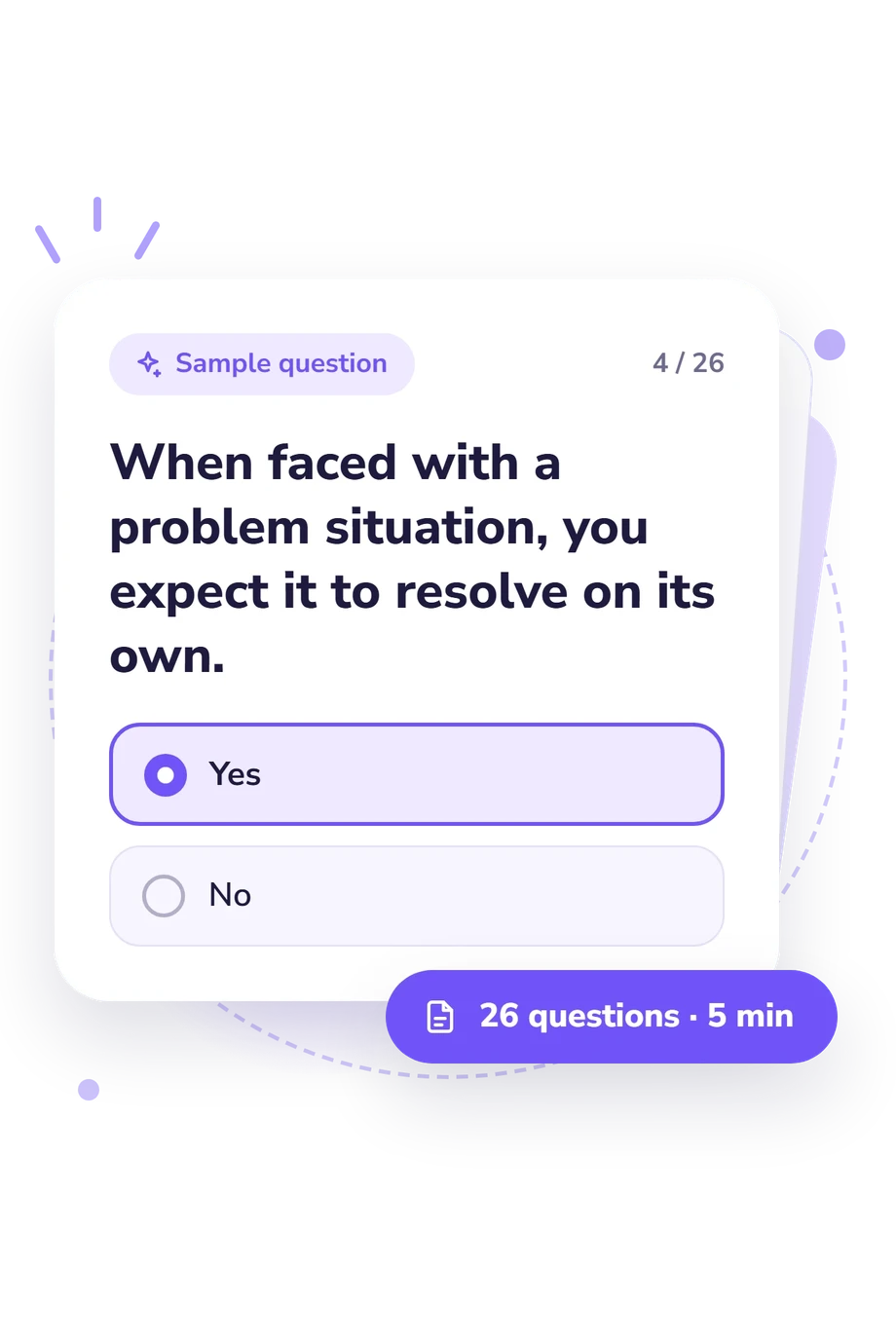
Example Questions From the Test
- Yes
- No
- Yes
- No
- Yes
- No
Problem-Solving in Educational Situations Difficulty Level Assessment Test - Description and methodology of the test
Teachers, educators, and others reflecting on decisions may use the Problem-Solving in Educational Situations Difficulty Level Assessment Test to examine how they respond when classroom or workplace problems demand judgment. The assessment focuses on immediate action, student characteristics, professional growth, and later consequences. As an educational problem-solving assessment, it clarifies whether responses tend toward immediate circumstances, broader educational consequences, or both.
What This Assessment Explores
At the center is a contrast between responding to an educational event's immediate conditions and seeing how it fits a wider system. Items address experience, prioritizing problems, adapting when familiar methods fail, considering student characteristics, examining one's own behavior, planning, and anticipating consequences. Together, these themes make the result relevant to situational problem-solving skills in educational work.
The following result dimensions show how the catalogue organizes that contrast:
- Suprasituational Level (0-13) measures broader-context reasoning; higher scores indicate systems thinking and generalizable solutions, while bands are Situation-bound 0-4, Developing systemic view 5-9, and Suprasituational (systemic) 10-13.
- Situational Level (0-13) measures adaptation to specific conditions; higher scores indicate flexibility in changing situations, with bands Low 0-4, Moderate 5-9, and High 10-13.
- Reflective decision-making appears as a question theme, showing how self-analysis, flexibility, individualized action, and attention to consequences contribute to the two displayed scales.
Methodology and Scientific Basis
Responses use a yes-or-no format. The statements contrast reliance on past experience with trying a new approach, immediate discipline with identifying causes, and action with reflection on later effects. They also address planning, professional development, change, and the link between individual decisions and the educational process. Scores therefore describe tendencies across related themes rather than one global ability.
The closest source is Problemacy in Pedagogical Tasks (Kashapov & Dyachenko, 2006), which distinguishes handling a task within its circumstances from moving toward broader analysis. This questionnaire is conceptually consistent with that work, not a direct adaptation or validation of the published instrument. Kashapov, Serafimovich, and Poshekhonova (2017) connect suprasituational pedagogical thinking with metacognition and forecasting, while Kashapov (2003) provides the wider framework of professional pedagogical thinking. That evidence explains why flexible case responses are read alongside systemic thinking in education.
Interpretation is descriptive: the bands organize the displayed score ranges, but the test is not presented with population norms or clinical thresholds. Self-report results may shift with current workload, social expectations, and self-awareness, so they are best considered alongside examples from practice and broader evidence about professional functioning.
- Kashapov, M. M., and Dyachenko, E. V. (2006). Questionnaire-Determiner of the Dominant Level of Problemacy in Solving Pedagogical Tasks. In M. M. Kashapov, Psychology of Creative Thinking of the Professional (p. 229). Moscow: Per Se. ISBN 5-9292-0161-7.
- Kashapov, M. M., Serafimovich, I. V., and Poshekhonova, Y. V. (2017). Components of metacognition and metacognitive properties of forecasting as determinants of supra-situational pedagogical thinking. Psychology in Russia: State of the Art, 10(1), 80-94. 10.11621/pir.2017.0106
- Kashapov, M. M. (ed.). (2003). Psychology of Professional Pedagogical Thinking. Moscow: Institute of Psychology of the Russian Academy of Sciences. ISBN 5-9270-0046-0
Updated: