
Structural Gender Barriers Assessment in Organizations Test
How the Scales are Structured
Who Usually Takes This Test?
See How You Compare
Below is a preview of how scores are typically distributed across each scale.
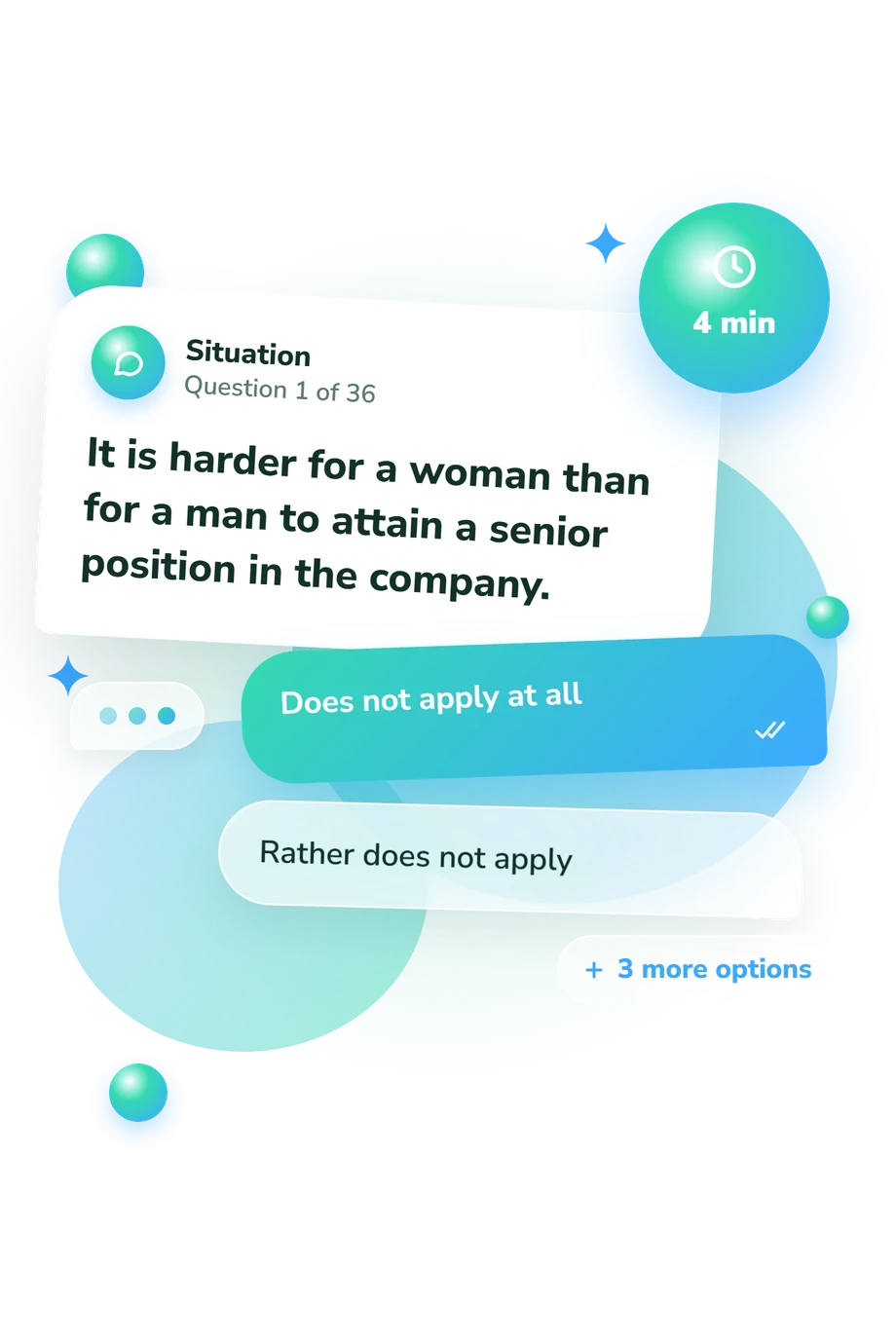
Example Questions From the Test
- Does not apply at all
- Rather does not apply
- Applies in some ways and not in others
- Rather applies
- Fully applies
- Does not apply at all
- Somewhat does not apply
- Partly applies and partly does not apply
- Somewhat applies
- Fully applies
- Does not apply at all
- Rather does not apply
- Applies in some ways and not in others
- Somewhat applies
- Completely applies
Structural Gender Barriers Assessment in Organizations Test - Description and methodology of the test
For employees, managers, HR professionals, and researchers examining workplace structures, the Structural Gender Barriers Assessment in Organizations Test offers a focused way to consider how gender may shape access to authority, opportunity, and informal influence. It is especially useful when you want to examine organizational gender barriers as patterns in the environment rather than as shortcomings of individual women.
What This Assessment Explores
Together, these dimensions map gender inequality in the workplace from access to influence through promotion and leadership risk. The profile includes:
- Glass Box (1-5) measures blocked access to influence, resources, and networks: Low 1-1.1; Moderate 1.2-3.2; High 3.3-5.
- Glass Cliff (1-5) measures crisis-linked leadership risk for women: Low presence 1-1.1; Moderate presence 1.2-3.1; High presence 3.2-5.
- Glass Escalator (1-5) measures men’s promotion advantages in female-dominated work: Low 1-1.2; Moderate 1.3-3.3; High 3.4-5.
- Glass Walls (1-5) measures occupational segregation between domains: Low 1-1.2; Moderate 1.3-3.5; High 3.6-5.
- Sticky Floor (1-5) measures low-paid, low-prestige advancement barriers: Low 1-1.4; Moderate 1.5-3.8; High 3.9-5.
- Glass Ceiling (1-5) measures invisible barriers to management: Low barriers 1-1.1; Moderate barriers 1.2-3.4; High barriers 3.5-5.
- Gender Barriers Level (1-5) measures overall structural obstacles: Low barriers 1-2.9; High barriers 3-5.
Methodology and Scientific Basis
Each statement asks how fully a workplace condition applies, using five ordered responses from “Does not apply at all” to “Fully applies.” Items address promotion, social access, departmental sorting, crisis appointments, and informal influence. Higher values indicate stronger perceived barriers; the ranges do not establish equal item weighting or population norms.
Conceptually, the assessment aligns with the Structural Gender Barriers Method (Gundelakh et al., 2023), which examines structural inequality through glass metaphors. It is not that published instrument or a validated adaptation. Carli and Eagly (2016) describe obstacles as a career-long labyrinth, while Ryan and Haslam (2005) provide evidence that women may be appointed to precarious leadership roles.
That study reported good reliability and evidence for construct and criterion validity, but its six-factor model was not supported; an exploratory one-factor solution explained 54% of variance, prompting a call for larger-sample testing. These findings support the framework, not automatic validation of this online version.
Read the bands as descriptive indications of perceived workplace gender bias. Current context, respondent knowledge, and self-report bias can shape results, which represent perceived organizational patterns rather than every employee’s experience.
- Gundelakh, O. E., Gurieva, S. D., Kazantseva, T. V., & Mararitsa, L. V. (2023). Method for Assessing Structural Gender Barriers in an Organization: Development and Assessment of Psychometric Properties. Vestnik of Saint Petersburg University. Psychology, 13(1), 95-112. 10.21638/spbu16.2023.106
- Carli, L. L., & Eagly, A. H. (2016). Women Face a Labyrinth: An Examination of Metaphors for Women Leaders. Gender in Management: An International Journal, 31(8), 514-527. 10.1108/GM-02-2015-0007
- Ryan, M. K., & Haslam, S. A. (2005). The Glass Cliff: Evidence that Women are Over-Represented in Precarious Leadership Positions. British Journal of Management, 16(2), 81-90. 10.1111/j.1467-8551.2005.00433.x
Updated: