
Professional Activity Motivation Scale Test
How the Scales are Structured
Who Usually Takes This Test?
See How You Compare
Below is a preview of how scores are typically distributed across each scale.
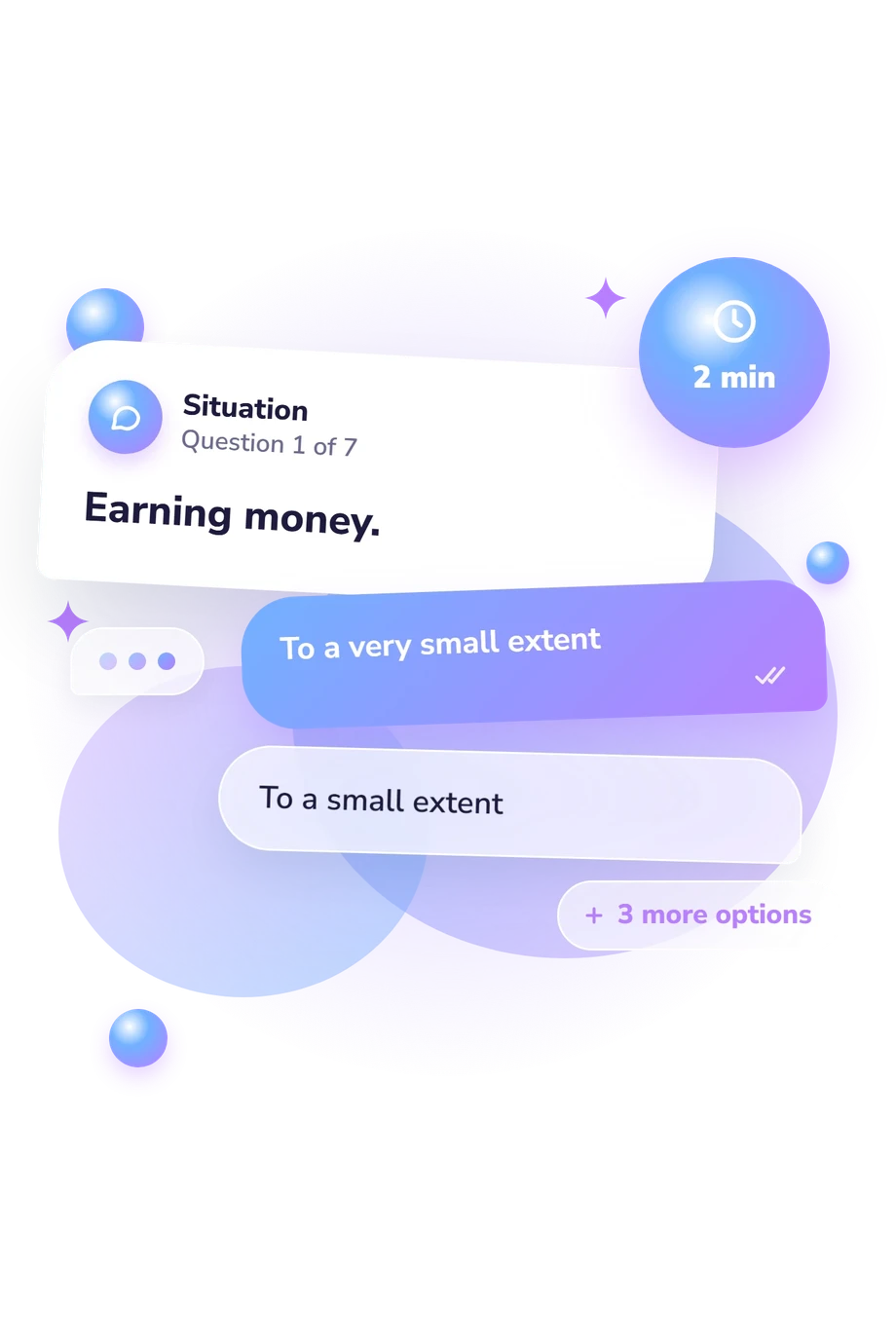
Example Questions From the Test
- To a very small extent
- To a small extent
- To a moderate extent
- To a great extent
- To a very great extent
- To a very small extent
- To a small extent
- To a moderate extent
- To a great extent
- To a very great extent
- To a very small extent
- To a small extent
- To a moderate extent
- To a large extent
- To a very large extent
Professional Activity Motivation Scale Test - Description and methodology of the test
People choosing a role, reassessing job satisfaction, or trying to understand what sustains their effort can use this questionnaire for focused self-reflection. The Professional Activity Motivation Scale Test organizes answers into a profile of motivational directions rather than ability or performance. This profile helps clarify motivation at work by showing the strength of each direction: consequences, rewards, or interest in the activity itself.
What This Assessment Explores
Professional motives may involve avoiding criticism or punishment, seeking money, advancement, recognition, or enjoying the work itself. This work motivation assessment suits reflection on career direction and workplace engagement.
The reported dimensions are:
- External Negative Motivation (ENM), 1-5, measures working to avoid punishment, displeasure, criticism, or adverse consequences; Low 1-2.3, Moderate 2.4-3.6, High 3.7-5.
- External Positive Motivation, 1-5, measures pursuit of recognition, advancement, material rewards, or prestige; Low 1-2.3, Moderate 2.4-3.6, High 3.7-5.
- Intrinsic Motivation, 1-5, measures satisfaction and interest in the activity, including opportunities to realize potential; Low 1-2.3, Moderate 2.4-3.6, High 3.7-5.
Together, the scales describe motive direction rather than ability. A higher result reflects greater strength in its corresponding direction; avoidance-based motivation is considered least effective for development, while positive external motivation is more desirable than negative external motivation.
Methodology and Evidence Base
Each statement asks how strongly a motive applies, using five ordered extent choices, with wording that varies slightly between items. Responses form a three-part profile; read the displayed scales separately, without inferring an additional total, weighting, or cutoff.
The questionnaire is conceptually consistent with Motivation for Professional Activity (Zamfir-Rean), a distinction among avoidance-driven, reward-driven, and activity-driven motives. Zamfir’s work on job satisfaction and Rean, Bordovskaya, and Rozum’s textbook provide theoretical context. Fedorinov and Antonova (2024) provide contextual evidence about relationships among motivation, engagement, and job satisfaction, not validation of this questionnaire.
The questionnaire is a descriptive self-report profile without established population norms or reliability estimates. The displayed result bands describe levels within each scale, not clinical thresholds. Someone exploring intrinsic work motivation can use the result to consider whether satisfaction comes from the activity, external outcomes, or both.
Answers may vary with current workplace conditions, self-awareness, and the wish to present motives favorably. Read the profile alongside personal experience and concrete career circumstances.
- Fedorinov, Vladislav, and Natalia Antonova. (2024). Motivation of Employees of a Financial Organization: Correlation Between Engagement and Job Satisfaction. Organizational Psychology, 14(1), 173-195. 10.17323/2312-5942-2024-14-1-173-195
- Zamfir, Catalin. (1983). Job Satisfaction: A Sociologist's Opinion. Moscow: Politizdat, 142 pp.
- Rean, A. A., Bordovskaya, N. V., and Rozum, S. I. (2007). Psychology and Pedagogy: Textbook for Universities. Saint Petersburg: Piter, 432 pp. ISBN 978-5-272-00266-2
Updated: