
Attitudes Toward Illness and Treatment Questionnaire Test
How the Scales are Structured
Who Usually Takes This Test?
See How You Compare
Below is a preview of how scores are typically distributed across each scale.
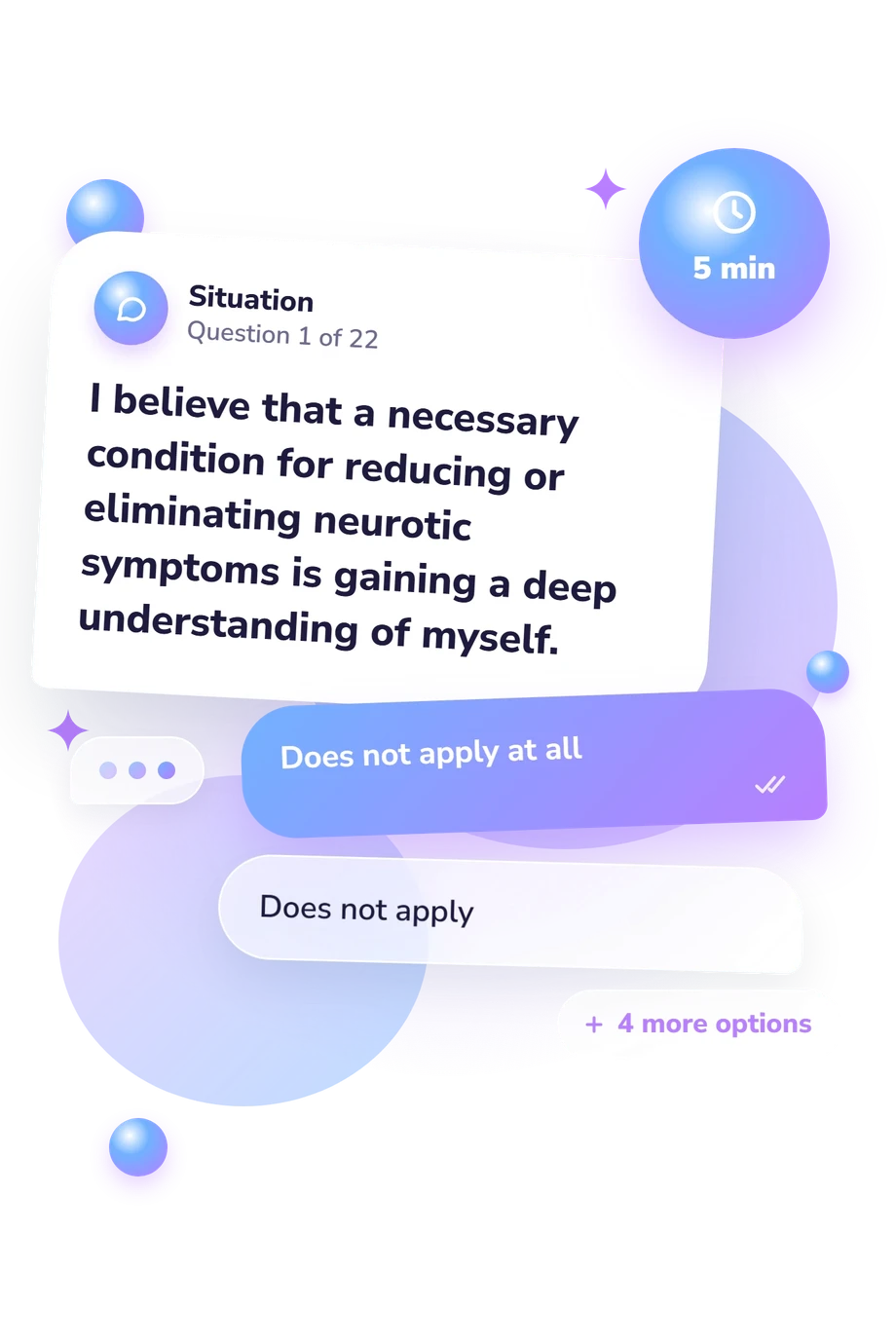
Example Questions From the Test
- Does not apply at all
- Does not apply
- Rather does not apply
- Rather applies
- Applies
- Applies completely
- Does not apply at all
- Does not apply
- Rather does not apply
- Rather applies
- Applies
- Applies completely
- Does not apply at all
- Does not apply
- Rather does not apply
- Rather applies
- Applies
- Applies completely
Attitudes Toward Illness and Treatment Questionnaire Test - Description and methodology of the test
People considering treatment, reflecting on their reasons for seeking help, or trying to understand their engagement with care may find this illness and treatment questionnaire useful. The Attitudes Toward Illness and Treatment Questionnaire Test examines how illness is understood, what a person hopes treatment will change, and how ready they feel to participate. It offers a structured starting point for self-reflection, not a clinical conclusion.
What This Assessment Explores
For people reflecting on treatment, the questionnaire organizes attitudes toward illness, motives, symptom relief, readiness to change, and recognition into five dimensions:
- Other Motivation (0-42) captures indirect motives or passivity toward illness: Low 0-14; Moderate 15-28; High 29-42.
- Secondary Gain (0-36) captures benefits of illness, such as care or relief from duties: Low 0-12; Moderate 13-24; High 25-36.
- Symptom Improvement Orientation (0-18) measures whether symptom relief is the primary treatment goal; higher scores may indicate a more superficial attitude toward therapy: Balanced focus 0-6; Symptom-focused 7-12; Strongly symptom-focused 13-18.
- Behavior Change (0-18) indicates readiness to modify habits and engage actively: Low readiness 0-6; Moderate readiness 7-12; High readiness 13-18.
- Insight Development (0-18) reflects awareness of illness and treatment need: Limited insight 0-6; Developing insight 7-12; Strong insight 13-18.
These bands describe the respondent’s pattern within each dimension.
Methodology and Scientific Basis
Each statement uses a six-point graded response asking whether an idea applies, fits, or is true for the respondent. This captures degree of endorsement rather than a yes-or-no choice.
The items group around reasons for seeking care, hoped-for symptom relief, behavior and relationship changes, and recognition of illness. The questionnaire reports separate scale totals and displayed bands, but no scoring or standardization basis is supplied beyond those descriptive bands.
A relevant published comparison by Sorokin et al. (2017) provides context for motives involving symptom relief, external pressure, interpersonal benefits, and personal change rather than validation of this online questionnaire. The questionnaire is conceptually consistent with Leventhal’s common-sense model but is not a direct adaptation of that model or the Treatment Motivation Questionnaire.
Interpret the profile as a pattern across the definitions within each dimension. Responses may shift with current distress, recent treatment experiences, and self-awareness, so the result is most useful when considered alongside the person’s circumstances.
- Sorokin M. Yu., Lutova N. B., Wied V. D. (2017). The Role of Treatment Motivation Subsystems in the Overall Structure of Compliance in Patients Undergoing Psychopharmacotherapy. Neuroscience and Behavioral Physiology, 47(8), 890-894. 10.1007/s11055-017-0486-z
- Leventhal H., Meyer D., Nerenz D. R. (1980). The common sense representation of illness danger. In S. Rachman (Ed.), Contributions to Medical Psychology, Vol. 2 (pp. 7-30). Pergamon Press.
- Leventhal H., Nerenz D. R., Steele D. J. (1984). Illness representations and coping with health threats. In A. Baum, S. E. Taylor, and J. E. Singer (Eds.), Handbook of Psychology and Health, Vol. 4 (pp. 219-252). Lawrence Erlbaum Associates.
Updated: