
Freudly+971 508685814hello@freudly.ai
Freudly
addiction

Alcohol Consumption Motivation Questionnaire Test
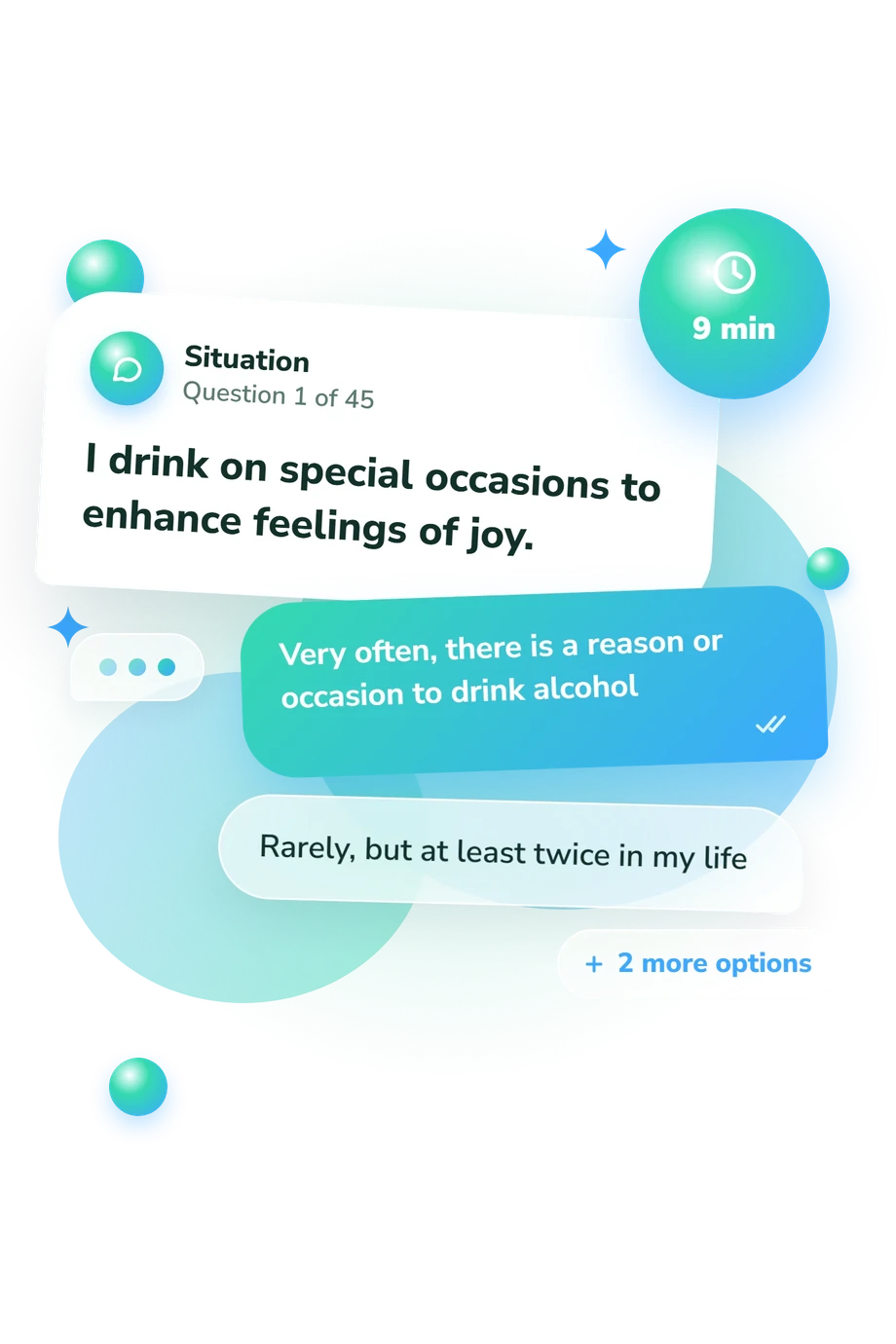
Take the online Alcohol Consumption Motivation Questionnaire Test - AI psychologist FreudlyYou can take Alcohol Consumption Motivation Questionnaire Testhere. Online version of a simple and accurate psychological test with interpretation.en
Understand what drives a man’s drinking in about 9 minutes, from stress relief to social motives to coping. Get clear insights fast to guide targeted support and more focused care.
Start Online Test
Questions: 459 minutes
08:30
October 2, 2025
October 2, 2025
Material has been updated
October 2, 2025
Material has been published
30,814 views
3,745 completions
3,129 likes
Verified by Daniel Hall
Psychologist with 25 years of experience
Share
Scale Explorer

How the Scales are Structured

example score
6/15
Self-Harm (SH)
Assesses the extent to which alcohol use is driven by self-destructive motives such as protest, loss of life meaning, and hostility toward self or others.
Low
Moderate
High
05: Low | 610: Moderate | 1115: High
A score of 6 falls in the Moderate range, suggesting some presence of self-destructive motives associated with alcohol use, though not strongly expressed.
example score
6/15
Addictive Motives (AM)
Measures the strength of addictive motives for alcohol use, reflecting craving and a developing need to drink.
Low
Moderate
High
05: Low | 610: Moderate | 1115: High
A score of 6 falls in the Moderate range, suggesting some presence of craving-related drinking motives without indicating a strongly persistent need.
example score
7/15
Hangover Relief (HR)
Measures the extent to which alcohol use is motivated by relieving hangover or withdrawal-like discomfort and improving immediate well-being.
Low
Moderate
High
05: Low | 610: Moderate | 1115: High
A score of 7 falls in the Moderate range, suggesting alcohol is sometimes used to reduce unpleasant aftereffects or feel better, but this motive is not dominant.
example score
12/15
Hyperactivation (H)
This scale measures the extent to which alcohol is used to boost activation, overcome boredom, and increase perceived effectiveness of actions.
Low
Moderate
High
05: Low | 610: Moderate | 1115: High
A score of 12 falls in the High range, suggesting alcohol is often associated with seeking stimulation, escaping boredom, or feeling more effective.
example score
5/15
Anxiolytic Motives (AM)
Measures the extent to which alcohol use is motivated by reducing negative emotions such as anxiety, tension, or fear.
Low
Moderate
High
05: Low | 610: Moderate | 1115: High
A score of 5 falls in the Low range, suggesting alcohol is not a prominent strategy for managing negative emotions in this profile.
example score
11/15
Hedonistic Motives (HM)
Measures the extent to which alcohol use is motivated by seeking pleasure, enjoyment, and euphoria.
Low
Moderate
High
05: Low | 610: Moderate | 1115: High
A score of 11 falls in the High range, suggesting a pronounced tendency to view alcohol as a way to obtain pleasurable sensations.
example score
9/15
Pseudocultural Motives (PM)
Measures the extent to which alcohol use is motivated by aligning with social norms and fitting into a group’s alcohol-related values.
Low
Moderate
High
05: Low | 610: Moderate | 1115: High
A score of 9 falls in the Moderate range, suggesting alcohol may sometimes be used to support social belonging or match the expectations of a desired group.
example score
7/15
Submissive Motives (SM)
Measures the extent to which alcohol use is driven by yielding to social or group pressure and conforming to others' opinions.
Low
Moderate
High
05: Low | 610: Moderate | 1115: High
A score of 7 falls in the Moderate range, suggesting social pressure and conformity sometimes influence your alcohol consumption decisions.
example score
9/15
Traditional (T)
Measures the extent to which alcohol consumption is driven by culturally common traditions and social norms.
Low
Moderate
High
05: Low | 610: Moderate | 1115: High
A score of 9 falls in the Moderate range, suggesting that traditions and social expectations play a noticeable but not dominant role in the motivation to drink.
example score
48/135
Overall Motivational Tension (OMT)
Measures the overall intensity of motives driving alcohol consumption across different situations.
Low tension
High tension
Very high tension
034: Low tension | 3550: High tension | 51135: Very high tension
A score of 48 falls in the High tension range, indicating a pronounced overall motivational pull toward alcohol compared with lower scores.
Start Online Test
just completed the test
DATA-BASED USER COHORTS

Who Usually Takes This Test?

Men in treatment programs
41%OF USERS
Men in rehab, outpatient care, or counseling take it to clarify what drives their drinking and focus the next steps of treatment.
Clinicians screening motives
35%OF USERS
Psychologists, addiction specialists, and clinic staff use it with male clients to quickly identify whether drinking is driven by stress relief, social reasons, or avoidance.
Concerned partners and family
24%OF USERS
Partners or relatives encourage a man to take it to better understand patterns behind his alcohol use and discuss support more constructively.
BASED ON AGGREGATED, ANONYMIZED DATA FROM TENS OF THOUSANDS OF FREUDLY USERS.
Benchmarking

See How You Compare

Once you complete the test, your results are compared with real-world data from people in your country.
Below is a preview of how scores are typically distributed across each scale.
Self-injury (S)
Self-injury (S)
Average
7.5
Normal range
5.29.8
min.
0
max.
15
This curve shows how scores are typically distributed.
Once you complete the test, your result will appear on the scale so you can see how you compare.
Additive (A)
Additive (A)
Average
6.5
Normal range
4.28.8
min.
0
max.
15
This curve shows how scores are typically distributed.
Once you complete the test, your result will appear on the scale so you can see how you compare.
Hangover (H)
Hangover (H)
Average
5.8
Normal range
3.28.3
min.
0
max.
15
This curve shows how scores are typically distributed.
Once you complete the test, your result will appear on the scale so you can see how you compare.
Hyperactivation (H)
Hyperactivation (H)
Average
4.8
Normal range
2.27.3
min.
0
max.
15
This curve shows how scores are typically distributed.
Once you complete the test, your result will appear on the scale so you can see how you compare.
Ataractic (A)
Ataractic (A)
Average
6.3
Normal range
3.69
min.
0
max.
15
This curve shows how scores are typically distributed.
Once you complete the test, your result will appear on the scale so you can see how you compare.
Hedonistic (H)
Hedonistic (H)
Average
7.5
Normal range
5.19.9
min.
0
max.
15
This curve shows how scores are typically distributed.
Once you complete the test, your result will appear on the scale so you can see how you compare.
Pseudocultural (P)
Pseudocultural (P)
Average
3.8
Normal range
1.95.7
min.
0
max.
15
This curve shows how scores are typically distributed.
Once you complete the test, your result will appear on the scale so you can see how you compare.
Submissive (S)
Submissive (S)
Average
3.9
Normal range
1.36.6
min.
0
max.
15
This curve shows how scores are typically distributed.
Once you complete the test, your result will appear on the scale so you can see how you compare.
Traditional (T)
Traditional (T)
Average
3.8
Normal range
1.36.3
min.
0
max.
15
This curve shows how scores are typically distributed.
Once you complete the test, your result will appear on the scale so you can see how you compare.
General motivational tension (Gmt)
Average
80
Normal range
59.6100.4
min.
0
max.
135
This curve shows how scores are typically distributed.
Once you complete the test, your result will appear on the scale so you can see how you compare.
Featured On
SAMPLE QUESTIONS

Example Questions From the Test

    • Very often, there is a reason or occasion to drink alcohol
    • Rarely, but at least twice in my life
    • Unsure
    • Not at all true of me
    • Very often there is a reason or situation to drink alcohol
    • Rarely, but at least 2 times in my life
    • Unsure
    • Does not apply to me at all
    • Very often there is a reason or situation to drink alcohol
    • Rarely, but at least twice in my life
    • I am unsure
    • Does not apply to me at all
WHAT THE TEST MEASURES
About This Assessment
Motivation for Alcohol Consumption, MAC Test

Alcohol Consumption Motivation Questionnaire Test - Symptoms and Signs

addiction
alcoholism
addiction medicine

This questionnaire is used to assess reasons an individual may drink alcohol, with an emphasis on identifying patterns in motivation that can inform case formulation. The Alcohol Consumption Motivation Questionnaire is a self-report measure intended to clarify the relative prominence of different drinking motives.

It consists of 45 items and typically takes about 9 minutes to complete. Items ask respondents to endorse statements reflecting common motivational themes (e.g., coping/avoidance, social facilitation, enhancement/relaxation), supporting a structured discussion of triggers and maintaining factors. Scoring is generally interpreted at the domain level to guide clinical interviewing and treatment planning; results should be integrated with broader assessment of alcohol use severity, context, and comorbid symptoms.

The Alcohol Consumption Motivation Questionnaire is attributed to G. A. Marlatt. It is best used as an adjunct to a comprehensive evaluation rather than a stand-alone diagnostic tool.

Author: G. A. Marlatt
Literature: Cox, W. M., & Klinger, E. A motivational model of alcohol use. Journal of Abnormal Psychology. 1988.; Marlatt, G. A., & Donovan, D. M. (Eds.). Relapse prevention: Maintenance strategies in the treatment of addictive behaviors. Guilford Press. 2005.; Cooper, M. L. Motivations for alcohol use among adolescents: Development and validation of a four-factor model. Psychological Assessment. 1994.
Popular tests
Comments
Leave a Comment