
SCOFF Questionnaire (SCOFF) Test
How the Scales are Structured
Who Usually Takes This Test?
See How You Compare
Below is a preview of how scores are typically distributed across each scale.
Example Questions From the Test
- Yes
- No
- Yes
- No
- Yes
- No
SCOFF Questionnaire (SCOFF) Test - Description and methodology of the test
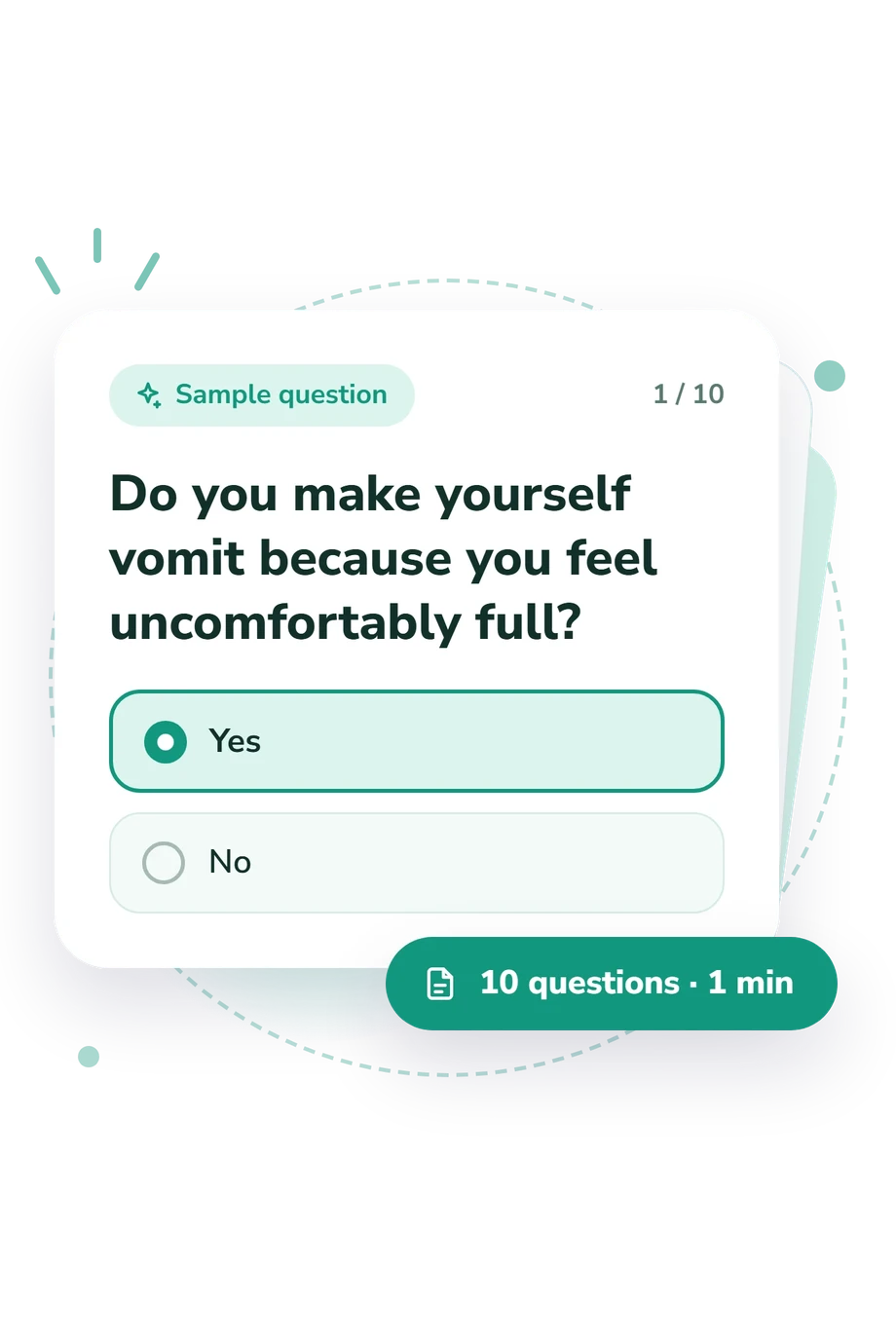
People who want a quick first look at whether eating-related experiences warrant further attention may use the SCOFF Questionnaire (SCOFF) Test. It focuses on warning signs such as loss of control around food, self-induced vomiting after uncomfortable fullness, recent weight loss, body-image concern, and food preoccupation. This brief eating disorder screening questionnaire gives a preliminary profile of responses that can guide thoughtful next steps.
What This Assessment Measures
These questions target experiences linked to eating-disorder risk, not general nutrition or body satisfaction. They cover self-induced vomiting after uncomfortable fullness, loss of control over eating, recent weight loss, feeling fat despite being told one is too thin, and food's place in daily life. The themes are grouped here for clarity, not scored separately:
- The first item theme covers whether self-induced vomiting after uncomfortable fullness is endorsed.
- The eating-control theme captures difficulty regulating intake.
- The weight-and-body-image theme combines recent weight change with feeling fat despite reassurance.
- The food-preoccupation theme reflects how strongly eating dominates attention.
The only scale in this eating disorder risk assessment is the SCOFF Total Score, which spans 0-5 and counts affirmative responses. Its displayed result bands are Low likelihood 0-1 and Positive screen 2-5. A higher total means more endorsed warning signs, not a severity grade.
Methodology and Evidence Base
Each item in this SCOFF screening tool uses Yes or No, and the score simply counts affirmative responses; no weighting or reverse scoring is specified. This makes the method transparent, while leaving accuracy dependent on how honestly and clearly the respondent recognizes personal experiences.
The five-item format follows the original SCOFF instrument, a published instrument for screening eating-disorder risk. Development work, comparisons with clinical interviews, and a multiethnic general-population study provide evidence about how affirmative responses can flag people who may need fuller evaluation. These sources support a brief screening approach, while their findings should be applied carefully to an online presentation.
Interpreting the displayed result means considering whether eating-related concerns persist or affect daily functioning. An affirmative-response threshold can identify people who may benefit from fuller evaluation, while the displayed bands are screening categories rather than a measure of symptom severity.
Self-report can be shaped by shame, memory, current distress, or limited self-awareness. A result at the lower end cannot rule out an eating disorder, while a result indicating greater concern calls for specialist assessment rather than a diagnosis.
- Morgan, J. F., Reid, F., & Lacey, J. H. (1999). The SCOFF questionnaire: assessment of a new screening tool for eating disorders. BMJ, 319(7223), 1467-1468. 10.1136/bmj.319.7223.1467
- Hill, L. S., Reid, F., Morgan, J. F., & Lacey, J. H. (2010). SCOFF, the development of an eating disorder screening questionnaire. International Journal of Eating Disorders, 43(4), 344-351. 10.1002/eat.20679
- Luck, A. J., Morgan, J. F., Reid, F., O’Brien, A., Brunton, J., Price, C., Perry, L., & Lacey, J. H. (2002). The SCOFF questionnaire and clinical interview for eating disorders in general practice: comparative study. BMJ, 325(7367), 755-756. 10.1136/bmj.325.7367.755
- Solmi, F., Hatch, S. L., Hotopf, M., Treasure, J., & Micali, N. (2015). Validation of the SCOFF questionnaire for eating disorders in a multiethnic general population sample. International Journal of Eating Disorders, 48(3), 312-316. 10.1002/eat.22373
Updated: