
Authenticity Inventory (AI-3) Test
How the Scales are Structured
Who Usually Takes This Test?
See How You Compare
Below is a preview of how scores are typically distributed across each scale.
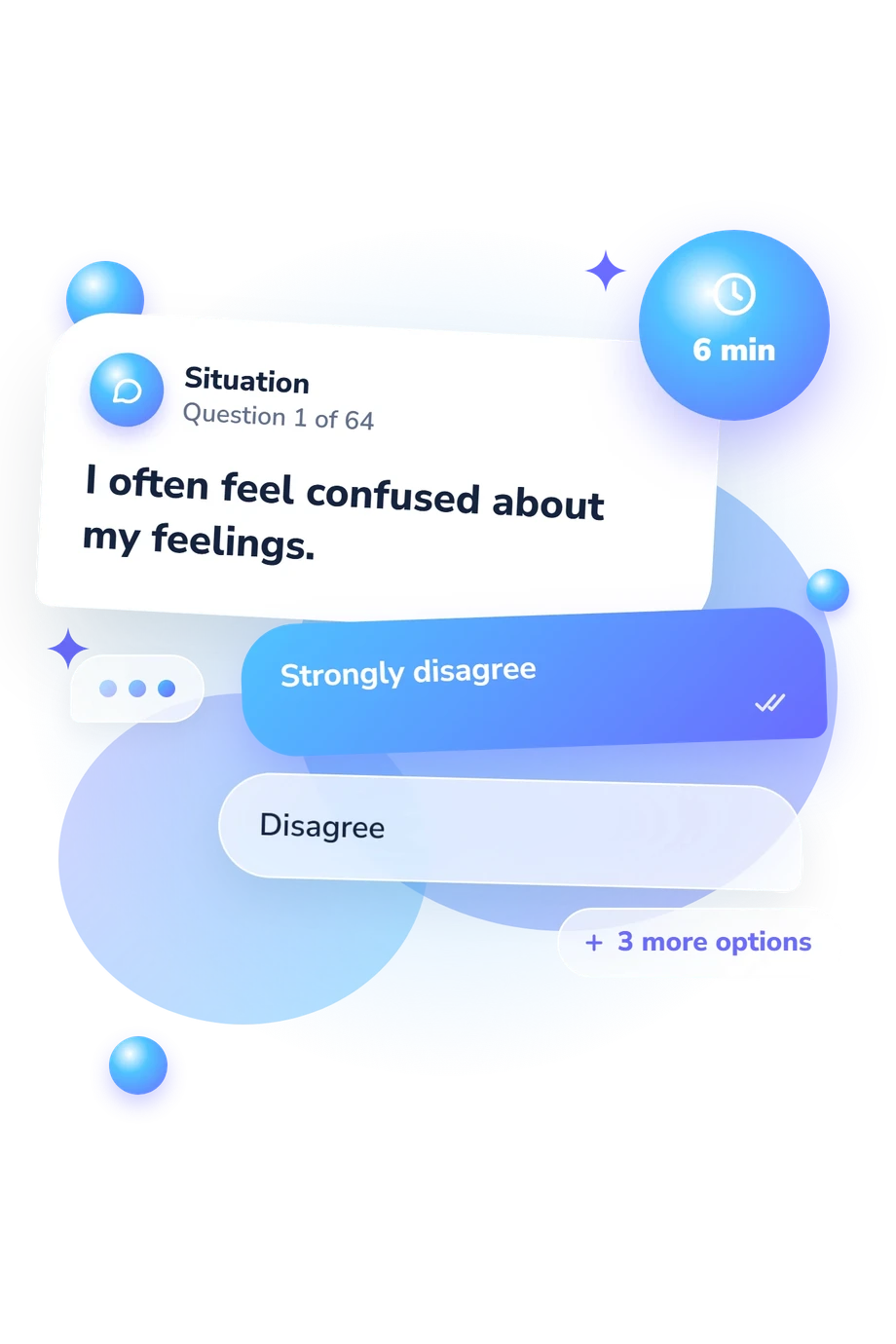
Example Questions From the Test
- Strongly disagree
- Disagree
- Neither agree nor disagree
- Agree
- Strongly agree
- Strongly disagree
- Disagree
- Neither agree nor disagree
- Agree
- Strongly agree
- Strongly disagree
- Disagree
- Neither agree nor disagree
- Agree
- Strongly agree
Authenticity Inventory (AI-3) Test - Description and methodology of the test
People wondering whether their everyday choices feel true to them may find the Authenticity Inventory (AI-3) Test useful when choosing a focus for self-reflection. As an authenticity questionnaire, it offers a structured starting point for noticing patterns that may merit attention, discussion, or further personal inquiry. Its profile can help a respondent decide which experiences to examine more closely.
What This Assessment Explores
The four displayed dimensions separate related but distinct aspects of authentic functioning. The profile from this authenticity assessment organizes them around openness with close others, value-guided action, willingness to face self-relevant facts, and awareness of inner states:
- Relationships (1-5) reflects valuing openness, being seen by close others as one's real self, and consistency across different aspects of the self: Guarded 1-2.4, Balanced 2.5-3.6, or Open & authentic 3.7-5.
- Behavior (1-5) reflects actions guided by personal values and needs: Low alignment 1-2.4, Moderate alignment 2.5-3.6, or High alignment 3.7-5.
- Unbiasedness (1-5) reflects willingness to face self-relevant information, including weaknesses: Defensive 1-2.4, Balanced 2.5-3.6, or Open and accurate 3.7-5.
- Awareness (1-5) reflects clarity about motives, feelings, desires, and difficult self-aspects: Low 1-2.3, Moderate 2.4-3.6, or High 3.7-5.
Methodology and Scientific Basis
This self-report questionnaire uses a five-point agreement scale from strong disagreement to strong agreement, with a midpoint. Items address feelings, motives, values, self-presentation, and reactions to criticism or unpleasant self-information. Some items describe alignment, concealment, or people-pleasing. The result summarizes responses by dimension rather than as one global score.
This online questionnaire's four dimensions are conceptually consistent with Kernis and Goldman's model of authenticity, but it should be distinguished from the published Authenticity Inventory (AI-3; Kernis & Goldman, 2006). The KGAI-SF, studied by Bond, Strauss, and Wickham in 2018, is a separate related short-form instrument; those studies do not validate this online form. Lakey et al. (2008) examined links between authenticity, mindfulness, and verbal defensiveness.
The online result is descriptive: it uses displayed bands rather than population percentiles or clinical cutoffs, indicating patterns in the respondent's answers rather than a population standing. The result from this authenticity test can help a respondent examine patterns that merit reflection, while responses are shaped by current context, self-awareness, and willingness to acknowledge unflattering experiences; scores may shift and are not a diagnosis.
- Kernis, M. H., & Goldman, B. M. (2006). A multicomponent conceptualization of authenticity: Theory and research. In M. P. Zanna (Ed.), Advances in Experimental Social Psychology (Vol. 38, pp. 283-357). Academic Press. 10.1016/S0065-2601(06)38006-9
- Bond, M. J., Strauss, N. E., & Wickham, R. E. (2018). Development and validation of the Kernis-Goldman authenticity inventory-short form (KGAI-SF). Personality and Individual Differences, 134, 1-6. 10.1016/j.paid.2018.05.033
- Lakey, C. E., Kernis, M. H., Heppner, W. L., & Lance, C. E. (2008). Individual differences in authenticity and mindfulness as predictors of verbal defensiveness. Journal of Research in Personality, 42(1), 230-238. 10.1016/j.jrp.2007.05.002
Updated: