
Life Orientation Questionnaire Test
How the Scales are Structured
Who Usually Takes This Test?
See How You Compare
Below is a preview of how scores are typically distributed across each scale.
Example Questions From the Test
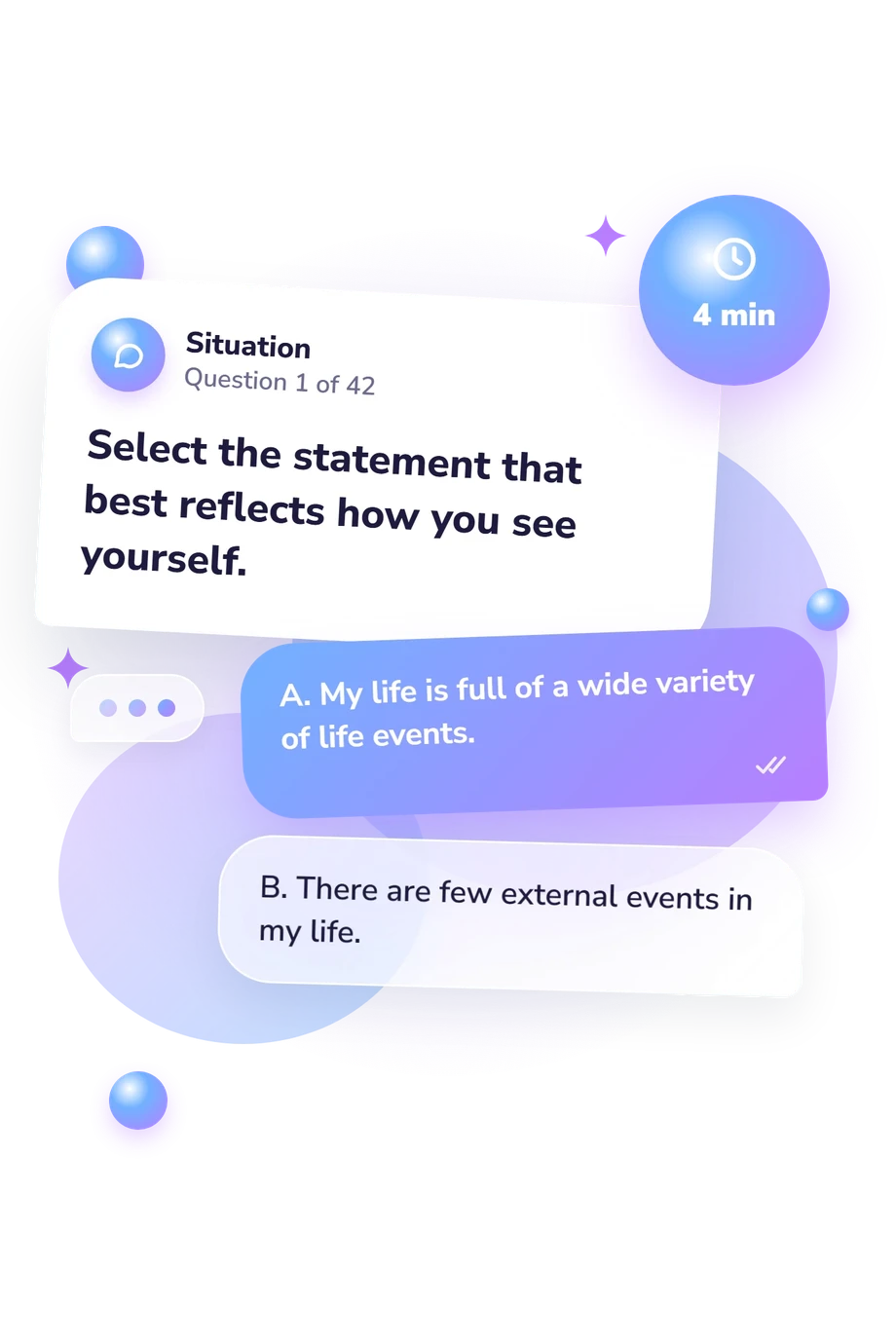
- My life is full of varied life events.
- My life has few external events.
- achieve self-expression.
- understand the meaning of my existence.
- A. The result of purposeful effort.
- B. A random gift of fate.
Life Orientation Questionnaire Test - Description and methodology of the test
People comparing their preferred ways of directing attention, making decisions, and responding to life circumstances may find the Life Orientation Questionnaire Test useful. This life orientation assessment presents a multidimensional profile rather than assigning a single personality type. The result helps readers compare broad patterns of inner direction, outward engagement, flexibility, and perceived responsibility.
What This Assessment Explores
This life orientation questionnaire explores novelty, control, and life events. The scales are:
- Creativity (1-10) measures creative flexibility: Low 1-4; Moderate 5-6; High 7-10.
- Mobility (1-10) measures novelty versus habit: More inertia 1-4; Balanced 5-6; More mobility 7-10.
- Mastery of the World (Oo, OO) (1-10) measures inward or outward orientation: Internal orientation 1-4; Balanced 5-6; External orientation 7-10.
- Locus of Control (OL) (1-10) measures personal or external control: More external control 1-4; Mixed / flexible control 5-6; More internal control 7-10.
- Changeability (OI) (1-10) measures stability versus novelty: Stability-oriented 1-4; Balanced 5-6; Variability-oriented 7-10.
- Overall Subject-Object Orientation Index (O) (1-10) measures internal or external determination: More externally determined 1-4; Balanced / mixed orientation 5-6; More internally determined 7-10.
Methodology and Evidence Base
Each item uses a paired-choice self-report format. Prompts contrast familiar and novel experience, inner development and practical realization, or personal agency and chance; the respondent selects the statement that fits better. Meaning comes from the pattern across dimensions, not a single choice.
The questionnaire reports six displayed dimensions on 1-10 scales, with the result bands indicating directional patterns rather than clinical cutoffs. The result is most useful as a life orientation profile of related tendencies: converging results may suggest a consistent preference, while mixed results may show situational flexibility.
The questions and displayed dimensions are conceptually consistent with the Subject-Object Orientations Questionnaire (Korzhova, 2001) and Korzhova’s 2006 account of life orientations. Related studies by Khairutdinov, Mukhametsanova, and Korzhova (2017) and by Korzhova and colleagues (2023) examine comparable structures across learning and cultural contexts. This correspondence identifies a conceptual framework; it does not establish that the online questionnaire reproduces the published instrument. Self-report results vary with context, self-awareness, and response style, so they describe present tendencies rather than a permanent personal property.
- Korzhova, Elena Yuryevna. Psychology of Human Life Orientations. Saint Petersburg: Russian Christian Humanitarian Academy Press, 2006, 384 pp. ISBN 5-88812-203-3.
- Korzhova, Elena Yuryevna. Subject-Object Orientations in Life Situations. In Psychological Problems of Personal Self-Realization, vol. 5, edited by G. S. Nikiforova and L. A. Korostyleva. Saint Petersburg: Saint Petersburg State University, 2001, pp. 91-101.
- Khairutdinov, Ramil R., Flera G. Mukhametsanova, and Elena Yuryevna Korzhova. Subject-Object Orientations for Students with Different Learning Profiles. European Research Studies Journal, 20(Special Issue), 2017, pp. 369-376.
- Korzhova, Elena Yuryevna, Pengfei Qin, Elena Konstantinovna Veselova, and Marianna Yaroslavna Dvoretskaya. The Structure of Basic Life Orientations: Ethno-Cultural Aspect (Using the Example of the Chinese Version of the Subject-Object Orientations Questionnaire). Vestnik of Saint Petersburg University. Psychology, 13(4), 2023, pp. 493-508. 10.21638/spbu16.2023.404
Updated: