
Sex Test

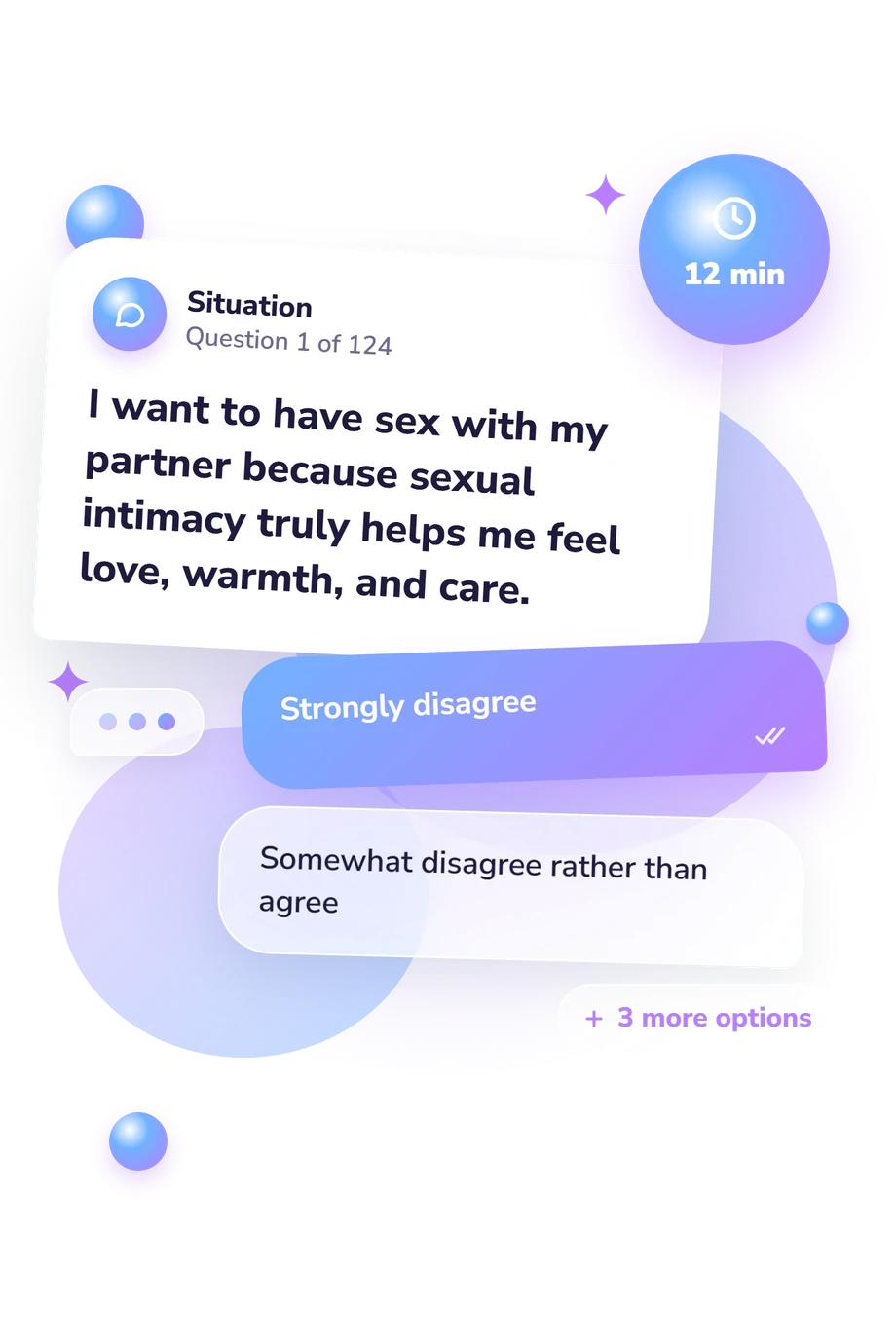
Understand the deeper motives behind erotic arousal and sexual behavior in about 12 minutes. A clear 62 item format supports accurate assessment and more focused therapy planning.
Start Online Test
Questions6212 minutes
Hi! My name is Freudly, i am an AI therapist, I will give you an interpretation of the test after you complete it.
08:30
October 2, 2025
October 2, 2025
Material has been updated
28,098 views
4,985 completions
2,662 likes
Verified by Daniel Hall
Psychologist with 25 years of experience
Share
Scale Explorer

How the Scales are Structured

example score
4/5
Reproduction (R)
Procreation measures the extent to which reproductive goals are a motivating factor in sexual behavior.
Low
Moderate
High
12.3Low2.43.6Moderate3.75High
A score of 4 falls in the High range, suggesting that reproductive intentions are a relatively strong component of your sexual motivation compared with other motives.
example score
3/5
Pleasure (P)
Measures the extent to which pleasurable sensations and gratification motivate sexual involvement.
Lower pleasure-driven
Moderately pleasure-driven
Highly pleasure-driven
12.3Lower pleasure-driven2.43.6Moderately pleasure-driven3.75Highly pleasure-driven
A score of 3 indicates a moderate tendency to seek enjoyable sensations and gratification as a motive in sexual relationships.
example score
3/5
Submission (S)
This scale measures the stable motivation to feel a partner’s power and direction during sexual interactions.
Low
Moderate
High
12.3Low2.43.6Moderate3.75High
A score of 3 indicates a moderate tendency to find partner-led control or dominance erotically motivating in some contexts, without it being a primary driver.
example score
3/5
Power (P)
This scale measures the extent to which sexual arousal is motivated by exerting control over a partner to intensify feelings.
Low
Moderate
High
12.3Low2.43.6Moderate3.75High
A score of 3 falls in the Moderate range, suggesting a balanced tendency for control dynamics to sometimes enhance arousal without being a dominant motive.
example score
3/5
Caring for One's Partner (CfOP)
This scale measures how strongly sexual activity is motivated by caring for and supporting a partner’s psychological well-being.
Lower partner-care focus
Balanced partner-care focus
Stronger partner-care focus
12.3Lower partner-care focus2.43.6Balanced partner-care focus3.75Stronger partner-care focus
A score of 3 indicates a balanced tendency to express care and support for a partner through sexual intimacy, without it being the dominant motive.
example score
4/5
Comfort (C)
Measures the tendency to seek emotional relief and stress reduction through sexual relationships.
Low comfort motive
Moderate comfort motive
High comfort motive
12.3Low comfort motive2.43.6Moderate comfort motive3.75High comfort motive
A score of 4 indicates a high tendency to use sexual intimacy as a way to alleviate stress and regain emotional ease.
example score
3/5
Partner Significance (PS)
Measures how strongly sexual motivation is tied to affirming a partner’s value and seeking their positive evaluation and recognition.
Low partner-affirmation motive
Moderate partner-affirmation motive
High partner-affirmation motive
12.4Low partner-affirmation motive2.53.6Moderate partner-affirmation motive3.75High partner-affirmation motive
A score of 3 indicates a moderate tendency to link sexual activity with affirming the partner’s importance and valuing their recognition.
example score
3/5
Self-Worth (SW)
Self-Importance measures the extent to which a person uses sexual intimacy to affirm their value and seek recognition from their partner.
Lower need for affirmation
Balanced affirmation
High need for recognition
12.3Lower need for affirmation2.43.6Balanced affirmation3.75High need for recognition
A score of 3 falls in the balanced range, suggesting self-affirmation and partner recognition are present but not dominant motives in sexual intimacy.
Start Online Test
just completed the test
DATA-BASED USER COHORTS

Who Usually Takes This Test?

Couples in intimacy slump
41%OF USERS
Partners take it to understand what actually turns them on and why their desires may have drifted apart.
Clients in sex therapy
34%OF USERS
People in counseling use it to clarify stable sexual motives that contribute to recurring patterns, conflicts, or concerns.
Curious self-explorers
25%OF USERS
Individuals take it for self-knowledge, to name their erotic drivers and communicate preferences more clearly.
BASED ON AGGREGATED, ANONYMIZED DATA FROM TENS OF THOUSANDS OF FREUDLY USERS.
Benchmarking

See How You Compare

Once you complete the test, your results are compared with real-world data from people in your country.
Below is a preview of how scores are typically distributed across each scale.
Procreation (P)
Average
2.4
Normal range
1.73
min.
1
max.
5
Majority
This curve shows how scores are typically distributed.
Once you complete the test, your result will appear on the scale so you can see how you compare.
Pleasure (P)
Average
3.5
Normal range
2.74.2
min.
1
max.
5
Majority
This curve shows how scores are typically distributed.
Once you complete the test, your result will appear on the scale so you can see how you compare.
Submission (S)
Average
2.2
Normal range
1.62.9
min.
1
max.
5
Majority
This curve shows how scores are typically distributed.
Once you complete the test, your result will appear on the scale so you can see how you compare.
Power (P)
Average
3.9
Normal range
3.34.5
min.
1
max.
5
Majority
This curve shows how scores are typically distributed.
Once you complete the test, your result will appear on the scale so you can see how you compare.
Taking Care of Your Partner (TCoYP)
Average
3.4
Normal range
2.84
min.
1
max.
5
Majority
This curve shows how scores are typically distributed.
Once you complete the test, your result will appear on the scale so you can see how you compare.
Comfort (C)
Average
3.9
Normal range
3.24.5
min.
1
max.
5
Majority
This curve shows how scores are typically distributed.
Once you complete the test, your result will appear on the scale so you can see how you compare.
The Importance of a Partner (TIoaP)
Average
4
Normal range
3.44.5
min.
1
max.
5
Majority
This curve shows how scores are typically distributed.
Once you complete the test, your result will appear on the scale so you can see how you compare.
Self-Importance (S)
Average
2.8
Normal range
2.33.4
min.
1
max.
5
Majority
This curve shows how scores are typically distributed.
Once you complete the test, your result will appear on the scale so you can see how you compare.
Featured On
CLEAR ANSWERS TO COMMON QUESTIONS

Frequently Asked Questions

What does this Sex Test measure?
It measures eight stable sexual motivation dimensions: reproduction, pleasure, submission, power, caring for one's partner, comfort, partner significance, and self-worth. Each dimension is scored 1–5. The profile describes which motivations most strongly drive your sexual interest and behavior — and where the most meaningful differences from a partner's profile may lie.
How is this different from a general sex quiz?
Most sex quizzes categorize people by sexual behavior or preference type. This sexual personality test measures the motivational layer beneath behavior — why you are drawn to sexual activity and what you seek from it. This distinction matters both for self-understanding and for therapy: motivational mismatches between partners are among the most common and least recognized sources of sexual dissatisfaction in relationships.
How long does it take and how many items are included?
Completion time is about 12 minutes. The questionnaire contains 62 items, each answered by selecting the option that best matches your typical thoughts, feelings, or reactions in sexual contexts. Select based on usual tendencies — not rare events or how you would ideally like to be — and avoid overthinking individual items.
Can couples take this sex preference test together?
Yes — and comparing profiles is often the most valuable use of this assessment. Motivational mismatches — one partner primarily seeking comfort and intimacy, another driven by pleasure or power — frequently underlie recurring sexual conflicts that neither partner has been able to name clearly. Reviewing profiles together with a sex therapist or couples counselor provides a structured, non-blaming framework for that conversation.
Is this Sex Test a diagnostic tool?
No. This is a self-report motivational assessment — it does not diagnose sexual disorders or clinical conditions. Results describe stable motivational tendencies and support case formulation when used alongside clinical interview and relevant history. If you are experiencing distress related to sexual behavior or intimacy, a qualified sex therapist or clinical psychologist can provide a comprehensive evaluation.
Is this test appropriate for all adults?
This sex type test is designed for adults and addresses sexual motivation themes in a clinical and psychological context. Items describe motivational patterns and feelings rather than explicit sexual behaviors. It is intended for personal insight, relationship communication, and clinical use. The questionnaire is not appropriate for minors.
How should I use my Sex Test results?
Review your eight-scale profile to identify which motivations are most prominent in your sexual life and which are minimal. Consider how your profile compares with a partner's — significant differences in dominant motives often explain persistent disconnection or dissatisfaction. If results surface patterns you want to explore further, sharing them with a sex therapist or counselor provides a concrete, evidence-based starting point for that work.
WHAT THE TEST MEASURES
About This Assessment
AMORE Questionnaire Test

This self-report measure is designed to assess stable individual differences in motivational factors related to sexual interest and behavior. Based on the dispositional sexual motivation framework developed by Hill and Preston, the Sex Test uses the AMORE Questionnaire to characterize the internal drivers behind erotic arousal and sexual engagement — distinguishing between eight distinct motivational themes rather than describing sexual behavior in purely behavioral terms. It consists of 62 items and typically takes about 12 minutes to complete.

Why Take a Sex Test

Sexual behavior is shaped by motivations that vary considerably between individuals — and within the same individual across relationships and life stages. Two people may engage in the same sexual behaviors for entirely different reasons: one seeking intimacy and emotional comfort, another driven by pleasure, a third by power dynamics or reproduction. Without understanding the motivational layer beneath behavior, recurring patterns in sexual relationships — conflicts, mismatches, dissatisfaction, or compulsive dynamics — are difficult to address effectively.

A structured test for sex personality provides exactly this motivational map. Rather than categorizing people by what they do sexually, it identifies why they are driven toward sexual activity and what they seek from it. This distinction is clinically significant: sex therapists and couples counselors use motivational profiles to understand the psychological function sexual intimacy serves for each partner — and where motivational mismatches are creating friction or disconnection.

For individuals, this sex quiz offers a non-judgmental, evidence-based framework for understanding patterns that may have felt confusing or hard to articulate — and for communicating sexual needs and preferences more clearly in relationships.

What the Assessment Measures

The AMORE Questionnaire yields scores across eight sexual motivation dimensions, each rated on a 1–5 scale:

  • Reproduction — the extent to which procreative goals motivate sexual engagement and influence arousal
  • Pleasure — the degree to which sensory gratification and pleasurable experience are primary drivers of sexual interest
  • Submission — stable motivation to experience a partner's power and direction as erotically enhancing
  • Power — motivation driven by exerting control or direction over a partner during sexual interaction
  • Caring for one's partner — sexual engagement motivated primarily by attending to a partner's psychological wellbeing and emotional needs
  • Comfort — using sexual intimacy as a means of emotional relief, stress reduction, or self-soothing
  • Partner significance — motivation tied to affirming a partner's value and importance through sexual connection
  • Self-worth — using sexual intimacy to affirm one's own attractiveness and value through a partner's positive response

Higher scores on a scale indicate that motive is a relatively prominent driver of sexual behavior. The eight-scale profile reveals which motivations are dominant, which are secondary, and where the most significant motivational differences between partners may lie.

Who This Assessment Is For

This Sex Test is appropriate for any adult who wants a structured, evidence-based picture of what drives their sexual motivation — whether for personal self-understanding, relationship communication, or preparation for sex therapy or couples counseling. It is widely used by sex therapists and clinical psychologists as a case formulation tool, and by couples seeking to understand motivational mismatches that may be contributing to intimacy difficulties.

Clinical Validity and Use in Practice

The AMORE Questionnaire is grounded in Hill and Preston's peer-reviewed framework of dispositional sexual motives and is designed for use in clinical, counseling, and research contexts. Results are descriptive — they characterize motivational tendencies rather than diagnosing clinical conditions. They should be interpreted alongside clinical interview data, relationship history, and other relevant context. Where results reveal significant motivational conflict or distress, discussion with a qualified sex therapist or clinical psychologist is recommended.

Author: robert-j-sternberg, Zick Rubin
Literature: Baumeister, R. F., & Vohs, K. D. Sexual economics: Sex as female resource for social exchange in heterosexual interactions. Personality and Social Psychology Review. 2004.; Hill, C. A., & Preston, L. K. Individual differences in the experience of sexual motivation: Theory and measurement of dispositional sexual motives. The Journal of Sex Research. 1996.
Test Question Form
You Might Also Like
Clinical Outcomes in Routine Evaluation – Outcome Measure (CORE-OM)
In routine clinical practice, the Clinical Outcomes in Routine Evaluation -…
Start Test
Questionnaire
This brief self-report measure is designed to characterize an individual’s…
Start Test
Popular tests
Narcissistic Personality Inventory (NPI)
This self-report measure is used to assess narcissism as a personality trai…
Start Test
Yale-Brown Obsessive Compulsive Scale (Y-BOCS)
This measure is used to rapidly quantify the current severity of obsessive…
Start Test
CRAFFT Screening Test (CRAFFT 2.1)
This brief screening measure is designed to identify potential alcohol and…
Start Test
Patient Health Questionnaire-9 (PHQ-9)
This measure is commonly used to quickly screen for the presence and severi…
Start Test
Maslach Burnout Inventory (MBI)
This self-report measure is used to assess occupational burnout symptoms in…
Start Test
Adolescent Anxiety Questionnaire
This measure is designed to support a brief appraisal of anxiety symptoms a…
Start Test
Emotional Creativity Inventory (ECI)
This self-report measure assesses individual differences in the originality…
Start Test
Horne–Ostberg Morningness–Eveningness Questionnaire (MEQ)
Circadian preferences influence typical patterns of alertness and sleep tim…
Start Test
Ambivalent Sexism Inventory (ASI)
This measure is designed to assess attitudes toward women, including both o…
Start Test
Internalized Misogyny Scale (IMS)
This measure is designed to assess internalized negative beliefs and stereo…
Start Test
Perceived Stress Scale (PSS-10)
This self-report measure assesses the degree to which individuals appraise…
Start Test
Impulsive Behavior Scale (SUPPS-P)
Impulsivity is a multidimensional construct that is often assessed with bri…
Start Test
Clinical Institute Withdrawal Assessment for Alcohol, Revised (CIWA-Ar)
This rating scale is used to rapidly assess the severity of alcohol withdra…
Start Test
Positive and Negative Affect Schedule (PANAS)
This measure provides a brief self-report assessment of current or typical…
Start Test
Light Triad Scale (LTS)
This self-report measure assesses prosocial personality tendencies and orie…
Start Test
Suicidal Ideation Scale
In clinical settings, the Suicidal Ideation Scale is used to structure an i…
Start Test
Body Dysmorphic Disorder Scale (BDD-D)
This brief self-report measure is designed to screen for and quantify distr…
Start Test
Beck Anxiety Inventory (BAI)
This measure is a brief self-report inventory used to screen for anxiety sy…
Start Test
Differential Test of Perfectionism
This instrument is used to screen for perfectionism-related attitudes and t…
Start Test
Locus of Control Scale
This measure assesses generalized expectancies regarding the degree to whic…
Start Test
New Apathy Scale
This brief self-report measure is used to screen for apathy-related symptom…
Start Test
Perth Alexithymia Questionnaire (PAQ)
This measure assesses individual differences in alexithymia, including diff…
Start Test
Social Intelligence Scale
This brief self-report measure is designed to support rapid screening of in…
Start Test
Fear Test
This measure is designed to evaluate individual differences in fear-related…
Start Test
Neuroticism Level Scale
The measure is intended for brief screening of an individual’s propensity t…
Start Test
Aggressiveness Indicators Screening Questionnaire
This screening tool is designed to quickly identify behavioral indicators a…
Start Test
Comments
Leave a Comment