
Freudly+971 508685814hello@freudly.ai
Freudly
dishonesty

Types of Lies Questionnaire Test
Take the online Types of Lies Questionnaire Test - AI psychologist FreudlyYou can take Types of Lies Questionnaire Testhere. Online version of a simple and accurate psychological test with interpretation.en
Understand how you react to different kinds of lies from people around you in about 9 minutes. Get a quick profile of what you tolerate, what bothers you, and the motives you tend to assume.
Start Online Test
Questions: 489 minutes
08:30
October 2, 2025
October 2, 2025
Material has been updated
October 2, 2025
Material has been published
17,062 views
1,340 completions
1,091 likes
Verified by Daniel Hall
Psychologist with 25 years of experience
Share
Scale Explorer

How the Scales are Structured

example score
6/12
Fantasy Lie (FL)
Measures how acceptable you find harmless “fantasy” lies used to create a more interesting self-image in everyday communication.
Low tolerance
Moderate tolerance
High tolerance
03: Low tolerance | 48: Moderate tolerance | 912: High tolerance
A score of 6 indicates moderate tolerance for fantasy lies, suggesting you may view occasional harmless embellishment as acceptable but still notice and evaluate it.
example score
3/12
Justifying Lie (JL)
Measures how acceptable and understandable you find excuse-based lies used to justify or soften the consequences of questionable actions.
Low acceptance
Moderate acceptance
High acceptance
04: Low acceptance | 58: Moderate acceptance | 912: High acceptance
A score of 3 indicates low acceptance of excuse lies, suggesting you tend to view self-justifying explanations as relatively unacceptable or unconvincing.
example score
2/12
Motives for Lying (MfL)
Measures how many different motives a person attributes to themselves for distorting information through lying.
Few motives
Several motives
Many motives
03: Few motives | 48: Several motives | 912: Many motives
A score of 2 falls in the 'Few motives' range, suggesting the person reports using lies for a limited number of reasons.
example score
5/12
Self-Presentation Lie (SPL)
Measures how acceptable or tolerable you find others embellishing their image through deceptive self-presentation, especially with less familiar people.
Low acceptance
Moderate acceptance
High acceptance
04: Low acceptance | 58: Moderate acceptance | 912: High acceptance
A score of 5 suggests a moderate acceptance of others using image-enhancing exaggerations, indicating you may see it as sometimes understandable but not always appropriate.
example score
7/12
Gossip (G)
Measures how acceptable or tolerable you find gossip, meaning the sharing of unverified or potentially false information about other people in everyday conversations.
Low tolerance
Moderate tolerance
High tolerance
04: Low tolerance | 58: Moderate tolerance | 912: High tolerance
A score of 7 falls in the Moderate tolerance range, suggesting you may view gossip as sometimes acceptable or understandable, though not necessarily desirable.
example score
4/12
Omission (O)
Measures how negatively you perceive omissions (withholding part of the truth) when others communicate with you.
More tolerant
Mixed/conditional
Less tolerant
04: More tolerant | 58: Mixed/conditional | 912: Less tolerant
A score of 4 suggests you are relatively tolerant of omissions, tending to see withholding information as less problematic in many situations.
example score
8/12
Benevolent Lie (BL)
Measures how acceptable you find “white lies” that withhold important information to protect someone from harm.
Low acceptance
Moderate acceptance
High acceptance
04: Low acceptance | 58: Moderate acceptance | 912: High acceptance
A score of 8 indicates moderately high acceptance of lies told for someone’s benefit, suggesting you may see them as sometimes justified depending on the situation.
example score
10/12
Politeness Lie (PL)
Measures how accepting a person is of etiquette-based “polite lies” used to maintain social harmony.
Low acceptance
Moderate acceptance
High acceptance
04: Low acceptance | 58: Moderate acceptance | 912: High acceptance
A score of 10 indicates high acceptance of polite lies, suggesting they are generally seen as a normal and mostly harmless part of everyday politeness.
Start Online Test
just completed the test
DATA-BASED USER COHORTS

Who Usually Takes This Test?

Trust-Hurt Relationship Seekers
41%OF USERS
People dealing with suspicion, jealousy, or past betrayals who want to clarify which kinds of lies feel tolerable versus relationship-breaking.
Psychology Clients and Students
34%OF USERS
Those in therapy or studying psychology who want a structured profile of their attitudes toward different forms of everyday dishonesty.
Workplace Communication Navigators
25%OF USERS
Professionals in team settings who want to understand their reactions to office omissions, polite lies, gossip, and self-presentation tactics.
BASED ON AGGREGATED, ANONYMIZED DATA FROM TENS OF THOUSANDS OF FREUDLY USERS.
Benchmarking

See How You Compare

Once you complete the test, your results are compared with real-world data from people in your country.
Below is a preview of how scores are typically distributed across each scale.
Lie-Fantasy (L)
Lie-Fantasy (L)
Average
4
Normal range
26.1
min.
0
max.
12
This curve shows how scores are typically distributed.
Once you complete the test, your result will appear on the scale so you can see how you compare.
Lie-justification (L)
Average
6.9
Normal range
5.18.7
min.
0
max.
12
This curve shows how scores are typically distributed.
Once you complete the test, your result will appear on the scale so you can see how you compare.
Motives for Lying (MfL)
Average
4.1
Normal range
1.86.3
min.
0
max.
12
This curve shows how scores are typically distributed.
Once you complete the test, your result will appear on the scale so you can see how you compare.
Deceptive Self-Presentation (DS)
Average
4.8
Normal range
3.16.4
min.
0
max.
12
This curve shows how scores are typically distributed.
Once you complete the test, your result will appear on the scale so you can see how you compare.
Gossip (G)
Gossip (G)
Average
8.1
Normal range
6.69.5
min.
0
max.
12
This curve shows how scores are typically distributed.
Once you complete the test, your result will appear on the scale so you can see how you compare.
Default (D)
Default (D)
Average
6.1
Normal range
48.2
min.
0
max.
12
This curve shows how scores are typically distributed.
Once you complete the test, your result will appear on the scale so you can see how you compare.
Lies for a Greater Good (LfaGG)
Average
4.3
Normal range
2.75.8
min.
0
max.
12
This curve shows how scores are typically distributed.
Once you complete the test, your result will appear on the scale so you can see how you compare.
Polite Lies (PL)
Polite Lies (PL)
Average
4.7
Normal range
2.66.8
min.
0
max.
12
This curve shows how scores are typically distributed.
Once you complete the test, your result will appear on the scale so you can see how you compare.
Featured On
SAMPLE QUESTIONS

Example Questions From the Test

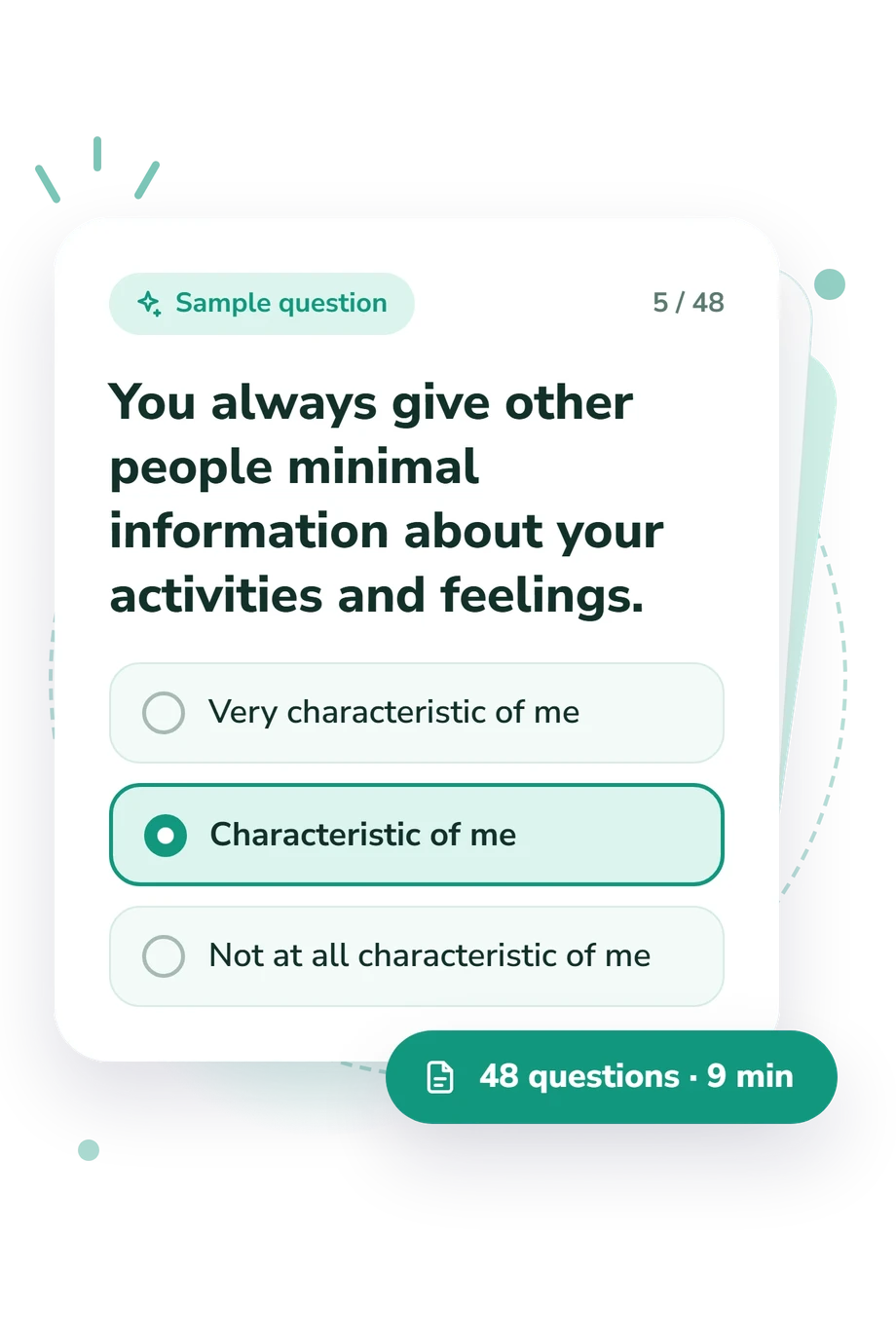
In everyday life, people often distort information about themselves. There is no one who tells only the truth. You are asked to rate the extent to which your behavior corresponds to the following statements.
    • Very characteristic of me
    • Characteristic of me
    • Not at all characteristic of me
    • Very characteristic of me
    • Characteristic of me
    • Not at all characteristic of me
    • Very typical of me
    • Typical of me
    • Not at all typical of me
WHAT THE TEST MEASURES
About This Assessment
Types of Lies Questionnaire Test

Types of Lies Questionnaire Test - Symptoms and Signs

dishonesty

This questionnaire assesses attitudes toward different forms of deception as they occur in everyday social interactions. The Types of Lies Questionnaire asks respondents to rate their reactions to several commonly described kinds of lying that may be encountered from close others, friends, or coworkers.

The measure includes 48 items and typically requires about 9 minutes to complete. It yields a profile of the respondent’s relative acceptance or intolerance of different lie types and may also include an adjunct scale that indexes the motives the respondent tends to attribute to other people’s deception. The Types of Lies Questionnaire is attributed to Paul Ekman and may be used in clinical or counseling contexts to support case formulation when deception, trust, or communication patterns are salient concerns.

Author: Paul Ekman
Literature: DePaulo, B. M., Kashy, D. A., Kirkendol, S. E., Wyer, M. M., & Epstein, J. A. Lying in everyday life. Journal of Personality and Social Psychology. 1996.
Popular tests
Comments
Leave a Comment