
Experiential Avoidance Questionnaire Test
How the Scales are Structured
Who Usually Takes This Test?
See How You Compare
Below is a preview of how scores are typically distributed across each scale.
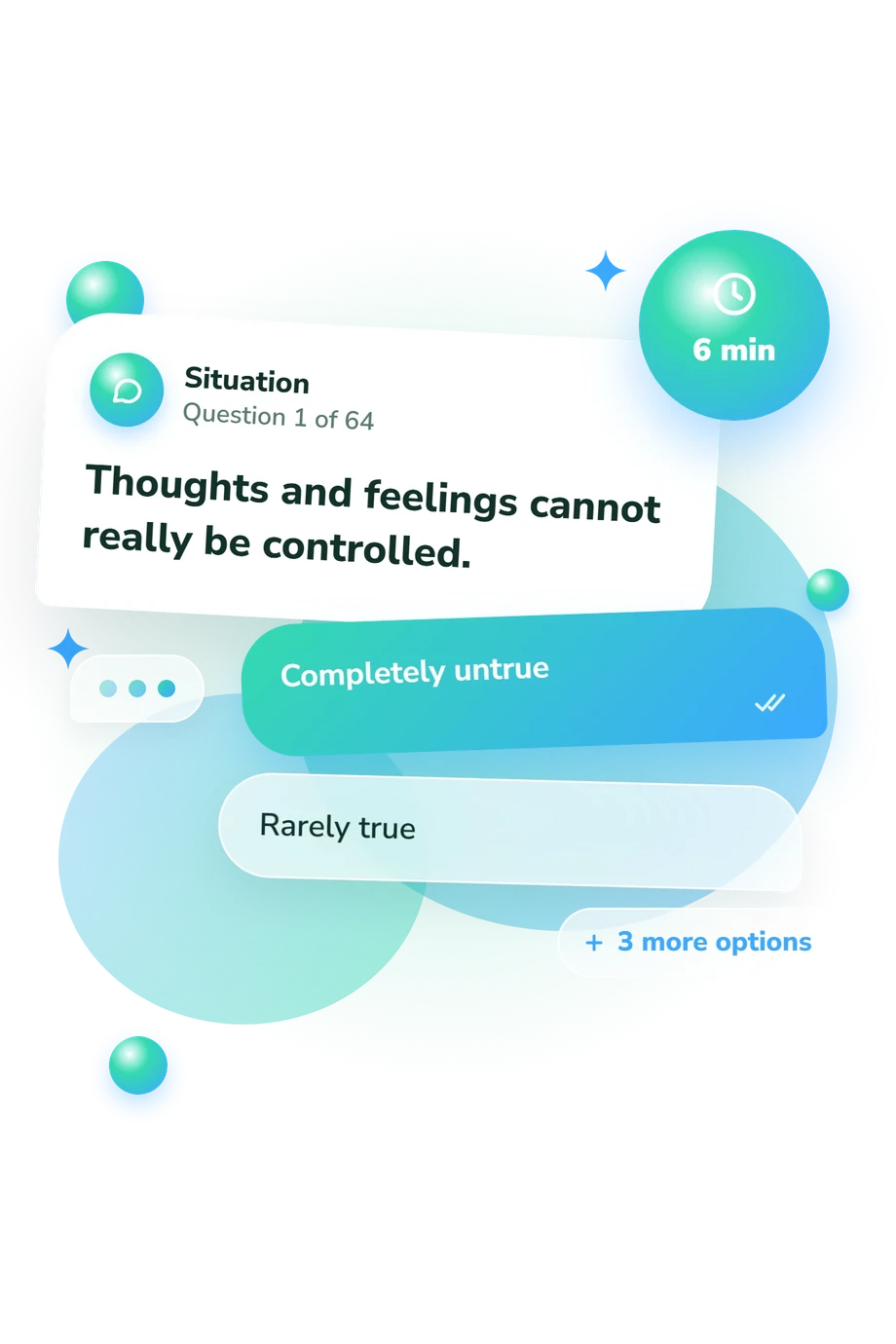
Example Questions From the Test
- Completely untrue
- Rarely true
- Sometimes true
- Often true
- Always true
- Completely untrue
- Rarely true
- Sometimes true
- Often true
- Always true
- Completely untrue
- Rarely true
- Sometimes true
- Often true
- Always true
Experiential Avoidance Questionnaire Test - Description and methodology of the test
People who want to understand why uncomfortable inner experiences influence their choices may find this self-report assessment useful. The Experiential Avoidance Questionnaire Test focuses on willingness, emotional control, and action under uncertainty in everyday life. As an experiential avoidance test, it can help readers notice recurring coping patterns and decide which situations, thoughts, or feelings merit closer reflection.
What This Assessment Explores
The items examine responses to anxiety, sadness, doubt, and unwanted experiences. They ask whether thoughts are treated as facts, whether certainty is required before action, whether distress must be removed, and whether uncomfortable situations or responsibilities are avoided. The focus is a pattern of responding to inner events, rather than a single emotional state. For someone using an experiential avoidance questionnaire, the result supports reflection on recurring coping habits.
The questionnaire presents one overall result:
- Experiential Avoidance (32-160) reflects avoidance of unpleasant thoughts, feelings, and memories; Low avoidance 32-74, Moderate avoidance 75-117, and High avoidance 118-160.
- Acceptance of inner experience describes allowing discomfort without making control a condition for action.
- Cognitive distance captures noticing thoughts and judgments as reactions, not complete facts.
- Values-guided action indicates continuing a direction despite uncertainty or unwanted feelings.
Methodology and Scientific Basis
Each item uses a five-point response scale, from complete untruth to complete truth, although the wording of the anchors varies slightly. Answers describe typical reactions, and the displayed result represents a broad pattern rather than separate symptom ratings.
The questionnaire is conceptually consistent with the Acceptance and Action Questionnaire (Hayes et al., 2004), which treats experiential avoidance dimensionally. The 1996 functional model by Hayes, Wilson, Gifford, Follette, and Strosahl links attempts to control private experiences with restricted behavior, while Bond et al. (2011) offers a later comparison through the revised AAQ-II. These sources support the construct and its connection with psychological flexibility; this online version remains a separate questionnaire.
The result from this psychological flexibility questionnaire can also be considered in relation to psychological flexibility, because it reflects how readily a person acts while experiencing discomfort. A high result may accompany stronger efforts to control or escape discomfort, while a lower result may suggest greater willingness to experience it. Answers can shift with current stress, mood, self-awareness, and response style, so the displayed bands are descriptive categories rather than population norms or clinical thresholds.
- Hayes, Steven C., Kirk Strosahl, Kelly G. Wilson, Richard T. Bissett, Jacqueline Pistorello, Dosheen Toarmino, Melissa A. Polusny, Thane A. Dykstra, Sonja V. Batten, John Bergan, Sherry H. Stewart, Michael J. Zvolensky, Georg H. Eifert, Frank W. Bond, John P. Forsyth, Maria Karekla, and Susan M. McCurry. (2004). Measuring experiential avoidance: A preliminary test of a working model. The Psychological Record, 54(4), 553-578. 10.1007/BF03395492
- Bond, Frank W., Steven C. Hayes, Ruth A. Baer, Kenneth M. Carpenter, Nigel Guenole, Holly K. Orcutt, Tom Waltz, and Robert D. Zettle. (2011). Preliminary Psychometric Properties of the Acceptance and Action Questionnaire-II: A Revised Measure of Psychological Inflexibility and Experiential Avoidance. Behavior Therapy, 42(4), 676-688. 10.1016/j.beth.2011.03.007
- Hayes, Steven C., Kelly G. Wilson, Elizabeth V. Gifford, Victoria M. Follette, and Kirk Strosahl. (1996). Experiential avoidance and behavioral disorders: A functional dimensional approach to diagnosis and treatment. Journal of Consulting and Clinical Psychology, 64(6), 1152-1168. 10.1037/0022-006X.64.6.1152
Updated: