
Automatic Thoughts Questionnaire (ATQ) Test
How the Scales are Structured
Who Usually Takes This Test?
See How You Compare
Below is a preview of how scores are typically distributed across each scale.
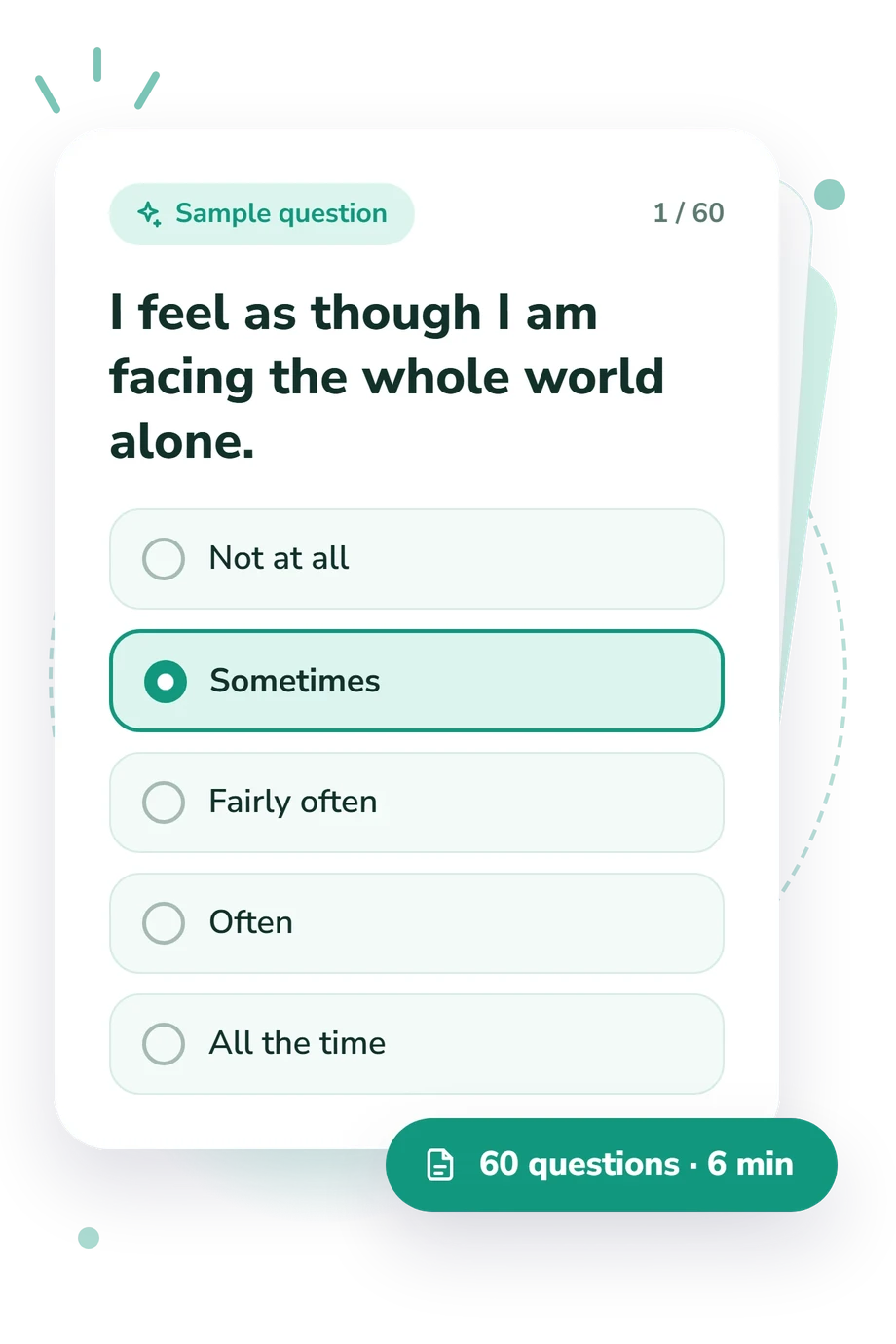
Example Questions From the Test
- Not at all
- Sometimes
- Fairly often
- Often
- All the time
- Not at all
- Sometimes
- Fairly often
- Often
- All the time
- Not at all
- Sometimes
- Relatively often
- Often
- All the time
Automatic Thoughts Questionnaire (ATQ) Test - Description and methodology of the test
People who notice recurring self-criticism, pessimistic predictions, or difficulty coping may find this questionnaire useful for organizing those experiences. The Automatic Thoughts Questionnaire (ATQ) Test gives a structured view of negative self-statements and the themes surrounding them. This automatic thoughts assessment organizes those themes into a focused snapshot for personal reflection and for deciding which patterns deserve closer attention.
What This Assessment Explores
The statements address coping, self-worth, failure, connection, motivation, and future expectations. The questionnaire assesses negative automatic thought patterns by organizing these themes into the result dimensions:
- Helplessness (1-5) reflects perceived inability to cope; Low 1-2.4, Moderate 2.5-3.6, High 3.7-5.
- Low Self-Esteem (LSE) (1-5) reflects self-doubt and reduced self-worth; Low 1-2.3, Moderate 2.4-3.6, High 3.7-5.
- NSNE (1-5) reflects negative self-perception and expectations; Low 1-2.4, Moderate 2.5-3.4, High 3.5-5.
- PMDC (1-5) reflects social maladjustment and a wish for change; Low 1-2.3, Moderate 2.4-3.6, High 3.7-5.
- Total Score (30-150) reflects overall endorsement of negative automatic thoughts; Low 30-69, Moderate 70-109, High 110-150.
The total summarizes overall endorsement.
Methodology and Evidence Base
Each item is a self-report statement rated with five ordered frequency choices spanning Not at all to All the time. The ATQ questionnaire asks how often a thought is experienced, not whether it is true or false.
The questionnaire reports four displayed scale scores and a total score; it does not document how individual items are allocated or how many points each response contributes. The displayed values are therefore the basis for reading the result, rather than a formula reconstructed from score ranges.
The online questionnaire is conceptually consistent with Automatic Thoughts Questionnaire (Hollon & Kendall, 1980) and Beck’s cognitive model of depression. Hollon, Kendall, and Lumry’s 1986 study examined depressotypic cognitions in clinical depression. These sources support the framework for interpreting negative self-statements.
The cited studies do not provide norms for this online version; its displayed bands are descriptive, not population norms. Because the items ask about thought frequency, scores can be affected by current mood, circumstances, self-awareness, and response style.
- Hollon, Steven D., and Philip C. Kendall. (1980). Cognitive self-statements in depression: Development of an automatic thoughts questionnaire. Cognitive Therapy and Research, 4(4), 383-395. 10.1007/BF01178214 (cir.nii.ac.jp)
- Hollon, Steven D., Philip C. Kendall, and Ann E. Lumry. (1986). Specificity of depressotypic cognitions in clinical depression. Journal of Abnormal Psychology, 95(1), 52-59. 10.1037/0021-843X.95.1.52
- Beck, Aaron T., A. John Rush, Brian F. Shaw, and Gary Emery. (1979). Cognitive therapy of depression. New York: Guilford Press.
Updated: