
Normative Attitudes in Parenting Test
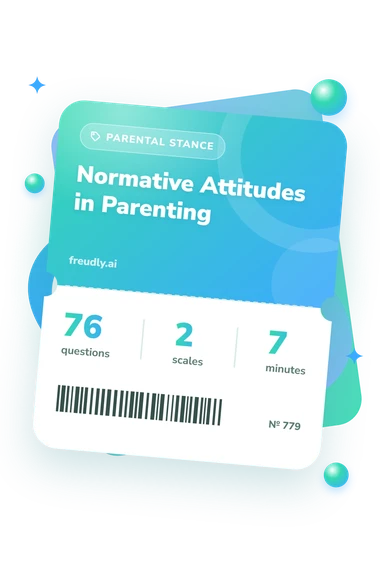
How the Scales are Structured
Who Usually Takes This Test?
See How You Compare
Below is a preview of how scores are typically distributed across each scale.
Example Questions From the Test
- Strongly agree
- Agree more than disagree
- Neither agree nor disagree
- Disagree more than agree
- Strongly disagree
- Completely agree
- Rather agree than disagree
- Partly agree, partly disagree
- Rather disagree than agree
- Completely disagree
- Strongly agree
- Agree more than disagree
- Neither agree nor disagree
- Disagree more than agree
- Strongly disagree
Normative Attitudes in Parenting Test - Description and methodology of the test
People who want to examine their assumptions about mothers’ and fathers’ responsibilities may find the Normative Attitudes in Parenting Test useful for structured self-reflection. The assessment is intended for people considering how they understand caregiving, authority, work, affection, and family decision-making. Results from this parenting attitudes test show how strongly respondents endorse shared parental roles or more differentiated expectations, making personal beliefs easier to examine.
What This Assessment Explores
The questionnaire examines beliefs about sharing care, authority, emotional support, financial responsibility, paid work, parental leave, and family decisions. It also asks whether gender should determine a parent’s role and how much personal freedom parents should adapt to children’s needs.
The result reports the strength of egalitarian parenting attitudes and traditional expectations separately; the pattern may show stronger alignment with one, mixed responses, or differing levels across both. Results describe stated norms and endorsement, not necessarily family behavior.
The result includes two complementary dimensions:
- Egalitarian (0-72) measures preference for equality and partnership in child-rearing and family responsibilities. Its result bands are More traditional-leaning (0-24), Mixed / flexible (25-48), and Strongly egalitarian (49-72).
- Traditional (0-72) measures commitment to established parental roles, conventional child-rearing expectations, and differentiated responsibilities. Its result bands are Egalitarian-leaning (0-24), Mixed/Moderate (25-48), and Traditional-leaning (49-72).
Methodology and Evidence Base
The representative questions include five-point agreement scales, moving from strong agreement through a neutral midpoint to strong disagreement. Other examples offer practical choices about parental leave, career decisions, or balancing personal interests with childcare, using three response options. This combines general beliefs with applied judgments.
Results are reported on the two displayed scales and interpreted through their supplied bands; the output therefore describes the orientations separately rather than combining them into one overall score.
The content is conceptually consistent with Bornstein and colleagues’ 2011 study, which connects parenting beliefs with family roles and cultural context. It also relates to Schaefer and Edgerton’s work on parental modernity, while Baumrind’s 1967 study offers a broader reference point for parental behavior. The questionnaire presents these themes as a thematic self-report.
As a self-report profile of normative parenting attitudes across two separately reported orientations, this version describes the strength of each orientation rather than assigning one overall type. Responses can be influenced by social desirability, current family circumstances, and interpretation of broad statements, so results are best treated as a structured snapshot of personal attitudes.
- Bornstein, M. H., Putnick, D. L., & Lansford, J. E. (2011). Parenting Attributions and Attitudes in Cross-Cultural Perspective. Parenting: Science and Practice, 11(2-3), 214-237. 10.1080/15295192.2011.585568
- Schaefer, E. S., & Edgerton, M. (1985). Parent and Child Correlates of Parental Modernity. In I. E. Sigel (Ed.), Parental Belief Systems: Psychological Consequences for Children (pp. 287-318). Lawrence Erlbaum Associates.
- Baumrind, D. (1967). Child Care Practices Anteceding Three Patterns of Preschool Behavior. Genetic Psychology Monographs, 75(1), 43-88. 10.1037/h0024919