
Freudly+971 508685814hello@freudly.ai
Freudly
foster family

German Family Dynamics Test
Take the online German Family Dynamics Test - AI psychologist FreudlyYou can take German Family Dynamics Test here. Online version of a simple and accurate psychological test with interpretation.en
See how your family manages everyday conflict and how healthy its structure is in about 8 minutes. Get clear, actionable insight into communication, support, and problem areas to guide next steps.
Start Online Test
Questions: 408 minutes
08:30
October 2, 2025
October 2, 2025
Material has been updated
October 2, 2025
Material has been published
15,063 views
1,138 completions
924 likes
Verified by Daniel Hall
Psychologist with 25 years of experience
Share
Scale Explorer

How the Scales are Structured

example score
10/12
Communication (C)
Measures how clear and direct information exchange is among family members during everyday interaction.
Clear & direct
Mixed clarity
Indirect / limited exchange
04: Clear & direct | 58: Mixed clarity | 912: Indirect / limited exchange
A score of 10 falls in the Indirect / limited exchange range, suggesting that messages may be conveyed less directly and important information may not be consistently shared or understood.
example score
11/18
Resistance (R)
Measures reluctance to disclose information or resistance to participating openly in the test.
Low resistance
Moderate resistance
High resistance
06: Low resistance | 712: Moderate resistance | 1318: High resistance
A score of 11 indicates moderate resistance, suggesting some guardedness or caution in responding that may slightly limit how fully the answers reflect the respondent’s experiences.
example score
12/18
Social Desirability (SD)
Measures the tendency to respond in a socially desirable way rather than fully candidly.
Low
Moderate
High
06: Low | 712: Moderate | 1318: High
A score of 12 falls in the Moderate range, suggesting some inclination to present oneself favorably that may slightly influence how openly responses reflect everyday family dynamics.
example score
5/12
Values and Norms (VaN)
Measures how consistent and shared the family’s values and norms are across members.
Coherent norms
Mixed coherence
Incoherent norms
04: Coherent norms | 58: Mixed coherence | 912: Incoherent norms
A score of 5 falls in the Mixed coherence range, suggesting some shared values alongside areas where expectations and rules may be unclear or inconsistently applied.
example score
2/12
Control (C)
Assesses how family control is expressed (rules, boundaries, supervision) and whether it tends to be flexible and constructive or rigid/chaotic and disruptive.
Flexible control
Mixed control
Rigid or chaotic control
04: Flexible control | 58: Mixed control | 912: Rigid or chaotic control
A score of 2 falls in the Flexible control range, suggesting generally constructive, adaptable boundaries with low signs of rigid or chaotic control patterns.
example score
4/12
Affective Perception (AP)
Measures the degree of empathy and mutual support perceived within the family, with higher scores indicating weaker empathy and support and lower autonomy.
Supportive & empathic
Mixed support
Low empathy & autonomy strain
04: Supportive & empathic | 58: Mixed support | 912: Low empathy & autonomy strain
A score of 4 falls in the Supportive & empathic range, suggesting generally present empathy and mutual support in the family.
example score
7/12
Emotionality (E)
Assesses how intense and appropriate emotional expression is within the family during everyday interactions and conflicts.
Appropriate emotional expression
Elevated emotional reactivity
Excessive or inappropriate emotionality
04: Appropriate emotional expression | 58: Elevated emotional reactivity | 912: Excessive or inappropriate emotionality
A score of 7 falls in the Elevated emotional reactivity range, suggesting emotions may be expressed more intensely than is typically helpful, though not at the most extreme level.
example score
7/12
Role Behavior (RB)
Assesses how clearly family roles are agreed upon and how flexibly members adapt to changing role expectations.
Clear & flexible roles
Some role tension
Role disagreement
04: Clear & flexible roles | 58: Some role tension | 912: Role disagreement
A score of 7 falls in the 'Some role tension' range, suggesting occasional disagreements or adjustment difficulties when roles shift, while some shared understanding may still be present.
example score
5/12
Task Accomplishment (TA)
Assesses how flexibly the family adapts to current demands, sets tasks, and copes with stress-related changes in everyday functioning.
Flexible & resilient
Some strain
Adaptation difficulties
04: Flexible & resilient | 58: Some strain | 912: Adaptation difficulties
A score of 5 falls in the 'Some strain' range, suggesting occasional difficulties aligning on tasks and adjusting to new demands, especially under stress.
Start Online Test
just completed the test
DATA-BASED USER COHORTS

Who Usually Takes This Test?

Parents in ongoing conflict
41%OF USERS
Mothers and fathers who feel stuck in recurring arguments take it to understand communication, roles, and stress points in the household.
Adoptive and foster families
34%OF USERS
Caregivers and children in adoptive or foster settings use it to spot areas where extra support is needed and track family adjustment over time.
Therapy and social work clients
25%OF USERS
Families referred by psychologists, counselors, or social services take it to get a quick snapshot of relationship health and guide next steps.
BASED ON AGGREGATED, ANONYMIZED DATA FROM TENS OF THOUSANDS OF FREUDLY USERS.
Benchmarking

See How You Compare

Once you complete the test, your results are compared with real-world data from people in your country.
Below is a preview of how scores are typically distributed across each scale.
Communication (C)
Communication (C)
Average
7.8
Normal range
5.79.9
min.
0
max.
12
This curve shows how scores are typically distributed.
Once you complete the test, your result will appear on the scale so you can see how you compare.
Resistance (R)
Resistance (R)
Average
5.4
Normal range
2.68.3
min.
0
max.
18
This curve shows how scores are typically distributed.
Once you complete the test, your result will appear on the scale so you can see how you compare.
Social desirability (Sd)
Average
12.6
Normal range
9.316
min.
0
max.
18
This curve shows how scores are typically distributed.
Once you complete the test, your result will appear on the scale so you can see how you compare.
Values and Norms (VaN)
Average
4.5
Normal range
35.9
min.
0
max.
12
This curve shows how scores are typically distributed.
Once you complete the test, your result will appear on the scale so you can see how you compare.
Control scale (Cs)
Control scale (Cs)
Average
5.1
Normal range
3.27
min.
0
max.
12
This curve shows how scores are typically distributed.
Once you complete the test, your result will appear on the scale so you can see how you compare.
Affective perception (Ap)
Average
3.3
Normal range
1.55
min.
0
max.
12
This curve shows how scores are typically distributed.
Once you complete the test, your result will appear on the scale so you can see how you compare.
Emotionality (E)
Emotionality (E)
Average
6.1
Normal range
4.37.9
min.
0
max.
12
This curve shows how scores are typically distributed.
Once you complete the test, your result will appear on the scale so you can see how you compare.
Role Behavior (RB)
Role Behavior (RB)
Average
7.8
Normal range
5.510
min.
0
max.
12
This curve shows how scores are typically distributed.
Once you complete the test, your result will appear on the scale so you can see how you compare.
Task execution (Te)
Task execution (Te)
Average
8.1
Normal range
6.39.8
min.
0
max.
12
This curve shows how scores are typically distributed.
Once you complete the test, your result will appear on the scale so you can see how you compare.
Featured On
SAMPLE QUESTIONS

Example Questions From the Test

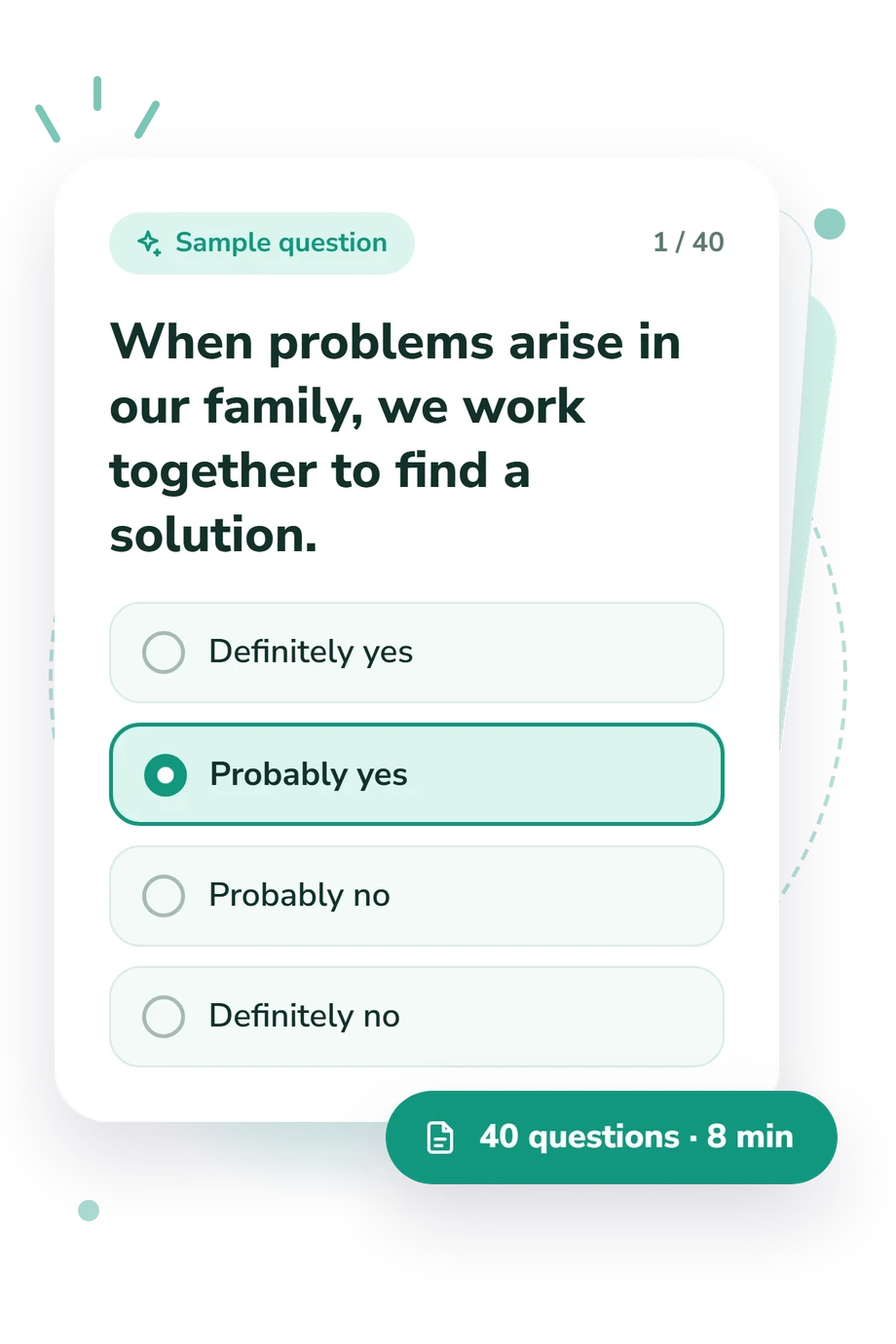
Indicate your agreement or disagreement with each of the statements below. Select one of four response options: • “Definitely yes” (if you are confident that this occurs in most cases) • “Probably yes” (if you believe this is typical of the family and does occur) • “Probably no” (if you believe this is not typical of the family and, in practice, rarely occurs) • “Definitely no” (if you are confident that this does not occur in most cases)
    • Definitely yes
    • Probably yes
    • Probably no
    • Definitely no
    • Definitely yes
    • Probably yes
    • Probably no
    • Definitely no
    • Definitely yes
    • Probably yes
    • Probably no
    • Definitely no
WHAT THE TEST MEASURES
About This Assessment
German Family Dynamics Test

German Family Dynamics Test - Symptoms and Signs

foster family
family

This questionnaire is intended to provide a brief snapshot of family functioning and day-to-day interaction patterns. The German Family Dynamics Test is used to characterize perceived communication, support, and areas of recurring conflict within the family system.

The measure includes 40 items and typically takes about 8 minutes to complete. Responses may be gathered from multiple family members and can be used to inform case formulation, guide treatment planning, or monitor change over time. The German Family Dynamics Test is sometimes applied in clinical and social service contexts where a structured description of family processes is needed; interpretation should consider the available evidence for its use in the specific setting and population.

Author: Salvador Minuchin
Literature: Beck, A. T. Depression: Causes and treatment. University of Pennsylvania Press. 1967.
Popular tests
Comments
Leave a Comment