
Self-Consciousness Scale (SCS-R) Test
How the Scales are Structured
Who Usually Takes This Test?
See How You Compare
Below is a preview of how scores are typically distributed across each scale.
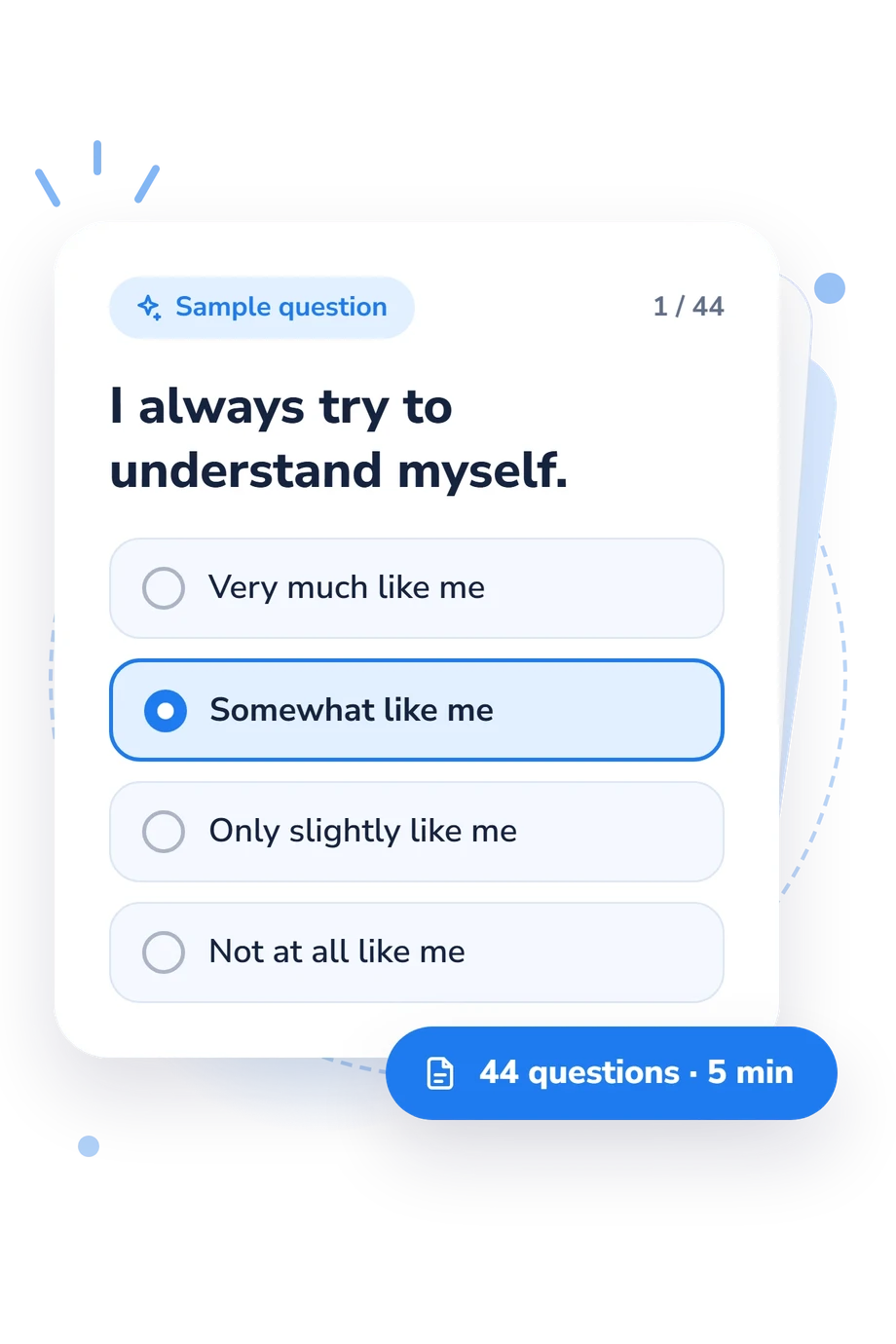
Example Questions From the Test
- Very much like me
- Somewhat like me
- Only slightly like me
- Not at all like me
- Very much like me
- Somewhat like me
- Only a little like me
- Not at all like me
- Very much like me
- Somewhat like me
- Only a little like me
- Not at all like me
Self-Consciousness Scale (SCS-R) Test - Description and methodology of the test
For people who want to understand why they monitor themselves, reflect on inner experience, or feel uneasy under observation, the Self-Consciousness Scale (SCS-R) Test offers a structured snapshot of these tendencies. This self-consciousness questionnaire helps compare attention directed inward with concern about appearance, performance, and other people’s judgments. The profile can support focused self-reflection without reducing a person to a single label.
What This Assessment Explores
Items sample three forms of self-attention. They ask about noticing thoughts, motives, moods, and bodily sensations; monitoring appearance, manner, performance, and impressions; and feeling shy, embarrassed, or nervous when others are present or watching.
The result separates these themes into the following displayed dimensions:
- Social Anxiety (0-18) captures concern about evaluation, doubts about making a desired impression, and self-criticism; Low 0-3, Moderate 4-13, High 14-18.
- Public Self-Consciousness (0-21) captures attention to observable behavior, mannerisms, and impressions made on other people; Low 0-8, Moderate 9-18, High 19-21.
- Private Self-Consciousness (0-27) reflects focus on inner beliefs, values, feelings, motives, and experiences, supporting self-reflection and self-knowledge; Low 0-10, Moderate 11-20, High 21-27.
Used as a self-consciousness assessment, the profile shows whether self-attention is more inward, socially focused, or accompanied by unease. It describes tendencies in the situations represented by the items, not a fixed personality verdict.
Methodology and Scientific Basis
Each statement uses four choices, from “Very much like me” to “Not at all like me,” with intermediate options such as “Somewhat like me.” Respondents rate typical tendencies, not correct answers or observed performance. Answers are combined into displayed totals; because point contributions are not specified, they should not be inferred from the ranges.
The methodology is conceptually consistent with the Revised Self-Consciousness Scale (Scheier & Carver, 1985), which revised the public/private self-consciousness approach of Fenigstein, Scheier, and Buss (1975). That framework distinguishes attention to observable aspects of self from attention to inner experience and includes social unease. Martin and Debus (1999) examined an alternative factor structure, so interpretation should follow the version and scoring model used here. This revised self-consciousness test uses that distinction without claiming to reproduce the published scoring procedure.
The published SCS-R studies support its construct and factor structure, but they do not validate this online scoring or its displayed bands. Mood, self-awareness, and willingness to disclose uncomfortable reactions may affect self-report. Here, the displayed bands are descriptive categories for response patterns, not population norms or clinical cutoffs, and the result is not a diagnosis.
- Scheier, M. F., & Carver, C. S. (1985). The Self-Consciousness Scale: A Revised Version for Use with General Populations. Journal of Applied Social Psychology, 15(8), 687-699. 10.1111/j.1559-1816.1985.tb02268.x
- Fenigstein, A., Scheier, M. F., & Buss, A. H. (1975). Public and private self-consciousness: Assessment and theory. Journal of Consulting and Clinical Psychology, 43(4), 522-527. 10.1037/h0076760
- Martin, A. J., & Debus, R. L. (1999). Alternative Factor Structure for the Revised Self-Consciousness Scale. Journal of Personality Assessment, 72(2), 266-281. 10.1207/S15327752JP720211
Updated: