
Narcissism Mask Questionnaire Test
How the Scales are Structured
Who Usually Takes This Test?
See How You Compare
Below is a preview of how scores are typically distributed across each scale.
Example Questions From the Test
- 1: Not at all true of me
- 2
- 3
- 4
- 5: Definitely true of me
- 1: Not at all true of me
- 2
- 3
- 4
- 5: Definitely true of me
- 1: Not at all true of me
- 2
- 3
- 4
- 5: Definitely true of me
Narcissism Mask Questionnaire Test - Description and methodology of the test
People who question the link between self-worth, approval, and relationships may use the Narcissism Mask Questionnaire Test to organize personal reflection. The result describes a pattern of narcissistic traits and related behaviors, including visible self-importance as well as more vulnerable reactions to rejection, shame, or unmet needs. As a narcissism test, it helps readers notice which responses may shape relationships and self-image.
What This Assessment Explores
The items look beyond grandiose presentation alone. They ask about dependence on others’ perceptions, need for recognition, fear of rejection, suppressed vulnerability, guilt around anger, and difficulty admitting mistakes. Other statements address admiration, entitlement, control, devaluing others, and resistance to outside direction. Together, these themes cover overt and covert self-perception and attitudes toward other people.
Used as a narcissism questionnaire, it can help a person connect familiar situations with the broader pattern represented by the result.
The displayed scale is Narcissism Mask Questionnaire, scored from 0-100. Its result bands are:
- Low expression (0-33) indicates that narcissistic features are less prominent in the reported pattern.
- Moderate expression (34-66) indicates a mixed or context-dependent presence of these features.
- High expression (67-100) indicates that narcissism-related traits and behaviors are more strongly represented.
Methodology and Scientific Basis
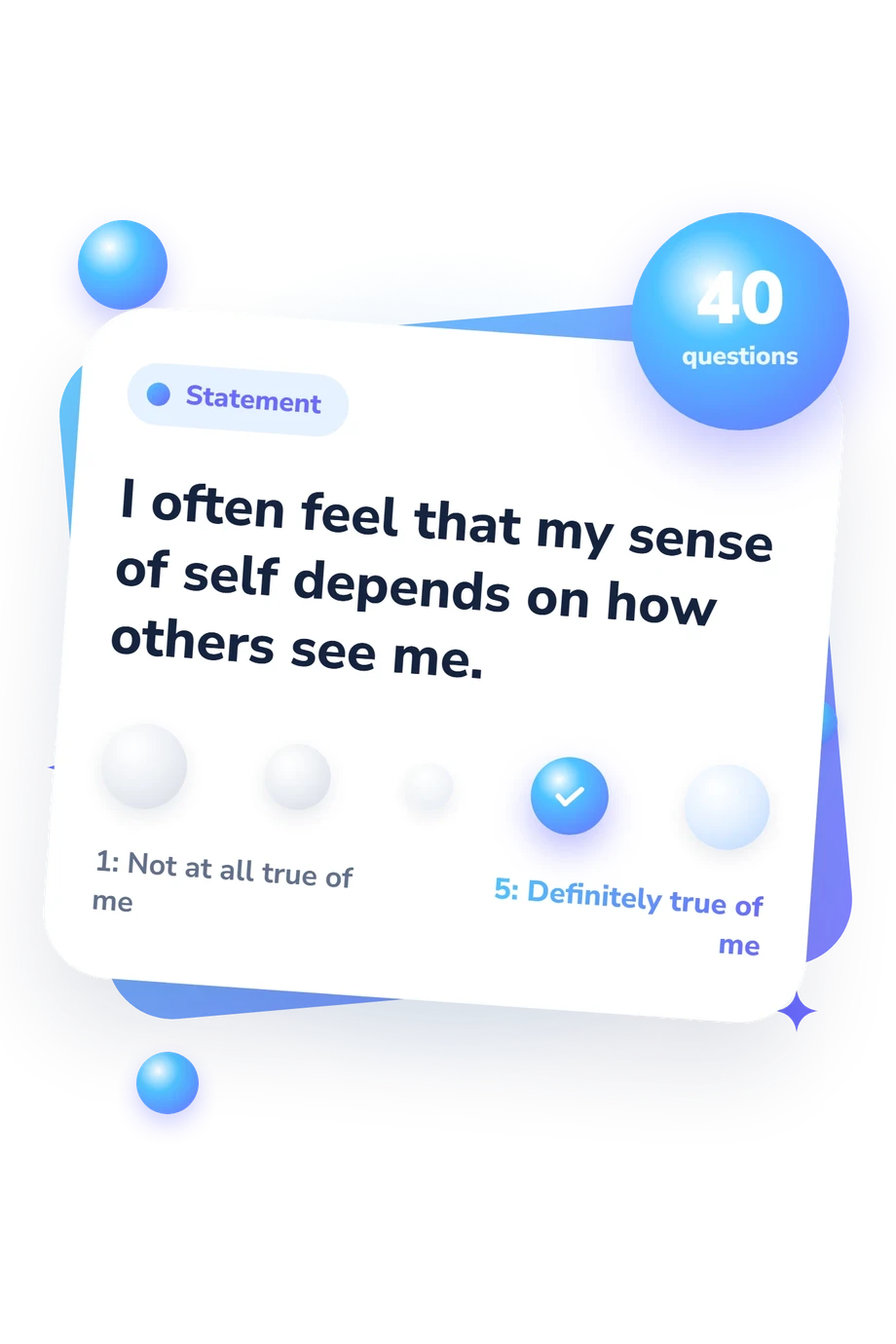
Each statement uses a five-point response format, ranging from “Not at all true of me” to “Definitely true of me.” The respondent rates how closely each statement matches personal experience; the answers are then combined into the displayed total. The exact weighting or item-level conversion is not specified, so no additional scoring rule should be inferred from the range alone.
Methodologically, the online questionnaire is conceptually consistent with Narcissism Mask Questionnaire (Pirumova, 2025), especially its focus on wounded self-worth, recognition, rejection, and interpersonal defenses. It is not a validated adaptation of that source. Pirumova’s 2020 discussion adds context, while Pincus and Lukowitsky (2010) distinguish grandiose and vulnerable expressions of pathological narcissism, and Zeigler-Hill and Besser (2013) connect narcissism facets with feelings of self-worth. As a narcissism assessment, this tool supports structured reflection and does not establish a clinical category.
Its online format has no stated independent norms, reliability estimates, or clinical validation. Results are sensitive to honesty, current relationships, mood, and self-awareness, so they describe a reported tendency within this questionnaire rather than a fixed personality verdict.
- Pirumova, Yulia. Fragile Connections: How Wounded Narcissism Prevents Us from Living in Peace with Ourselves and Others. Moscow: Bombora, 2025.
- Pirumova, Yulia. Fragile People: A Hidden Door into the World of Narcissists. Moscow: Bombora, 2020.
- Pincus, Aaron L., and Mark R. Lukowitsky. Pathological Narcissism and Narcissistic Personality Disorder. Annual Review of Clinical Psychology 6 (2010): 421-446. 10.1146/annurev.clinpsy.121208.131215.
- Zeigler-Hill, Virgil, and Avi Besser. A Glimpse Behind the Mask: Facets of Narcissism and Feelings of Self-Worth. Journal of Personality Assessment 95, no. 3 (2013): 249-260. 10.1080/00223891.2012.717150
Updated: