
Administrative Style Assessment Test
How the Scales are Structured
Who Usually Takes This Test?
See How You Compare
Below is a preview of how scores are typically distributed across each scale.
Example Questions From the Test
- Rely on my own abilities, knowledge, and experience. Ultimately, I am the one who is held responsible.
- Support decisions and methods that result from interaction between team members and senior administrators.
- If problems arise or serious tasks need to be addressed, refer them to higher-level administrators for a decision and further action.
- Allow team members to sometimes make their own decisions.
- Organize a group (committee) to assist in managing the organization.
- Listen carefully to employees’ views, analyze them, and then make a management decision.
- Involve staff in discussion and set up special work groups to study a problem. I often accept group recommendations and suggestions.
- A – distributing all written instructions and procedures among staff and ensuring that staff and a designated committee use them in their work and make necessary changes.
- B – organizing committees to review proposed rules and make appropriate changes.
- C – filing them away and allowing staff to act based on their professional skills.
- D – relying on them as flexible and useful tools for solving school-related problems.
- D – using them to achieve your own goals by fostering harmonious relationships between staff and administration.
- E – referring to them often, as they are a valuable source of information in many situations; following the rules can prevent most problems.
- F – using them as needed to maintain a positive and firm management style, especially when an employee does not follow the general rules.
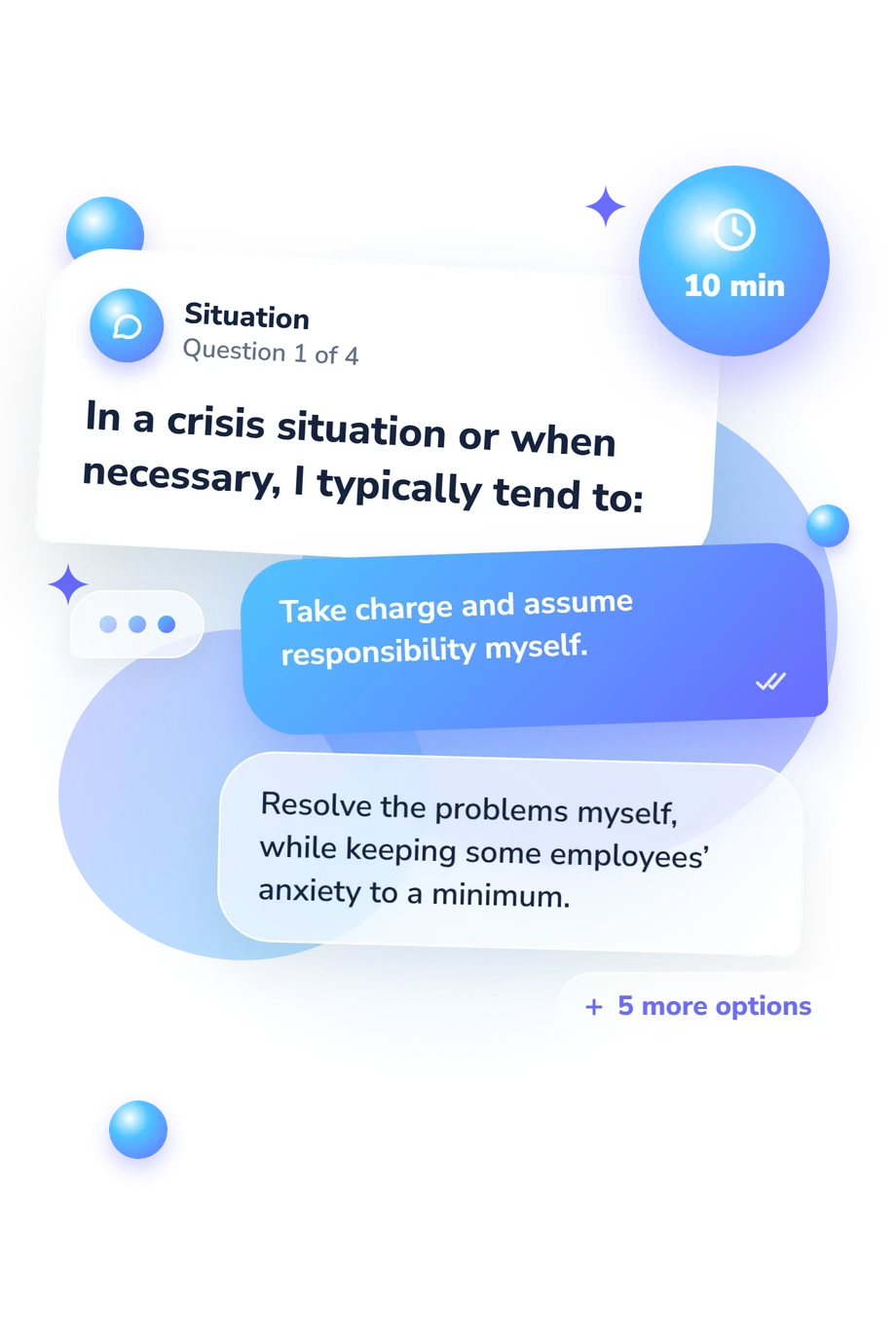
- Take charge and assume responsibility myself.
- Resolve the problems myself, while keeping some employees’ anxiety to a minimum.
- Allow employees to handle the situation on their own.
- Act according to the rules, since they were developed by experienced people based on long-standing practical application of laws.
- Consult with a few knowledgeable (experienced) people before making a final decision and taking action.
- Convene a meeting of the committee I established to handle this situation.
- Bring together all responsible staff who can best solve the problem, who are familiar with the situation, and who can offer recommendations to help make the most appropriate decision.
Administrative Style Assessment Test - Description and methodology of the test
Managers, coordinators, and people responsible for group decisions can use the Administrative Style Assessment Test to examine how authority, consultation, and responsibility are handled in everyday work. As an administrative style questionnaire, it is most useful when you want a clear profile of your preferred way of directing a team and a starting point for considering how that approach affects participation and accountability.
What This Assessment Measures
Workplace scenarios in this management style assessment cover rules, crises, planning, delegation, consultation, and responsibility. Seven tendencies may coexist rather than define one permanent style. Dimensions follow:
- Democratic (0-28) measures shared decisions: Low 0-9; Moderate 10-18; High 19-28.
- Limited Participation (0-28) shows partial delegation: Low delegation 0-9; Moderate delegation 10-19; High delegation 20-28.
- Bureaucratic (0-28) measures rule-bound hierarchy: Low 0-9; Moderate 10-18; High 19-28.
- Cooperative (0-28) measures consultation: Low cooperative 0-9; Moderate cooperative 10-18; High cooperative 19-28.
- Benevolent-Authoritarian (0-28) shows friendly unilateral decisions: Low 0-9; Moderate 10-19; High 20-28.
- Authoritarian (0-28) measures leader control: Low 0-9; Moderate 10-18; High 19-28.
- Non-Intervention (0-28) measures limited oversight: Active involvement 0-9; Selective non-interference 10-18; Strong non-interference 19-28.
Methodology and Evidence Base
Each question presents a workplace situation and seven response statements describing different ways to act. The respondent selects the statement that best matches their usual approach. Results are reported as separate scores for the profile dimensions, allowing several tendencies to appear together rather than forcing one style to be the sole outcome.
This online questionnaire is conceptually consistent with Tunik’s classification of administrative behavior and with Rensis Likert’s management-systems framework, particularly its attention to authority, consultation, participation, and delegation. Berndsen and Lima Machado provide a related application of Likert’s theory in public administration, but this online questionnaire is not presented as a direct adaptation of their study.
Because this leadership assessment focuses on management behavior, its profile is best read alongside the respondent’s actual team context: how rules operate, whether consultation changes decisions, how authority is delegated, and who accepts responsibility in practice. The displayed bands describe score levels for each scale, while self-report remains sensitive to current pressures, self-awareness, and the wish to appear favorable.
- Tunik, Elena. "Management Styles in the Education System." School Psychologist, no. 2 (98), 2002.
- Likert, Rensis. The Human Organization: Its Management and Value. New York: McGraw-Hill, 1967.
- Berndsen, Cecílio A. F., and A. J. Lima Machado. "Management Styles in Municipal Governments of Rio Grande do Sul: A Test of Rensis Likert's Theory." Revista de Administração de Empresas, vol. 14, no. 4, 1974, pp. 29-46. 10.1590/S0034-75901974000400002.
Updated: