
Reverse Intuition Level Questionnaire Test
How the Scales are Structured
Who Usually Takes This Test?
See How You Compare
Below is a preview of how scores are typically distributed across each scale.
Example Questions From the Test
- Rarely
- Sometimes
- Often
- Always
- Rarely
- Sometimes
- Often
- Always
- Rarely
- Sometimes
- Often
- Always
Reverse Intuition Level Questionnaire Test - Description and methodology of the test
People who notice that an inner hunch points away from useful choices may want a structured way to examine that experience. The Reverse Intuition Level Questionnaire Test is for people exploring misleading cues, confidence in inner guidance, and decisions made when instinct and evidence diverge. An online reverse intuition assessment organizes these experiences as a reported tendency rather than a fixed personal quality.
What This Assessment Explores
These items examine moments when intuition appears misleading, points toward trouble, or must be deliberately reversed. They cover work, close relationships, personal matters, plans, difficult choices, and dreams, while also asking whether acting against an inner signal brings better outcomes. This intuition reversal questionnaire therefore describes how a person responds when instinct and evidence seem to disagree.
The result contains two displayed measures:
- Raw Score: 0-33 totals questionnaire points and indicates the measured severity of reverse intuition; Low 0-8, Moderate 9-16, and High 17-33 are the shown bands.
- Reverse Intuition Level: 0-10 reflects the capacity to recognize and use reverse intuition consciously or automatically; Low 0-3, Moderate 4-7, and High 8-10 are the shown bands.
The raw band describes reverse-intuition severity; the level band concerns capacity to recognize and use reverse intuition; neither means constant error or poor judgment.
Methodology and Scientific Basis
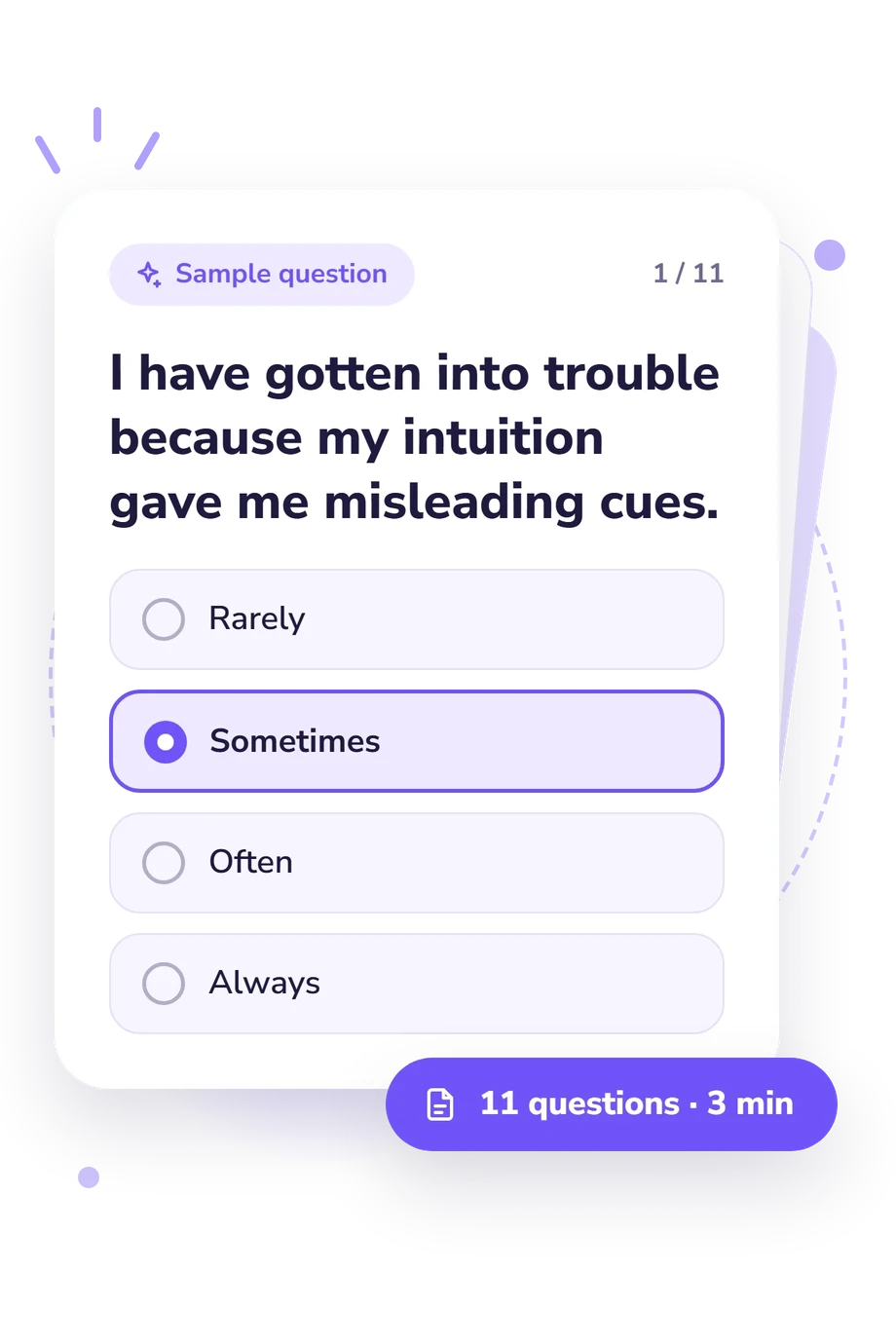
Each statement uses a four-choice frequency format: Rarely, Sometimes, Often, or Always. The items ask about misleading intuitive cues and deliberate reversal, so the response pattern captures both recurring experiences and reactions to doubtful inner signals. The questionnaire records a raw total and a separate level score; raw values are intended for later conversion to standard scores, or stens, while the visible ranges do not establish how many points each answer contributes.
The questionnaire’s themes are conceptually consistent with Grigoriev’s 2025 Reverse Intuition Questionnaire, especially its focus on contrary or misleading intuitive cues; this online measure remains a separate questionnaire, not that published instrument or a validated adaptation. Its theoretical context also aligns with Epstein’s cognitive-experiential approach, which distinguishes intuitive-experiential and analytical-rational ways of processing information.
Interpretation is strongest when the bands are treated as descriptions of reported tendencies rather than population norms or clinical thresholds. No standardization, reliability estimates, or diagnostic status are stated for this online questionnaire. Self-report results can shift with memory, self-awareness, and current circumstances, so the score is best considered alongside concrete examples and broader reflection.
- Grigoriev, P. E. (2025). Questionnaire for Assessing the Level of Reverse Intuition. In S. Yu. Korovkin, D. V. Ushakov, and A. L. Zhuravlev (Eds.), Psychology of Creativity: Traditions, Innovations, Prospects: Proceedings of the International Scientific Conference Dedicated to the 105th Anniversary of Ya. A. Ponomarev (pp. 104-107). Moscow: Institute of Psychology of the Russian Academy of Sciences.
- Epstein, S., Pacini, R., Denes-Raj, V., and Heier, H. (1996). Individual Differences in Intuitive-Experiential and Analytical-Rational Thinking Styles. Journal of Personality and Social Psychology, 71(2), 390-405. 10.1037/0022-3514.71.2.390
- Epstein, S. (1994). Integration of the Cognitive and the Psychodynamic Unconscious. American Psychologist, 49(8), 709-724. 10.1037/0003-066X.49.8.709
Updated: