
Learning Resistance Determinants Severity Questionnaire Test
How the Scales are Structured
Who Usually Takes This Test?
See How You Compare
Below is a preview of how scores are typically distributed across each scale.
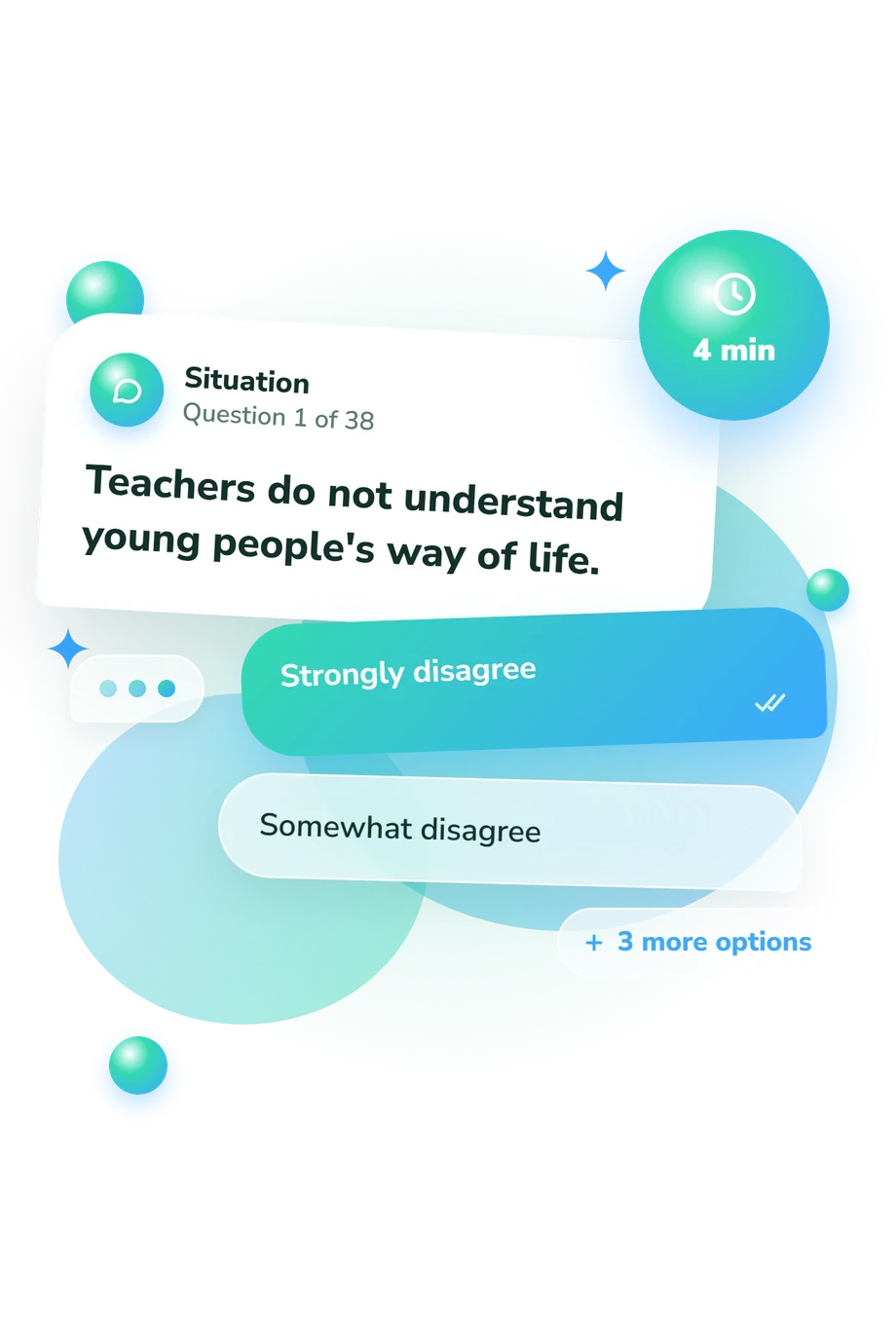
Example Questions From the Test
- Strongly disagree
- Somewhat disagree
- Not sure
- Somewhat agree
- Strongly agree
- Strongly disagree
- Somewhat disagree
- Not sure
- Somewhat agree
- Strongly agree
- Strongly disagree
- Somewhat disagree
- Not sure
- Somewhat agree
- Strongly agree
Learning Resistance Determinants Severity Questionnaire Test - Description and methodology of the test
For students and adult learners trying to understand why study feels blocked, the Learning Resistance Determinants Severity Questionnaire Test offers a structured way to examine perceived obstacles in the educational environment. It is suited to self-reflection as a learning resistance questionnaire when difficulty, anxiety, disappointment, or upsetting experiences interfere with engagement. The result points to areas that may deserve closer attention rather than reducing resistance to a single cause.
What This Assessment Explores
Five reported dimensions reflect determinants of resistance to learning:
- Excessive Subjective Difficulty of Learning (1-5) reflects perceived work-to-capability imbalance: Low difficulty (1-2.4), Moderate difficulty (2.5-3.6), High difficulty (3.7-5).
- Mismatch With Academic Expectations (1-5) reflects perceived gaps in course fit: Aligned expectations (1-2.3), Mixed fit (2.4-3.6), Strong mismatch (3.7-5).
- Academic Anxiety (1-5) captures learning-related fear and nervousness: Low (1-2.3), Moderate (2.4-3.6), High (3.7-5).
- Psychological Trauma Triggers (1-5) reflects distressing personal experiences activated by study: Low (1-2.3), Moderate (2.4-3.6), High (3.7-5).
- Meaning Barrier (1-5) reflects perceived unfairness, ineffective teaching, negative emotion, or values conflict around teachers’ demands: Low (1-2.3), Moderate (2.4-3.6), High (3.7-5).
Methodology and Evidence Base
Each item uses a five-point agreement response, from strong disagreement to strong agreement, with wording variations such as rather or completely. The sample addresses workload, school-to-university transition, curriculum fit, teaching methods, authority, exam worry, concentration, negative influence, and upsetting memories. Results are organized by five dimensions rather than one total score; the bands show the intensity assigned to each dimension.
Conceptually, it is consistent with the Learning Resistance Determinants Questionnaire (Yakushin, 2025), the closest named instrument for these themes, but it is not presented as a direct adaptation or validated copy. Atherton frames resistance through learning conditions and participant experience, while Dweck’s Self-Theories connects beliefs about capability with motivation and engagement.
As a learning resistance assessment, it supports pattern-finding around task difficulty, course fit, exam pressure, teacher interactions, and emotional triggers. Self-report is sensitive to current stress, memory, self-awareness, and willingness to disclose, and the displayed bands are not established clinical norms. A high result indicates a prominent reported tendency, not a diagnosis.
- Yakushin, Sergey M. (2025). Developing of psychological questionnaire for studying factors that cause learning resistance among students of higher education institutions. World of Science. Pedagogy and Psychology, 13(1), 15PSMN125. 10.15862/15PSMN125
- Atherton, James. (1999). Resistance to learning: A discussion based on participants in in-service professional training programmes. Journal of Vocational Education & Training, 51(1), 77-90. 10.1080/13636829900200070
- Dweck, Carol S. (1999). Self-Theories: Their Role in Motivation, Personality, and Development. Psychology Press.
Updated: