
School Motivation Assessment Questionnaire Test
How the Scales are Structured
Who Usually Takes This Test?
See How You Compare
Below is a preview of how scores are typically distributed across each scale.
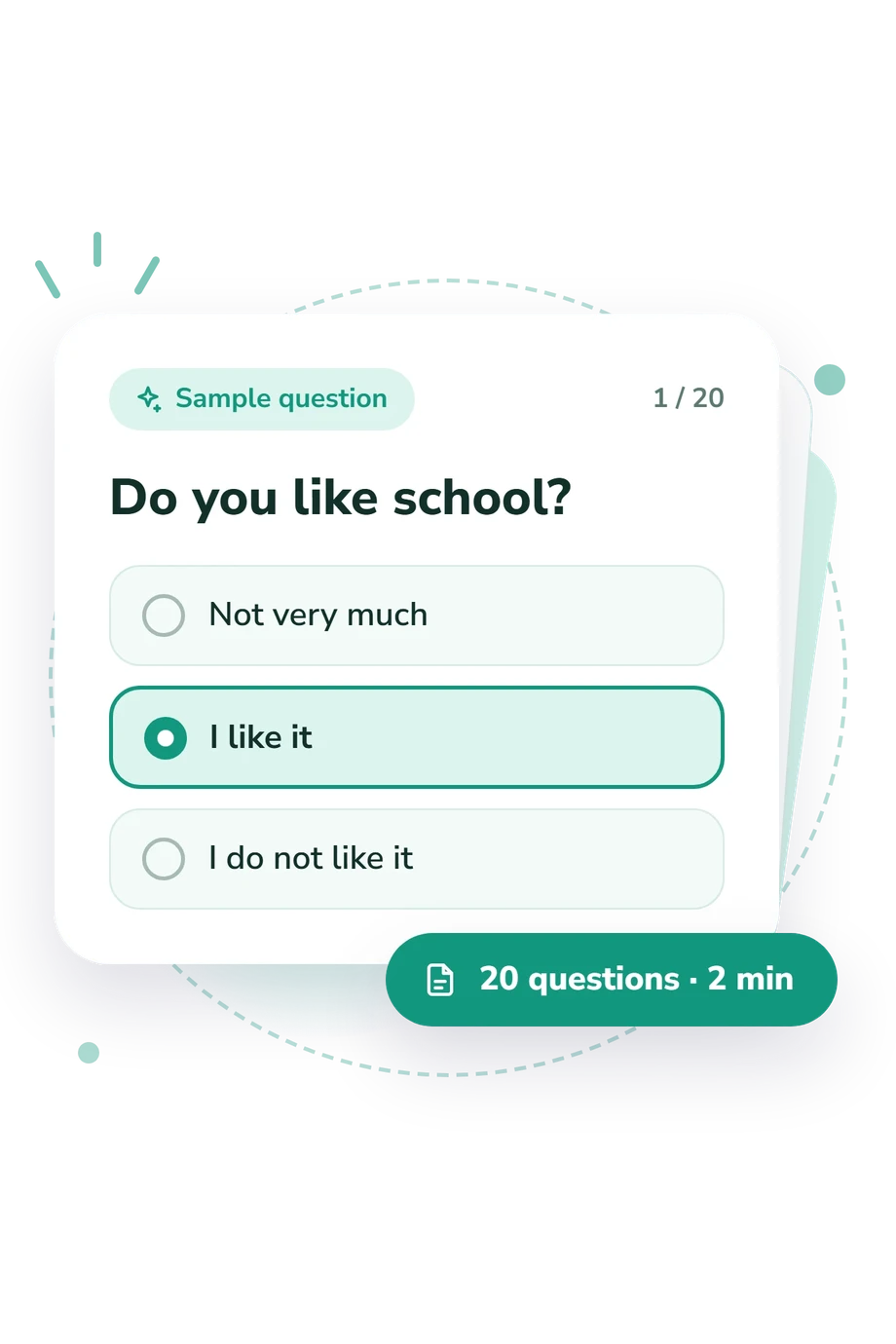
Example Questions From the Test
- Not very much
- I like it
- I do not like it
- I more often want to stay home
- It varies
- I go gladly
- I do not like it
- It varies
- I like it
School Motivation Assessment Questionnaire Test - Description and methodology of the test
This school motivation test for children helps parents, teachers, and other caregivers examine a child's experience of school, including motivation, participation, and adjustment. The School Motivation Assessment Questionnaire Test gives adults a way to consider the child's willingness to attend, interest in lessons, and connection with classmates. The school motivation questionnaire organizes those everyday signals into a concise basis for reflection and discussion.
What This Assessment Explores
This assessment considers a child's relationship with school, not subject knowledge. Items about attendance, lessons, homework, cancelled classes, teacher strictness, parents, and classmates place motivation in the wider school environment.
The catalogue interprets this school assessment as follows: lower scores indicate adaptation difficulties and a negative attitude toward learning, average scores indicate a positive attitude toward school, and higher scores indicate strong academic motivation and activity.
The item themes contributing to the single result are:
- Attendance and lessons show willingness to approach school and participate in classes.
- Homework and teachers show responses to learning demands and classroom structure.
- Parents and classmates place the child's school experience in family and peer relationships.
- School Motivation: 0-30 measures the level of children's school motivation and their engagement and adaptation; Low motivation (0-9), Average motivation (10-19), and High motivation (20-30) are the displayed bands.
Methodology and Scientific Basis
Each item offers three answer choices, with wording suited to the situation: the child indicates liking, willingness, uncertainty, or frequency. This self-report format captures preferences and reactions to imagined school situations. The responses produce a displayed result with a total range, but the questionnaire does not specify how individual responses contribute, so item weights cannot be inferred from the number of choices or the range.
The method is conceptually consistent with School Motivation Level Assessment (Luskanova, 1993), which considers attendance, lessons, homework, teachers, and the social school setting. Mamedova and Koroleva (2022) later applied Luskanova's method in a study of fifth-graders' school motivation. That paper is an application of Luskanova's method; it does not validate this online questionnaire, standardize it, or establish norms for its scores.
For interpretation, the questionnaire works best as a school engagement assessment when the result is read as a pattern in the child's experience. Mood, recent events, classroom relationships, social desirability, and limited self-awareness can affect answers. The score helps identify topics for discussion, while context is needed before concluding that motivation or adjustment difficulties are persistent.
- Luskanova, N. G. (1993). Methods for Studying Children with Learning Difficulties: Methodological Recommendations. Moscow: Folium, 32 pp.
- Mamedova, L. V., and Koroleva, M. E. (2022). Assessment of Fifth-Graders' School Motivation Using N. G. Luskanova's Diagnostic Method. Educational Management: Theory and Practice, 12(10), 161-166. 10.25726/e9766-0602-1883-j
Updated: