
Freudly+971 508685814hello@freudly.ai
Freudly
pedagogy

Motivation for Learning Among Teacher Education Students Test
Take the online Motivation for Learning Among Teacher Education Students Test - AI psychologist FreudlyYou can take Motivation for Learning Among Teacher Education Students Test here. Online version of a simple and accurate psychological test with interpretation.en
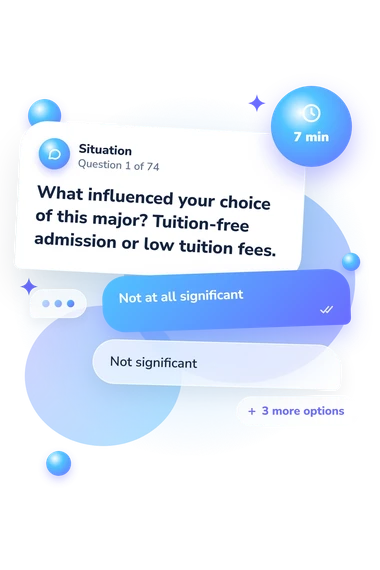
In seven minutes, this 37-question Motivation for Learning Among Teacher Education Students Test maps the reasons behind a student’s academic effort, distinguishing professional, intrinsic, and external influences. The result offers a structured profile for reflecting on study goals, educational choices, and the motivations that may shape future professional development.
Questions: 377 minutes
Motivation for Learning Among: situation and reply bubbles
October 2, 2025October 2, 2025Material has been updatedOctober 2, 2025Material has been published
30,014 views
2,404 completions
2,014 likes
Daniel HallPsychologist · Test reviewer
2,014 likes
Scale Explorer

How the Scales are Structured

Professional MotivesPM
Measures the extent to which a student’s learning is driven by externally oriented professional goals and social expectations about their future career.
example score13/35
13/35Lowexample score
7 – 16Low
17 – 26Moderate
27 – 35High
A score of 13 indicates low professional motives, suggesting external career-related expectations are a relatively weak driver of the student’s learning at this time.
Actual Learning MotivesALM
Measures how strongly a student’s learning is driven by external rewards or avoidance of negative consequences.
example score14/35
14/35Low external driveexample score
7 – 16Low external drive
17 – 26Moderate external drive
27 – 35High external drive
A score of 14 indicates low external motivational pressure, suggesting study behavior is relatively less shaped by rewards or fear of punishment.
Extrinsic Learning MotivationELM
This scale measures the extent to which a student’s learning is driven by external rewards, approval, grades, or avoidance of negative consequences.
example score76/105
76/105Moderate external motivationexample score
21 – 49Low external motivation
50 – 77Moderate external motivation
78 – 105High external motivation
A score of 76 indicates moderately strong reliance on external incentives and feedback to maintain learning effort.
Professional MotivesPM
Measures how strongly a student is oriented toward future professional activity and professional self-determination during their studies.
example score7/25
7/25Lowexample score
5 – 11Low
12 – 18Moderate
19 – 25High
A score of 7 indicates low professional motivation, suggesting professional goals currently play a limited role in guiding the student’s learning.
Actual Learning MotivesALM
Measures the degree to which a student’s learning is driven by genuine internal motives such as interest in knowledge, self-improvement, and professional growth.
example score20/25
20/25Highexample score
5 – 11Low
12 – 18Moderate
19 – 25High
A score of 20 falls in the High range, suggesting strong intrinsic engagement with learning and clear orientation toward personal and professional development.
Motives for Entering Higher EducationMfEHE
Measures the strength of a student’s internal reasons for choosing university and the teaching profession, including interest in education and professional intent.
example score15/25
15/25Moderateexample score
5 – 12Low
13 – 18Moderate
19 – 25High
A score of 15 falls in the Moderate range, suggesting a balanced mix of internal interest and practical considerations in the decision to apply to university.
Intrinsic Learning MotivationILM
Measures the degree to which learning is driven by internal interest in the profession, self-development, and enjoyment of mastering challenging material.
example score46/105
46/105Lowexample score
21 – 49Low
50 – 77Moderate
78 – 105High
A score of 46 falls in the Low range, suggesting intrinsic interest and self-driven engagement in learning are present but not yet a consistent driver of study behavior.
Motives for Entering UniversityMfEU
Measures how strongly a student’s decision to enroll in university is driven by external circumstances and others’ expectations rather than internal academic or professional motives.
example score17/35
17/35Moderate external admission motiveexample score
7 – 16Low external admission motive
17 – 26Moderate external admission motive
27 – 35High external admission motive
A score of 17 falls in the Moderate range, suggesting external factors (e.g., circumstances or others’ expectations) play a noticeable but not dominant role in the decision to apply to university.
just completed the test
DATA-BASED USER COHORTS

Who Usually Takes This Test?

Pedagogical university students
57%OF USERS
Students take it to understand what currently drives their learning—getting a diploma, real interest in studies, or future teaching goals—and how this changes over time.
Teacher educators and mentors
26%OF USERS
Lecturers and curators use it to monitor group motivation, spot early drops in engagement, and adjust support and learning activities.
University psychologists and advisors
17%OF USERS
Student support specialists apply it to identify motivation risks, guide individual counseling, and evaluate the impact of interventions during the semester.
BASED ON AGGREGATED, ANONYMIZED DATA FROM TENS OF THOUSANDS OF FREUDLY USERS.
Benchmarking

See How You Compare

Once you complete the test, your results are compared with real-world data from people in your country.
Below is a preview of how scores are typically distributed across each scale.
Shaded area — where most people score
Dot — the average
You — your score lands on each curve after the test— your score, after the test
Professional motivesPm
You?
Average14.8
Typical rangeTypical10.5 – 19
Possible7 – 35
Real Motivations Behind LearningRMBL
You?
Average25.7
Typical rangeTypical21.8 – 29.6
Possible7 – 35
External Motivation for LearningEMfL
You?
Average77.5
Typical rangeTypical62.5 – 92.5
Possible21 – 105
Professional MotivationsPM
You?
Average11.8
Typical rangeTypical9.1 – 14.6
Possible5 – 25
Genuinely Effective Motivations for LearningGEMfL
You?
Average13.8
Typical rangeTypical11.1 – 16.5
Possible5 – 25
Motivations for Applying to UniversityMfAtU
You?
Average12.1
Typical rangeTypical9.1 – 15.2
Possible5 – 25
Intrinsic motivation for learningImfl
You?
Average47.4
Typical rangeTypical35.7 – 59.1
Possible21 – 105
Motivations for Applying to UniversityMfAtU
You?
Average15.7
Typical rangeTypical11.1 – 20.3
Possible7 – 35
Featured On
SAMPLE QUESTIONS

Example Questions From the Test

Carefully read the motives for entering a university, the motives that actually guide studying, and the professional motives presented in this section. Rate the motives that are significant for you in studying at a teacher-training university. Respond quickly, without overthinking.
    • Not significant at all
    • Not significant
    • Significant to some extent
    • Significant
    • A very significant motive
    • Not significant at all
    • Not significant
    • Somewhat significant
    • Significant
    • Very significant
    • Not at all important as a motive
    • Not important
    • Somewhat important
    • Important
    • Very important as a motive
WHAT THE TEST MEASURES

Motivation for Learning Among Teacher Education Students Test - Description and methodology of the test

pedagogy
academic motivation

Students preparing for, entering, or reflecting on teacher education can use the Motivation for Learning Among Teacher Education Students Test to examine what sustains their academic choices and effort. The result creates a teacher education student motivation profile across professional aims, knowledge seeking, social approval, practical rewards, and outside pressure. It is useful when a learner wants to understand competing reasons behind study behavior.

What This Assessment Explores

Learning motivation assessment shows:

  • Professional Motives (7-35), Actual Learning Motives (7-35), and Extrinsic Learning Motivation (21-105) show: Low 7-16; Moderate 17-26; High 27-35; Low external drive 7-16; Moderate external drive 17-26; High external drive 27-35; Low external motivation 21-49; Moderate external motivation 50-77; High external motivation 78-105.
  • Professional Motives (5-25), Actual Learning Motives (5-25), and Motives for Entering Higher Education (5-25) show: Low 5-11; Moderate 12-18; High 19-25; Low 5-11; Moderate 12-18; High 19-25; Low 5-12; Moderate 13-18; High 19-25.
  • Intrinsic Learning Motivation (21-105) and Motives for Entering University (7-35) show: Low 21-49; Moderate 50-77; High 78-105; Low external admission motive 7-16; Moderate external admission motive 17-26; High external admission motive 27-35.

Methodology and Evidence Base

Each item asks how significant a motive is, using five ordered responses from 1, Not significant at all, to 5, Very significant. The sample covers professional interest, deep knowledge, preparation, grades, approval, employment, and avoidance of unwanted circumstances. Responses are combined within the displayed scales; the published ranges and bands define interpretation, so the answer-to-point rule should not be inferred.

The closest named source is the Pedagogical University Student Learning Motivation Method (Ketko & Pakulina, 2010). As a motivation questionnaire for teacher education students, it is conceptually consistent with that work, not presented as a direct adaptation. Ovchinnikov (2007) and Pakulina (2008) provide related context on how learning motives develop and are structured, while Ryan and Deci (2000) distinguish intrinsic from extrinsic motivation.

Results are most useful when internal and external patterns are read together rather than treated as a verdict. The online format supplies interpretive bands but no established population norms, reliability estimates, or clinical cutoffs. Honest self-report, current circumstances, and limited self-awareness can shift the profile, which describes reported motivational tendencies rather than observed classroom performance.

Author: John T. Guthrie, Paul R. Pintrich
Literature:
  • Ketko, S. M., & Pakulina, S. A. (2010). Diagnostics Method of Learning Motivation in Pedagogical University Students. Psychological-Educational Studies, 2(1), Article 7.
  • Ovchinnikov, M. V. (2007). Dynamics of Learning Motivation of Pedagogical University Students and Its Formation: Dissertation for the Candidate of Psychological Sciences. Kurgan, Russia, 214 pp.
  • Pakulina, S. A. (2008). Adaptive Abilities of Pedagogical University Students: Structure, Factors, and Means of Development. Moscow: SGU Press, 201 pp.
  • Ryan, R. M., & Deci, E. L. (2000). Intrinsic and Extrinsic Motivations: Classic Definitions and New Directions. Contemporary Educational Psychology, 25(1), 54-67. 10.1006/ceps.1999.1020
Popular tests
Comments
Leave a Comment