
Freudly+971 508685814hello@freudly.ai
Freudly
cbt

Multidimensional Psychological Flexibility Inventory (MPFI) Test
Take the online Multidimensional Psychological Flexibility Inventory (MPFI) Test - AI psychologist FreudlyYou can take Multidimensional Psychological Flexibility Inventory (MPFI) Testhere. Online version of a simple and accurate psychological test with interpretation.en
In about 11 minutes, it maps how you handle thoughts, emotions, and challenges and where you get stuck. A 60 item, 12 dimension profile guides focused ACT treatment, tracking progress and tailoring care.
Start Online Test
Questions: 6011 minutes
08:30
September 1, 2026
September 1, 2026
Material has been updated
October 2, 2025
Material has been published
21,560 views
1,660 completions
1,310 likes
Verified by Daniel Hall
Psychologist with 25 years of experience
Share
Scale Explorer

How the Scales are Structured

example score
3/6
Experiential Avoidance (EA)
Measures the tendency to avoid or suppress unpleasant emotions and thoughts rather than staying open to them.
Low avoidance
Moderate avoidance
High avoidance
11.9: Low avoidance | 24.2: Moderate avoidance | 4.36: High avoidance
A score of 3 indicates a moderate tendency to steer away from distressing inner experiences, which may sometimes narrow coping options under stress.
example score
4/6
Inaction (I)
Inaction measures the tendency toward passivity and difficulty initiating purposeful actions toward goals.
Low inaction
Moderate inaction
High inaction
11.4: Low inaction | 1.53.7: Moderate inaction | 3.86: High inaction
A score of 4 indicates a higher tendency toward passivity, suggesting it may often feel harder to take purposeful action even when goals are important.
example score
3/6
Cognitive Fusion (CF)
Cognitive Fusion measures how strongly a person treats thoughts as literal truths that can dominate attention and guide behavior rigidly.
Low fusion
Moderate fusion
High fusion
11.5: Low fusion | 1.64.2: Moderate fusion | 4.36: High fusion
A score of 3 indicates a moderate tendency to get caught up in thoughts at times, while still being able to step back from them in other situations.
example score
3/6
Self-As-Content (SAC)
This scale measures how strongly a person identifies with a fixed self-image (roles, labels, or thoughts), which can reduce psychological flexibility.
Low attachment
Moderate attachment
High attachment
11.4: Low attachment | 1.53.9: Moderate attachment | 46: High attachment
A score of 3 indicates moderate attachment to a self-image, suggesting some tendency to rely on self-definitions while still being able to shift perspective in many situations.
example score
2/6
Lack of Contact With the Present Moment (LoCWtPM)
Measures how often a person is disengaged from present-moment experiences and events, reducing attentive responding to what is happening now.
Low
Moderate
High
11.4: Low | 1.53.7: Moderate | 3.86: High
A score of 2 falls in the Moderate range, suggesting occasional difficulty staying connected to the present moment, though not consistently.
example score
3/6
Psychological Inflexibility (PI)
Measures the degree of rigidity and avoidance that can limit adaptation to difficult thoughts, emotions, and changing situations.
Low inflexibility
Moderate inflexibility
High inflexibility
11.8: Low inflexibility | 1.93.7: Moderate inflexibility | 3.86: High inflexibility
A score of 3 indicates a moderate level of psychological inflexibility, suggesting some tendency toward rigid thinking or avoidance that may show up in certain situations while remaining flexible in others.
example score
4/6
Committed Action (CA)
Purposeful action measures how consistently a person takes goal- and values-aligned steps despite internal discomfort or external obstacles.
Low
Moderate
High
12.9: Low | 35.2: Moderate | 5.36: High
A score of 4 indicates a moderate tendency to keep moving toward goals and values, though follow-through may be disrupted at times by barriers or competing demands.
example score
4/6
Values (V)
Measures how clearly you recognize and use personal values as guiding directions for everyday choices and actions.
Unclear values
Developing clarity
Clear values
12.9: Unclear values | 35.2: Developing clarity | 5.36: Clear values
A score of 4 indicates moderately clear values that can guide behavior in many situations, though they may feel less consistent under stress or competing demands.
example score
4/6
Cognitive Defusion (CD)
Measures the ability to step back from intrusive thoughts so they have less influence on attention and behavior.
Low defusion
Moderate defusion
High defusion
12.5: Low defusion | 2.64.8: Moderate defusion | 4.96: High defusion
A score of 4 indicates a moderate capacity to notice thoughts as mental events and sometimes choose actions without automatically following them.
example score
3/6
Self-as-Context (SaC)
Measures the ability to experience a stable observer perspective on thoughts and feelings without fully identifying with them.
Low observer stance
Moderate observer stance
High observer stance
12.9: Low observer stance | 35: Moderate observer stance | 5.16: High observer stance
A score of 3 suggests a moderate capacity to step back and observe inner experiences, though identification with thoughts or feelings may still occur in more challenging moments.
example score
3/6
Contact With the Present Moment (CWtPM)
This scale measures how well a person stays attentive to what is happening right now rather than getting pulled into past or future concerns.
Low
Moderate
High
12.9: Low | 35: Moderate | 5.16: High
A score of 3 suggests a moderate ability to maintain present-moment awareness, with attention sometimes shifting to thoughts about the past or future.
example score
3/6
Acceptance (A)
Assesses willingness to experience unwanted thoughts and emotions without avoidance or suppression.
Low acceptance
Moderate acceptance
High acceptance
12.4: Low acceptance | 2.54.6: Moderate acceptance | 4.76: High acceptance
A score of 3 indicates a moderate level of acceptance, suggesting some capacity to allow uncomfortable inner experiences while still sometimes trying to manage or avoid them.
example score
3/6
Psychological Flexibility (PF)
Measures the ability to stay open to difficult internal experiences and adapt behavior in line with personal values despite changing circumstances.
Lower flexibility
Moderate flexibility
Higher flexibility
12.9: Lower flexibility | 34.9: Moderate flexibility | 56: Higher flexibility
A score of 3 indicates moderate psychological flexibility, suggesting some capacity to accept difficult thoughts or feelings and still move toward valued actions, with room to strengthen this skill under stress.
example score
5/6
Unclear Values (UV)
Measures how unclear or poorly defined a person’s life values and goals are, which can hinder decisions and sustained motivation.
Clear values
Somewhat unclear
Highly unclear
11.6: Clear values | 1.73.7: Somewhat unclear | 3.86: Highly unclear
A score of 5 indicates highly unclear values, suggesting goals and priorities may feel hard to define and may make choices and follow-through more difficult.
Start Online Test
just completed the test
DATA-BASED USER COHORTS

Who Usually Takes This Test?

ACT clients in therapy
41%OF USERS
People already in counseling take it to see where they get stuck with thoughts and emotions and what helps them act according to their values.
Mental health professionals
34%OF USERS
Therapists and counselors use it to build a clear flexibility profile, plan interventions, and track change over time.
Self-growth and burnout
25%OF USERS
People under chronic stress, anxiety, or burnout take it to understand their coping patterns and strengthen flexibility in daily life.
BASED ON AGGREGATED, ANONYMIZED DATA FROM TENS OF THOUSANDS OF FREUDLY USERS.
Benchmarking

See How You Compare

Once you complete the test, your results are compared with real-world data from people in your country.
Below is a preview of how scores are typically distributed across each scale.
Avoiding emotional distress (Aed)
Average
2.9
Normal range
2.13.8
min.
1
max.
6
This curve shows how scores are typically distributed.
Once you complete the test, your result will appear on the scale so you can see how you compare.
Inaction (I)
Inaction (I)
Average
3.7
Normal range
2.94.4
min.
1
max.
6
This curve shows how scores are typically distributed.
Once you complete the test, your result will appear on the scale so you can see how you compare.
Cognitive Fusion (CF)
Average
3.5
Normal range
2.74.4
min.
1
max.
6
This curve shows how scores are typically distributed.
Once you complete the test, your result will appear on the scale so you can see how you compare.
Attachment to the "Self"-image (Att")
Average
2.8
Normal range
23.6
min.
1
max.
6
This curve shows how scores are typically distributed.
Once you complete the test, your result will appear on the scale so you can see how you compare.
Lack of contact with the moment (Locwtm)
Average
3.2
Normal range
2.53.9
min.
1
max.
6
This curve shows how scores are typically distributed.
Once you complete the test, your result will appear on the scale so you can see how you compare.
Psychological Inflexibility (PI)
Average
4.7
Normal range
4.15.3
min.
1
max.
6
This curve shows how scores are typically distributed.
Once you complete the test, your result will appear on the scale so you can see how you compare.
Purposeful action (Pa)
Average
4.2
Normal range
3.35.1
min.
1
max.
6
This curve shows how scores are typically distributed.
Once you complete the test, your result will appear on the scale so you can see how you compare.
Values (V)
Values (V)
Average
2.3
Normal range
1.43.1
min.
1
max.
6
This curve shows how scores are typically distributed.
Once you complete the test, your result will appear on the scale so you can see how you compare.
Cognitive Disconnection (CD)
Average
4.5
Normal range
3.85.2
min.
1
max.
6
This curve shows how scores are typically distributed.
Once you complete the test, your result will appear on the scale so you can see how you compare.
"I"-context (")
"I"-context (")
Average
4.5
Normal range
3.75.3
min.
1
max.
6
This curve shows how scores are typically distributed.
Once you complete the test, your result will appear on the scale so you can see how you compare.
Contact with the Present Moment (CwtPM)
Average
3.1
Normal range
2.43.8
min.
1
max.
6
This curve shows how scores are typically distributed.
Once you complete the test, your result will appear on the scale so you can see how you compare.
Acceptance (A)
Acceptance (A)
Average
2.9
Normal range
2.23.6
min.
1
max.
6
This curve shows how scores are typically distributed.
Once you complete the test, your result will appear on the scale so you can see how you compare.
Psychological Flexibility (PF)
Average
3.4
Normal range
2.64.3
min.
1
max.
6
This curve shows how scores are typically distributed.
Once you complete the test, your result will appear on the scale so you can see how you compare.
Unclear values (Uv)
Unclear values (Uv)
Average
2.7
Normal range
1.83.6
min.
1
max.
6
This curve shows how scores are typically distributed.
Once you complete the test, your result will appear on the scale so you can see how you compare.
Featured On
SAMPLE QUESTIONS

Example Questions From the Test

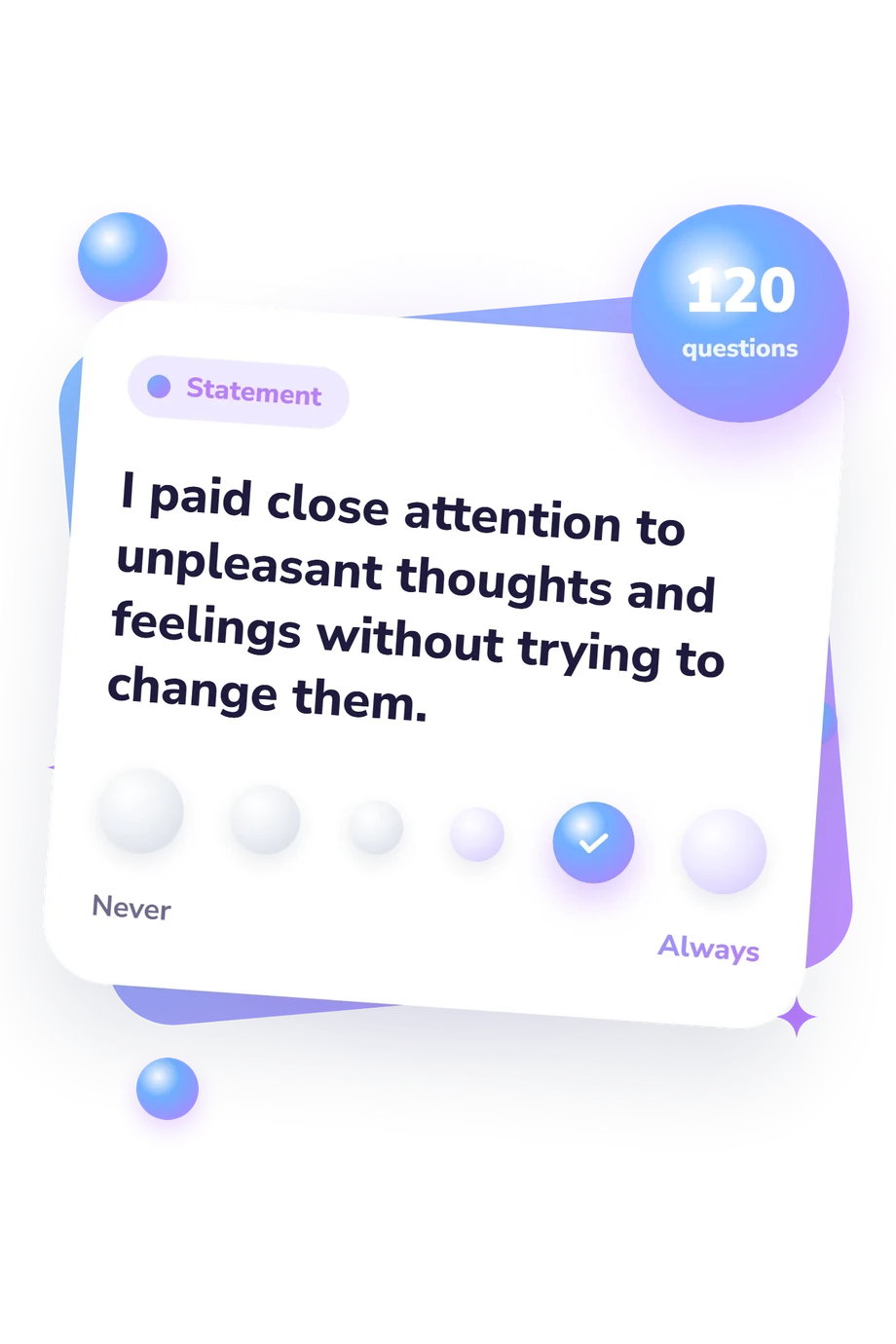
Read the statements and indicate how often you have felt or behaved in this way during the past two weeks.
    • Never
    • Rarely
    • Sometimes
    • Often
    • Very often
    • Always
    • Never
    • Rarely
    • Sometimes
    • Often
    • Very often
    • Always
    • Never
    • Rarely
    • Sometimes
    • Often
    • Very often
    • Always
WHAT THE TEST MEASURES
About This Assessment
Multidimensional Psychological Flexibility Inventory, MPFI Test

Multidimensional Psychological Flexibility Inventory (MPFI) Test - Symptoms and Signs

cbt
psychological flexibility
tpo

This measure is designed to assess psychological flexibility processes relevant to Acceptance and Commitment Therapy (ACT). The Multidimensional Psychological Flexibility Inventory (MPFI) uses self-report statements to characterize patterns of flexible and inflexible responding across multiple domains.

The instrument contains 60 items and typically requires about 11 minutes to complete. Results are intended to support clinical case conceptualization and treatment planning by identifying areas of relative strength and difficulty in how an individual relates to internal experiences and guides behavior in line with values. The Multidimensional Psychological Flexibility Inventory (MPFI) may also be used to monitor change over time and to inform evaluation of intervention response.

Literature: Rolffs, J. L., Rogge, R. D., & Wilson, K. G. Disentangling components of flexibility via the hexaflex model: Development and validation of the Multidimensional Psychological Flexibility Inventory (MPFI). Assessment. 2018.
Popular tests
Comments
Leave a Comment