
Freudly+971 508685814hello@freudly.ai
Freudly
achieving success

University Students' Achievement Motivation Scale Test
Take the online University Students' Achievement Motivation Scale Test - AI psychologist FreudlyYou can take University Students' Achievement Motivation Scale Testhere. Online version of a simple and accurate psychological test with interpretation.en
Understand what drives a student’s academic success in just 7 minutes. This 36 item check-in clarifies key motivators to guide targeted support, boost engagement, and remove roadblocks.
Start Online Test
Questions: 367 minutes
08:30
October 2, 2025
October 2, 2025
Material has been updated
October 2, 2025
Material has been published
25,067 views
1,899 completions
1,602 likes
Verified by Daniel Hall
Psychologist with 25 years of experience
Share
Scale Explorer

How the Scales are Structured

example score
16/20
Calling (C)
Measures how strongly a student experiences their future professional activity as personally meaningful and vocation-like.
Low
Moderate
High
413: Low | 1417: Moderate | 1820: High
A score of 16 falls in the Moderate range, suggesting a fairly developed sense of meaningful professional direction, though not consistently experienced as a clear vocation.
example score
13/20
Overcoming Obstacles (OO)
Measures persistence and readiness to overcome difficulties in pursuit of academic success goals.
Lower persistence
Moderate persistence
High persistence
413: Lower persistence | 1417: Moderate persistence | 1820: High persistence
A score of 13 falls in the Lower persistence range, suggesting obstacles may more often reduce drive to keep working toward goals.
example score
9/20
Mental State (MS)
Measures the emotional tone and satisfaction a student experiences in connection with perceived academic success.
Low positive tone
Moderate positive tone
High positive tone
413: Low positive tone | 1417: Moderate positive tone | 1820: High positive tone
A score of 9 falls in the Low positive tone range, suggesting comparatively limited satisfaction and positive emotional uplift associated with success experiences right now.
example score
13/20
Personal Success (PS)
Measures how strongly a student’s motivation is driven by self-evaluation of achievements and aspirations for personal growth.
Low personal-success focus
Moderate personal-success focus
High personal-success focus
413: Low personal-success focus | 1417: Moderate personal-success focus | 1820: High personal-success focus
A score of 13 falls in the low range, suggesting personal growth and self-respect motives are present but are not the primary drivers of academic effort compared with other motivators.
example score
13/20
Results of One's Own Performance (RoOOP)
Measures how strongly a student is oriented toward achieving concrete, efficient results through their own actions.
Low result focus
Moderate result focus
High result focus
413: Low result focus | 1417: Moderate result focus | 1820: High result focus
A score of 13 falls in the low result focus range, suggesting results and productivity are a less central driver in the student’s own activity compared with other motives.
example score
43/100
Success Internalization (SI)
Measures the degree to which striving for success is driven by internal values, self-development, and personal standards rather than external rewards.
Low internalization
Moderate internalization
High internalization
2065: Low internalization | 6689: Moderate internalization | 90100: High internalization
A score of 43 indicates low internalization of success, suggesting motivation is less consistently anchored in personal growth and internal standards and may rely more on external factors or situational prompts.
example score
17/20
Power (P)
Measures the strength of the student’s need to influence, lead, and control others as part of achievement motivation.
Low power drive
Moderate power drive
High power drive
413: Low power drive | 1417: Moderate power drive | 1820: High power drive
A score of 17 suggests a moderately strong drive for leadership and influence, with control and dominance motives present but not at the highest level.
example score
11/20
Recognition (R)
Measures how strongly a student seeks social approval and recognition as part of their sense of academic success.
Low need for recognition
Moderate need for recognition
High need for recognition
413: Low need for recognition | 1417: Moderate need for recognition | 1820: High need for recognition
A score of 11 suggests a relatively low emphasis on others’ approval, with motivation and self-evaluation less dependent on social recognition.
example score
7/20
Material Standard of Living (MSoL)
Measures how strongly material achievements and wealth are viewed as indicators of success in academic and life goals.
Low material focus
Moderate material focus
High material focus
413: Low material focus | 1417: Moderate material focus | 1820: High material focus
A score of 7 falls in the Low material focus range, suggesting material rewards are a relatively minor driver of this student’s motivation for success.
example score
6/20
Luck (L)
Measures how strongly a student attributes academic success to luck or random circumstances rather than personal effort and stable factors.
Low reliance on luck
Mixed attribution
High reliance on luck
413: Low reliance on luck | 1417: Mixed attribution | 1820: High reliance on luck
A score of 6 falls in the Low reliance on luck range, suggesting the student tends to see achievement as less dependent on chance and more on controllable factors.
example score
63/100
Externalization of Success (EoS)
Measures the extent to which academic success is driven by external rewards and social approval such as luck, status, recognition, and power.
Low external focus
Moderate external focus
High external focus
2065: Low external focus | 6689: Moderate external focus | 90100: High external focus
A score of 63 falls in the Low external focus range, suggesting achievement motivation is less centered on recognition, material gains, or outward status cues.
Start Online Test
just completed the test
DATA-BASED USER COHORTS

Who Usually Takes This Test?

Students feeling stuck
41%OF USERS
University students who are procrastinating, underperforming, or burned out take it to pinpoint what really motivates them and how to regain momentum.
Career-focused achievers
34%OF USERS
Ambitious students use it to clarify whether grades, professional growth, recognition, or personal satisfaction most drives their effort and choices.
Advisors and counselors
25%OF USERS
Academic advisors, tutors, and psychologists administer it to quickly map a student’s motivation profile and tailor support strategies.
BASED ON AGGREGATED, ANONYMIZED DATA FROM TENS OF THOUSANDS OF FREUDLY USERS.
Benchmarking

See How You Compare

Once you complete the test, your results are compared with real-world data from people in your country.
Below is a preview of how scores are typically distributed across each scale.
Calling (C)
Calling (C)
Average
10.6
Normal range
8.113.1
min.
4
max.
20
This curve shows how scores are typically distributed.
Once you complete the test, your result will appear on the scale so you can see how you compare.
Overcoming Obstacles (OO)
Average
8.7
Normal range
6.211.3
min.
4
max.
20
This curve shows how scores are typically distributed.
Once you complete the test, your result will appear on the scale so you can see how you compare.
Mental state (Ms)
Mental state (Ms)
Average
13.3
Normal range
11.215.4
min.
4
max.
20
This curve shows how scores are typically distributed.
Once you complete the test, your result will appear on the scale so you can see how you compare.
Personal Success (PS)
Average
15.2
Normal range
12.917.5
min.
4
max.
20
This curve shows how scores are typically distributed.
Once you complete the test, your result will appear on the scale so you can see how you compare.
Result of own activity (Rooa)
Average
8
Normal range
5.210.8
min.
4
max.
20
This curve shows how scores are typically distributed.
Once you complete the test, your result will appear on the scale so you can see how you compare.
Internalization of Success (IoS)
Average
46.2
Normal range
33.359.1
min.
20
max.
100
This curve shows how scores are typically distributed.
Once you complete the test, your result will appear on the scale so you can see how you compare.
Power (P)
Power (P)
Average
13.1
Normal range
10.515.7
min.
4
max.
20
This curve shows how scores are typically distributed.
Once you complete the test, your result will appear on the scale so you can see how you compare.
Admission (A)
Admission (A)
Average
12.3
Normal range
9.415.1
min.
4
max.
20
This curve shows how scores are typically distributed.
Once you complete the test, your result will appear on the scale so you can see how you compare.
Material standard of living (Msol)
Average
12.9
Normal range
10.814.9
min.
4
max.
20
This curve shows how scores are typically distributed.
Once you complete the test, your result will appear on the scale so you can see how you compare.
Luck (L)
Luck (L)
Average
14.4
Normal range
12.216.6
min.
4
max.
20
This curve shows how scores are typically distributed.
Once you complete the test, your result will appear on the scale so you can see how you compare.
Externalization of success (Eos)
Average
58.9
Normal range
4869.8
min.
20
max.
100
This curve shows how scores are typically distributed.
Once you complete the test, your result will appear on the scale so you can see how you compare.
Featured On
SAMPLE QUESTIONS

Example Questions From the Test

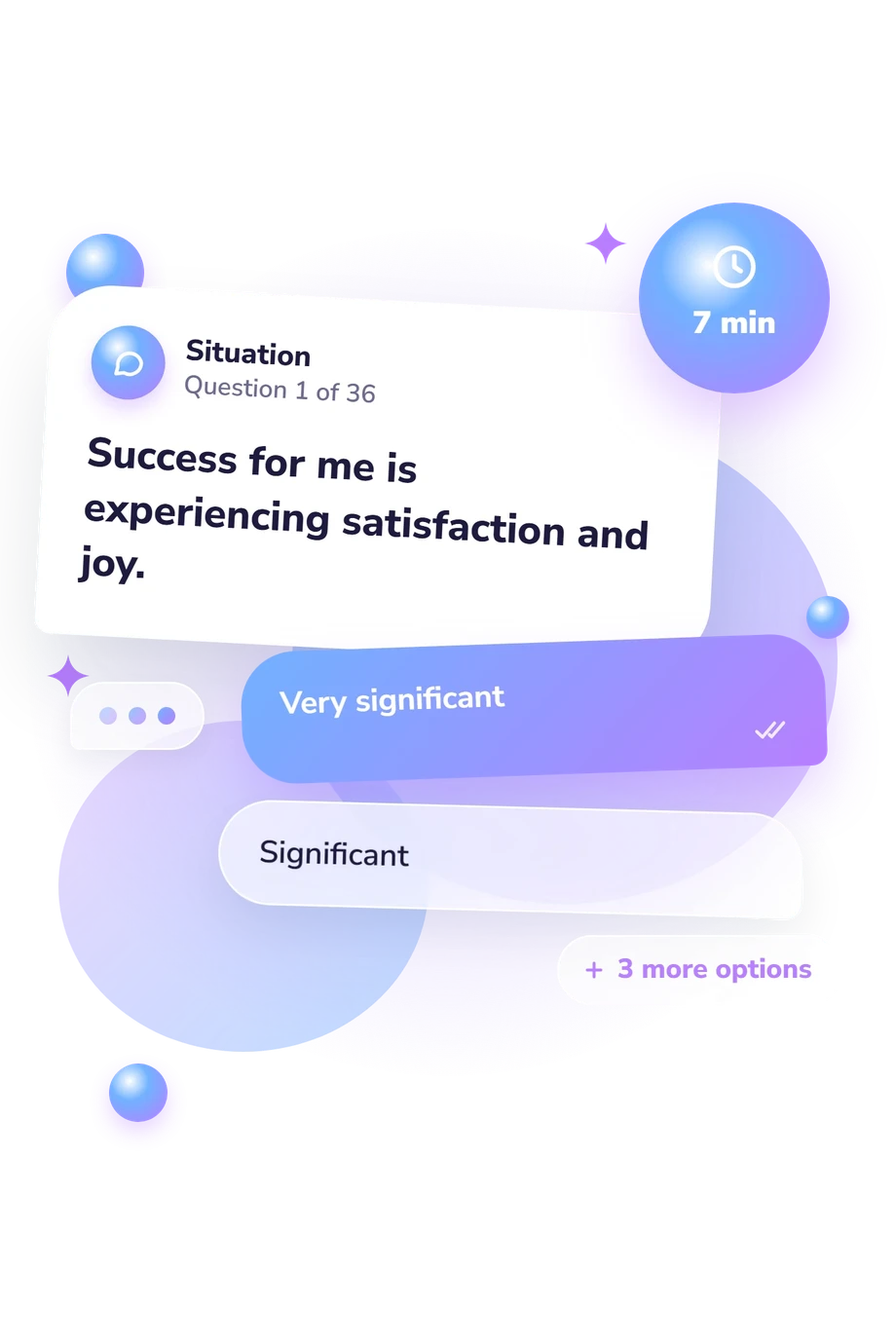
You are asked to rate 36 highlighted meanings of the concept “Success for me is…” in key areas of your life, reflecting the meaning of achievements and successful outcomes in a person’s behavior and activities. Please read all statements about success carefully and consider each in terms of its subjective usefulness, social significance, and desirability. Rate each statement using the response scale provided.
    • Very significant
    • Significant
    • Rather significant
    • Rather not significant
    • Not significant
    • Very significant
    • Significant
    • Rather significant
    • Rather insignificant
    • Insignificant
    • Very significant
    • Significant
    • Rather significant
    • Rather not significant
    • Not significant
WHAT THE TEST MEASURES
About This Assessment
Motivation for Academic Success Among University Students Test

University Students' Achievement Motivation Scale Test - Symptoms and Signs

achieving success
motivation

This measure is designed to assess achievement-related motivation in college or university settings. The University Students' Achievement Motivation Scale is intended to help characterize the relative importance of academic outcomes, career-oriented goals, self-evaluative satisfaction, and social recognition as drivers of student effort. It is commonly used to support motivational profiling in educational or counseling contexts.

The instrument includes 36 items and typically takes about 7 minutes to complete. Response patterns may be interpreted to describe an individual’s achievement motivation profile and to inform case formulation, goal setting, or intervention planning. The University Students' Achievement Motivation Scale is attributed to John W. Atkinson and David C. McClelland.

Author: David C. McClelland, John W. Atkinson
Literature: Elliot, A. J., & McGregor, H. A. A 2×2 achievement goal framework. Journal of Personality and Social Psychology. 2001.
Popular tests
Comments
Leave a Comment