
Children's Depression Inventory (CDI) Test
How the Scales are Structured
Who Usually Takes This Test?
See How You Compare
Below is a preview of how scores are typically distributed across each scale.
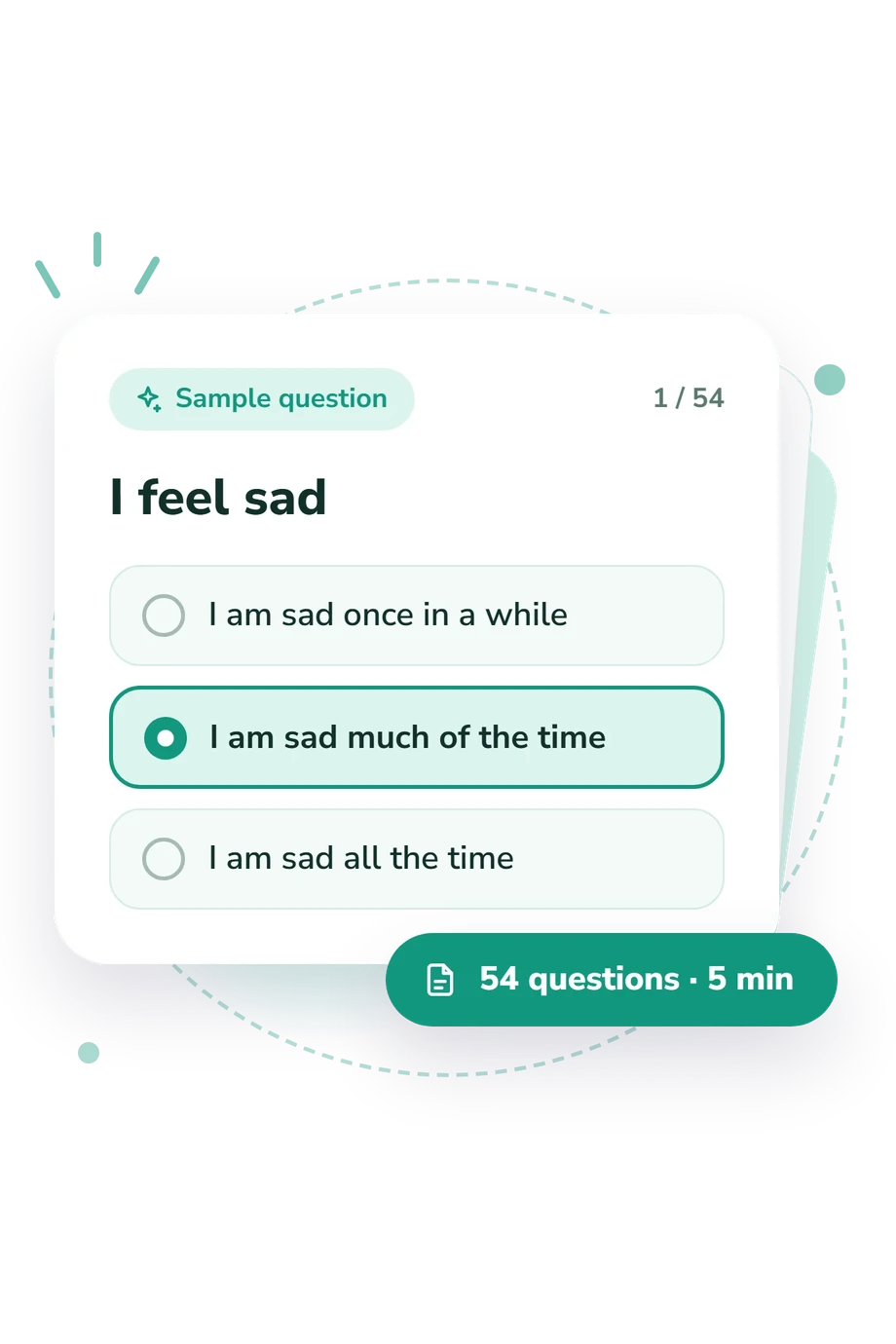
Example Questions From the Test
- I am sad once in a while.
- I am sad many times.
- I am sad all the time.
- I never feel that I can do things successfully.
- I rarely feel confident that I can do things successfully.
- I feel that I do things well.
- I do almost everything well.
- I do many things wrong.
- I do everything wrong.
Children's Depression Inventory (CDI) Test - Description and methodology of the test
Parents, caregivers, and young people who want a clearer picture of persistent sadness or related difficulties can use the Children's Depression Inventory (CDI) Test as a structured self-report exercise. This children's depression questionnaire offers a practical starting point for discussing emotional changes and deciding which profile areas may need attention.
What This Assessment Explores
Items cover mood, self-worth, pleasure, schoolwork, friendships, loneliness, and mistakes. This child depression test groups responses into an elevated profile. The scales are:
- Negative Self-Esteem (30-100) measures negative self-attitudes, low self-esteem, possible suicidal ideation; Low 30-39, Moderate 40-55, High 56-100. High scores warrant clinical attention.
- Anhedonia (0-100) measures reduced pleasure, loneliness, fatigue; Low 0-33, Moderate 34-66, High 67-100.
- Ineffectiveness (0-100) measures inadequacy, limited school success; Low 0-33, Moderate 34-66, High 67-100.
- Interpersonal Problems (0-100) measures social difficulty, negativism, aggression; Low 0-33, Moderate 34-66, High 67-100.
- Negative Mood (0-100) measures low mood, anxiety, adverse-event expectations; Low 0-33, Moderate 34-66, High 67-100.
- Overall Depression Index (30-100) reflects depressive symptoms across scales; Low/typical 30-55, Elevated 56-70, High 71-100.
Methodology and Scientific Basis
Items use brief graded statements, and the respondent selects the option that best fits. The questionnaire combines those responses into domain scores and an overall index. The questionnaire does not specify a point value for each response, so results should be interpreted through the displayed bands rather than an assumed scoring formula.
The reference framework is Children's Depression Inventory (Kovacs, 1985), with the CDI manual providing administration and interpretation guidance. Smucker and colleagues (1986) reported norms and reliability findings for the published CDI. The published CDI is administered as a self-report measure, with norms used to interpret T-scores by age. The cited manual and studies describe the published CDI, including its norms and reliability; they do not establish independent standardization or validation for this online presentation.
Interpretation is strongest when the overall pattern and individual areas are considered together; the overall index uses T-scores relative to age norms. Results can shift with current context and depend on honest, developmentally appropriate self-report. Because this CDI assessment is not a substitute for broader clinical assessment, an elevated profile should be discussed with a qualified professional, especially when self-worth concerns or possible suicidal thoughts are present.
- Kovacs, M. (1985). The Children's Depression Inventory (CDI). Psychopharmacology Bulletin, 21(4), 995-998.
- Kovacs, M. (1992). Children's Depression Inventory manual. North Tonawanda, NY: Multi-Health Systems.
- Smucker, M. R., Craighead, W. E., Craighead, L. W., & Green, B. J. (1986). Normative and reliability data for the Children's Depression Inventory. Journal of Abnormal Child Psychology, 14(1), 25-39. 10.1007/BF00917219
Updated: