
Assertiveness Questionnaire Test
How the Scales are Structured
Who Usually Takes This Test?
See How You Compare
Below is a preview of how scores are typically distributed across each scale.
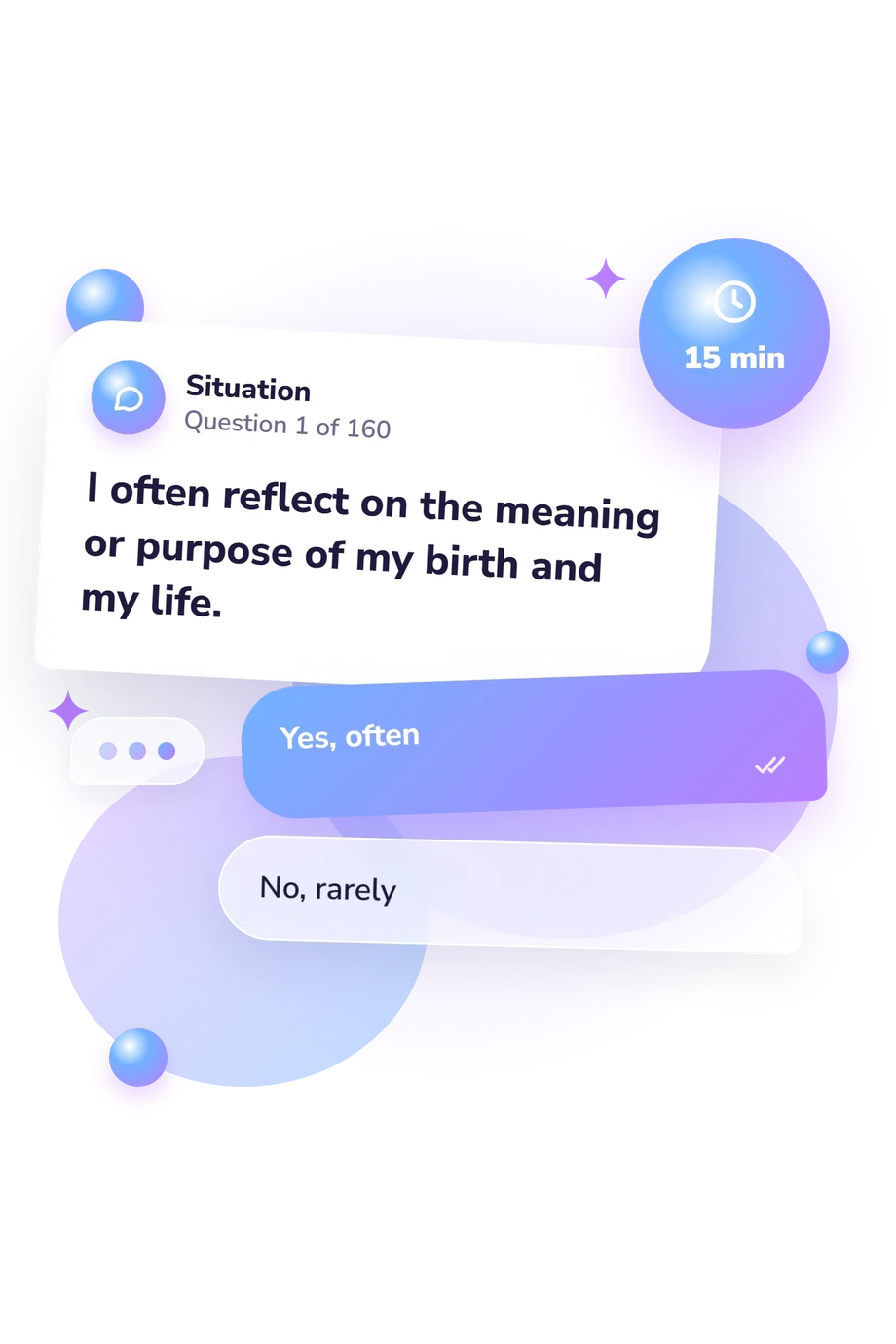
Example Questions From the Test
- Yes, often
- No, rarely
- Yes, it does
- No, it does not
- Yes, I feel that way
- No, I do not feel that way
Assertiveness Questionnaire Test - Description and methodology of the test
People who want to understand how they speak up, set limits, or respond under social pressure may find the Assertiveness Questionnaire Test useful. It is intended for self-reflection on everyday interpersonal behavior, especially when needs, disagreement, responsibility, or emotional pressure make communication difficult. It can help organize reflection on handling social pressure and on the situations that make communication difficult.
What This Assessment Explores
Assertiveness here refers to expressing thoughts and feelings confidently, standing up for personal rights, and doing so without violating another person’s rights. The items address expressing personal needs, calm disagreement, saying no, admitting limits, resisting pressure, self-evaluation, empathy, negotiation, criticism, emotional intensity, and fear of seeming different.
The questionnaire gives an overall indication of how consistently these behaviors appear in the respondent’s self-description. It can show whether confidence remains available during conflict, social evaluation, or strong emotion.
The result reports one overall Assertiveness Scale (0-80). The displayed result bands are:
- Low assertiveness (0-31) indicates a lower reported tendency to express needs and defend rights confidently.
- Moderate assertiveness (32-63) reflects intermittent assertiveness and uneven confidence across situations.
- High assertiveness (64-80) indicates stronger reported self-respect and more effective interpersonal interaction.
Methodology and Scientific Basis
Items use paired yes/no responses or short alternatives, asking the respondent to select the statement closest to personal experience. This structured self-report captures reported attitudes and reactions rather than observed conduct or an interview judgment.
The questionnaire reports one overall scale, with higher displayed scores indicating stronger assertiveness under the stated definition. Because individual point assignments are not specified, no answer-level scoring rule should be inferred. The score is most useful for noticing patterns in responding to disagreement and across situations rather than treating one number as a fixed trait.
Khokhlov and Portnova (2019) discuss passive, aggressive, and assertive behavior, and this questionnaire’s treatment of those patterns is conceptually consistent with their model. Rathus (1973) represents a formal self-report approach to assertive behavior, while Capponi and Novak (1992) and Smith (1975) describe practical assertive-living and systematic assertive-therapy frameworks.
Interpretation requires context. Current mood, self-awareness, social desirability, and recent interpersonal experiences can shape answers. Interpret the score within the displayed result bands and alongside the respondent’s broader context; it is not a diagnosis.
- Khokhlov, A. A., & Portnova, A. G. (2019). Assertive Person: Ascending to Oneself: Essays on the Psychology of Passive, Aggressive, and Assertive Behavior. Yekaterinburg: Izdatelskiye Resheniya. ISBN 978-5-4496-9188-0.
- Rathus, S. A. (1973). A 30-item schedule for assessing assertive behavior. Behavior Therapy, 4(3), 398-406. 10.1016/S0005-7894(73)80120-0.
- Capponi, V., & Novak, T. (1992). How to Assert Yourself: Assertive Living. Prague: Svoboda-Libertas. ISBN 80-205-0240-8.
- Smith, Manuel J. (1975). When I Say No, I Feel Guilty: How to Cope Using the Skills of Systematic Assertive Therapy. New York: Bantam Books.
Updated: