
Assessment of Professional-Psychological Personality Type Test
How the Scales are Structured
Who Usually Takes This Test?
See How You Compare
Below is a preview of how scores are typically distributed across each scale.
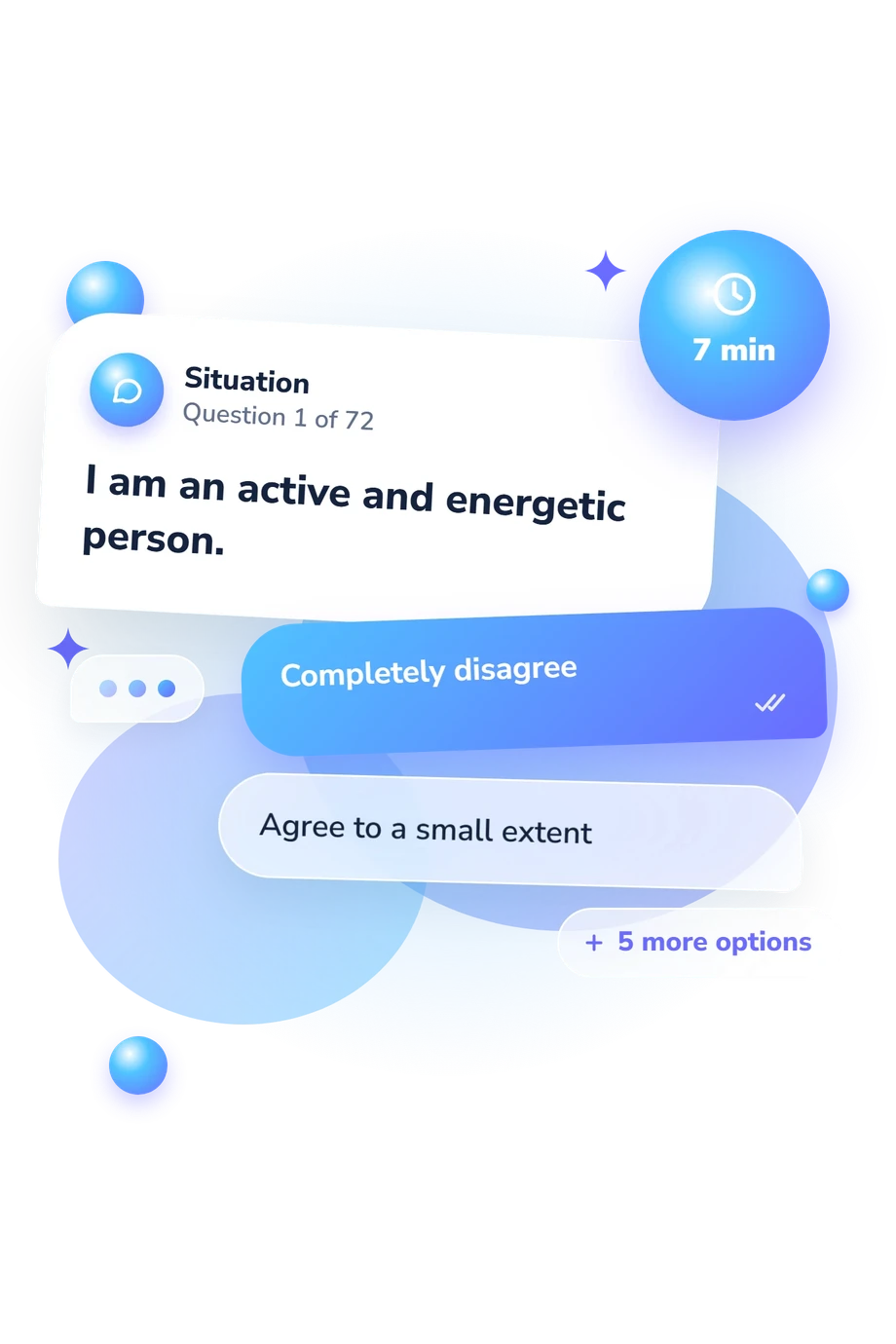
Example Questions From the Test
- Completely disagree
- Agree to a small extent
- Agree almost halfway
- Agree halfway
- Agree more than halfway
- Agree almost completely
- Completely agree
- Strongly disagree
- Agree to a small extent
- Agree slightly
- Agree somewhat
- Agree more than somewhat
- Agree almost completely
- Strongly agree
- Completely disagree
- Agree to a small extent
- Agree almost halfway
- Agree halfway
- Agree more than halfway
- Agree almost completely
- Agree completely
Assessment of Professional-Psychological Personality Type Test - Description and methodology of the test
For people deciding how they prefer to contribute at work, this professional personality assessment examines ways of generating ideas, collaborating, leading, and carrying out assigned duties. The Assessment of Professional-Psychological Personality Type Test is intended for readers weighing whether their natural approach fits a role, team, or work setting. Its result offers language for comparing preferred responsibilities and recognizing where a different contribution style may require deliberate effort.
What This Assessment Explores
Taken as a professional personality type test, this questionnaire presents a profile of work-related preferences, not a permanent identity. Items address initiative, originality, sociability, emotional influence, responsibility, compliance, delegation, analysis, and task monitoring. The result indicates which tendencies are more prominent in the respondent’s professional style.
The four displayed dimensions are:
- Generator (1-10) reflects creativity, intuition, innovation, future-oriented activity, autonomy, and routine detachment: Practical & routine-focused 1-5, Balanced innovator 6-8, and Strong idea generator 9-10.
- Communicator (1-10) reflects sociability, emotional influence, emotional-centre seeking, manipulation, and avoiding difficulties: Reserved 1-5, Balanced 6-7, and Highly Expressive 8-10.
- Executor (1-10) reflects disciplined, compliant task execution, submissiveness, responsibility avoidance, and supervisor support or patronage: Independent stance 1-5, Balanced performer 6-8, and Highly compliant performer 9-10.
- Leader (1-10) reflects dominance, responsibility, decision-making, delegation, analytical management, and task monitoring: Low 1-5, Moderate 6-8, and High 9-10.
Methodology and Scientific Basis
Each statement uses a seven-point agreement response, from strong disagreement to strong agreement. First-person items address activity, communication, responsibility, help-seeking, pressure, creativity, and leadership, asking respondents to judge recurring tendencies rather than choose a job title.
Responses form four displayed dimensions with descriptive bands. The questionnaire does not state a per-answer conversion formula, so the output should be read as a profile summary rather than a scoring rule reconstructed from response options.
The evidence base is the Vocational and Psychological Type Method (Dukhnovsky, 2020), a published approach linking vocational preferences with psychological types. The questionnaire is conceptually consistent with that method and with the broader psychodiagnostic context in Dukhnovsky’s textbook, but it is not presented as a direct adaptation or restandardized clinical instrument; as an online self-report, this psychological personality type test is best understood as a structured profile.
Results can shift with mood, current workplace demands, self-presentation, and self-awareness. Because stated population norms and diagnostic thresholds are absent, the bands describe tendencies within this questionnaire rather than determining professional suitability or a person’s complete behavior.
- Dukhnovsky, Sergey Vitalievich. "Career Preferences and Vocational and Psychological Types of University Students." Izvestiya of Saratov University. Philosophy. Psychology. Pedagogy, vol. 20, no. 1, 2020, pp. 69-75. 10.18500/1819-7671-2020-20-1-69-75
- Dukhnovsky, Sergey Vitalievich. Psychodiagnostics: Textbook and Practical Course for Universities. Moscow: Yurait Publishing, 2020, 353 pp. ISBN 978-5-534-13881-8.
Updated: