
Migrant Child Social Skills Assessment Test
How the Scales are Structured
Who Usually Takes This Test?
See How You Compare
Below is a preview of how scores are typically distributed across each scale.
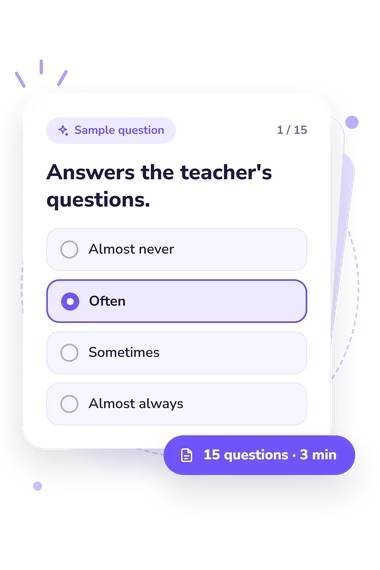
Example Questions From the Test
- Almost never
- Often
- Sometimes
- Almost always
- Almost never
- Often
- Sometimes
- Almost always
- Almost never
- Often
- Sometimes
- Almost always
Migrant Child Social Skills Assessment Test - Description and methodology of the test
Adults supporting a child who is adjusting to a new school environment can use this structured questionnaire to review social skills in school, including communication, participation, and classroom conduct. It is designed for observations gathered across ordinary school situations, not for judging a single difficult day. The Migrant Child Social Skills Assessment Test organizes those observations into practical areas that can guide discussion between families and educators.
What This Assessment Explores
The questionnaire examines recurring social and behavioral demands in school. It suits an adult who knows the child’s everyday behavior, such as a parent, teacher, or support professional. The result distinguishes adult communication, peer relationships, and classroom adjustment.
The three result scales are:
- Interaction With Adults at School (0-9) measures the child’s ability to initiate and maintain constructive relationships with teachers and other school adults, including communication and trust; Needs support is 0-3, Developing 4-6, and Strong 7-9.
- Peer Interaction (0-18) measures social integration, cooperation, conversation, and relationship-building; Needs support is 0-6, Developing 7-12, and Strong 13-18.
- Behavior in the Classroom Setting (0-18) measures adaptation, rule-following, and independence; Needs support is 0-6, Developing 7-12, and Well-adapted 13-18.
This assessment of migrant child social skills can show which area may deserve closer support.
Methodology and Evidence Base
Each item asks how often the child displays a behavior, using four frequency choices from almost never or hardly ever to almost always, with intermediate options sometimes and often. The content covers adult communication, rule-following, independent work, homework, cooperation, conversation, group participation, help-seeking, respectful refusal, and non-aggressive anger expression.
After the frequency responses are recorded, the questionnaire reports a migrant child social skills profile for each domain against its displayed range and band. These labels are the questionnaire’s displayed support categories. No standardization or population norming is established for this online scoring system.
The school social-skills content is conceptually consistent with Sargent’s 1991 framework for systematic instruction in school and community, but this online questionnaire is not presented as an adaptation of that work. Khukhlaev, Chibisova, and Tkachenko’s 2022 framework is likewise conceptually relevant to this questionnaire’s attention to school social functioning, well-being, and cultural adaptation; the questionnaire’s focus remains observable school behavior rather than acculturation itself. Observer perspective, current context, language, cultural expectations, and limited observations can shift ratings, so results identify discussion topics rather than establish a diagnosis.
- Sargent, Laurence R. Social Skills for School and Community: Systematic Instruction for Children and Youth with Cognitive Delays. Reston, VA: Council for Exceptional Children, Division on Mental Retardation, 1991.
- Khukhlaev, O. E., Chibisova, M. Yu., and Tkachenko, N. V. Program for Assessing the Special Educational Needs of Foreign Citizen Children in the Areas of Psychological Well-Being, Social Skills, and Cultural Adaptation. Moscow: Moscow State University of Psychology and Education, 2022.
- Berry, John W. Immigration, Acculturation, and Adaptation. Applied Psychology: An International Review 46, no. 1 (1997): 5-34. 10.1111/j.1464-0597.1997.tb01087.x