
Freudly+971 508685814hello@freudly.ai
Freudly
eating behavior

Health Behavior Disorders Questionnaire Test
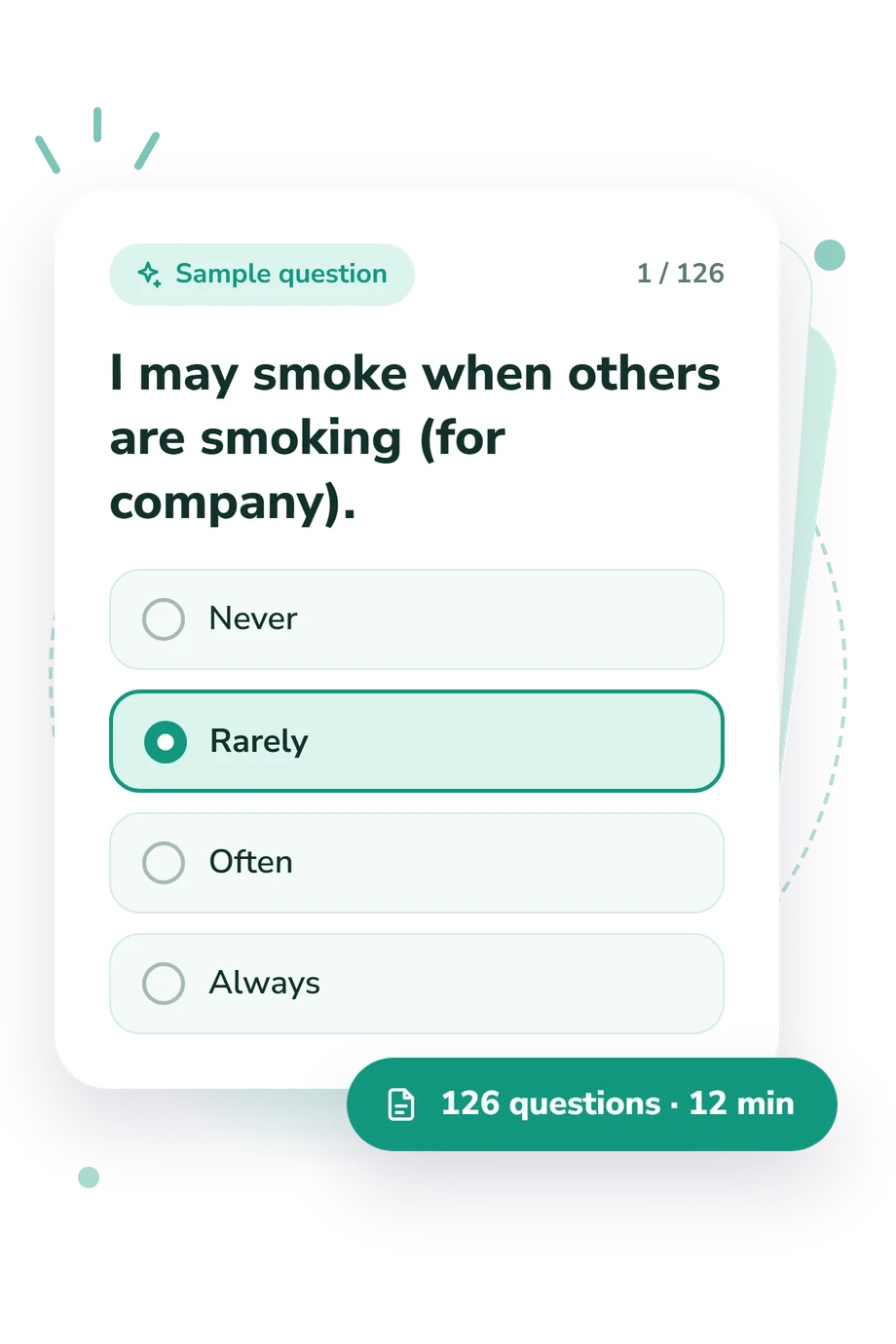
Take the online Health Behavior Disorders Questionnaire Test - AI psychologist FreudlyYou can take Health Behavior Disorders Questionnaire Testhere. Online version of a simple and accurate psychological test with interpretation.en
In 12 minutes, see where unhealthy habits and risky choices may be undermining your health. Get a clear, actionable profile across key areas in just 63 questions.
Start Online Test
Questions: 6312 minutes
08:30
October 2, 2025
October 2, 2025
Material has been updated
October 2, 2025
Material has been published
28,622 views
1,850 completions
1,576 likes
Verified by Daniel Hall
Psychologist with 25 years of experience
Share
Scale Explorer

How the Scales are Structured

example score
13/28
Low Self-Control (LSC)
Measures how well a person can regulate impulses and resist behaviors that may negatively affect health.
Adequate self-control
Low self-control
720: Adequate self-control | 2128: Low self-control
A score of 13 falls in the Adequate self-control range, suggesting generally sufficient ability to manage impulses related to health-affecting behaviors.
example score
29/36
Pursuit of a Fashionable Image (PoaFI)
Measures how strongly a person prioritizes following fashion and appearance standards even when it may conflict with health-supportive choices.
Low
High
924: Low | 2536: High
A score of 29 falls in the High range, suggesting a pronounced focus on maintaining a trendy image that may sometimes outweigh health considerations.
example score
9/16
Self-Destructive Behavior (SDB)
Measures the tendency toward knowingly health- and life-threatening actions such as drug use and unprotected sexual activity.
Low
Moderate
High
46: Low | 79: Moderate | 1016: High
A score of 9 falls in the Moderate range, suggesting an occasional inclination toward self-destructive behavior patterns without a strongly pronounced tendency.
example score
11/24
Emotional Incompetence (EI)
Assesses difficulties with emotional regulation and stress coping that can contribute to unhealthy behavior patterns.
Adequate emotional coping
Emotional coping difficulties
616: Adequate emotional coping | 1724: Emotional coping difficulties
A score of 11 falls in the Adequate emotional coping range, suggesting generally effective emotion management and stress responses with fewer signs of emotional incompetence.
example score
33/36
Alcohol Craving (AC)
Assesses the intensity of craving for alcohol as a health-harming behavioral tendency.
Low
High
922: Low | 2336: High
A score of 33 falls in the High range, indicating a pronounced inclination toward alcohol use as a risky health-related behavior.
example score
24/48
Neglect of Safety (NoS)
Measures how often a person tends to ignore safety rules and precautions, increasing exposure to avoidable risks.
Low
High
1228: Low | 2948: High
A score of 24 falls in the Low range, suggesting safety rules and precautions are generally followed with only occasional lapses.
example score
24/28
Disordered Eating (DE)
Measures the tendency toward eating behaviors that may harm health, such as overeating, unbalanced nutrition, and reduced control over food intake.
Low
High
720: Low | 2128: High
A score of 24 falls in the High range, suggesting pronounced difficulties with regulating eating behavior and maintaining balanced nutrition.
example score
23/36
Craving to Smoke (CtS)
Assesses the intensity of craving to smoke as a health-harming behavioral tendency.
Low craving
High craving
922: Low craving | 2336: High craving
A score of 23 falls in the High craving range, suggesting a pronounced urge to smoke or a stable smoking habit tendency.
example score
151/252
Overall Propensity Toward Unhealthy Health Behavior (OPTUHB)
Measures the overall tendency to engage in behaviors that deviate from healthy lifestyle principles and neglect bodily signals.
Low tendency
Moderate tendency
High tendency
63104: Low tendency | 105144: Moderate tendency | 145252: High tendency
A score of 151 falls in the High tendency range, suggesting a pronounced inclination to disregard health-related cues and engage in health-damaging habits.
Start Online Test
just completed the test
DATA-BASED USER COHORTS

Who Usually Takes This Test?

People worried about habits
41%OF USERS
They suspect alcohol, smoking, overeating, poor self-control, or risky routines are affecting their health and want a quick reality check.
Students and young adults
34%OF USERS
They take it to understand impulsive choices, peer pressure, and trend-driven behaviors that may lead to unsafe or self-destructive patterns.
Clients in counseling or clinics
25%OF USERS
They complete it during prevention, counseling, or treatment to pinpoint which specific risky behaviors need targeted support.
BASED ON AGGREGATED, ANONYMIZED DATA FROM TENS OF THOUSANDS OF FREUDLY USERS.
Benchmarking

See How You Compare

Once you complete the test, your results are compared with real-world data from people in your country.
Below is a preview of how scores are typically distributed across each scale.
Low Self-Control (LS)
Average
20.3
Normal range
16.324.2
min.
7
max.
28
This curve shows how scores are typically distributed.
Once you complete the test, your result will appear on the scale so you can see how you compare.
Chasing the Trendy Image (CtTI)
Average
26.2
Normal range
21.231.2
min.
9
max.
36
This curve shows how scores are typically distributed.
Once you complete the test, your result will appear on the scale so you can see how you compare.
Self-Destructive Behavior (SB)
Average
10
Normal range
8.111.8
min.
4
max.
16
This curve shows how scores are typically distributed.
Once you complete the test, your result will appear on the scale so you can see how you compare.
Emotional Incompetence (EI)
Average
17.1
Normal range
13.720.4
min.
6
max.
24
This curve shows how scores are typically distributed.
Once you complete the test, your result will appear on the scale so you can see how you compare.
Craving for alcohol (Cfa)
Average
18.9
Normal range
14.523.2
min.
9
max.
36
This curve shows how scores are typically distributed.
Once you complete the test, your result will appear on the scale so you can see how you compare.
Neglecting Safety (NS)
Average
27.9
Normal range
21.634.3
min.
12
max.
48
This curve shows how scores are typically distributed.
Once you complete the test, your result will appear on the scale so you can see how you compare.
Eating Disorders (ED)
Average
13.2
Normal range
9.616.7
min.
7
max.
28
This curve shows how scores are typically distributed.
Once you complete the test, your result will appear on the scale so you can see how you compare.
Craving for smoking (Cfs)
Average
22.2
Normal range
18.925.5
min.
9
max.
36
This curve shows how scores are typically distributed.
Once you complete the test, your result will appear on the scale so you can see how you compare.
General tendency to deviate from healthy behavior (Gttdfhb)
Average
158.5
Normal range
122.9194.2
min.
63
max.
252
This curve shows how scores are typically distributed.
Once you complete the test, your result will appear on the scale so you can see how you compare.
Featured On
SAMPLE QUESTIONS

Example Questions From the Test

    • Never
    • Rarely
    • Often
    • Always
    • Never
    • Rarely
    • Often
    • Always
    • Never
    • Rarely
    • Often
    • Always
WHAT THE TEST MEASURES
About This Assessment
Questionnaire on Unhealthy Behavior Test

Health Behavior Disorders Questionnaire Test - Symptoms and Signs

eating behavior
self-regulation
health
healthy lifestyle

In clinical and counseling settings, the Health Behavior Disorders Questionnaire is used to screen for patterns of health-compromising and risk-related behaviors. It is a self-report measure intended to support initial case conceptualization and identify domains that may warrant further assessment.

The instrument includes 63 items and typically takes about 12 minutes to complete. Items are rated as statements and can be summarized to provide a profile of behavioral tendencies across relevant areas (e.g., substance-related urges, eating-related difficulties, safety nonadherence, self-control problems, emotion regulation difficulties, and self-destructive patterns).

Results from the Health Behavior Disorders Questionnaire are best interpreted in conjunction with clinical interview data and other sources of information, rather than as a standalone diagnostic indicator. The measure is attributed to James O. Prochaska and Carlo C. DiClemente.

Author: Carlo C. DiClemente, James O. Prochaska
Literature: Prochaska, J. O., & DiClemente, C. C. Stages and processes of self-change of smoking: Toward an integrative model of change. Journal of Consulting and Clinical Psychology. 1983.
Popular tests
Comments
Leave a Comment