
Eating Behavior Questionnaire (EEV) Test

Understand what drives eating habits in just 6 minutes, including emotional, external, and self-control patterns. Fast, research-backed insight for screening, treatment planning, and progress tracking.
Start Online Test
Questions306 minutes
Hi! My name is Freudly, i am an AI therapist, I will give you an interpretation of the test after you complete it.
08:30
October 2, 2025
October 2, 2025
Material has been updated
27,967 views
3,429 completions
2,757 likes
Verified by Daniel Hall
Psychologist with 25 years of experience
Share
Scale Explorer

How the Scales are Structured

example score
7/10
Dietary Restraint (DR)
Measures the degree of deliberate control and self-limitation of eating to manage weight or dietary goals.
Low restriction
Moderate restriction
High restriction
03Low restriction46Moderate restriction710High restriction
A score of 7 indicates a high level of conscious dietary control and intentional limitation of food intake.
example score
5/10
Emotional Eating (EE) (EE)
Measures the tendency to eat in response to negative emotions rather than physical hunger.
Low emotional eating
Moderate emotional eating
High emotional eating
03Low emotional eating46Moderate emotional eating710High emotional eating
A score of 5 indicates a moderate tendency to use food to cope with negative emotions in some situations.
example score
4/10
External Eating (EE)
Measures how strongly eating is triggered by external cues like the sight or smell of food rather than internal hunger signals.
Low cue-reactivity
Moderate cue-reactivity
High cue-reactivity
03Low cue-reactivity46Moderate cue-reactivity710High cue-reactivity
A score of 4 suggests a moderate tendency to eat in response to environmental food cues, with external triggers sometimes influencing intake alongside hunger.
Start Online Test
just completed the test
DATA-BASED USER COHORTS

Who Usually Takes This Test?

Emotional eaters under stress
41%OF USERS
People who notice they eat more when anxious, sad, tired, or overwhelmed and want to understand the emotional triggers behind it.
Dieters seeking control
34%OF USERS
People who often restrict food, count rules in their head, or feel guilty after eating and want to see how restraint shapes their habits.
Externally triggered snackers
25%OF USERS
People who find it hard to resist food when they see, smell, or are offered it and want to measure how much cues drive their eating.
BASED ON AGGREGATED, ANONYMIZED DATA FROM TENS OF THOUSANDS OF FREUDLY USERS.
RESULTS YOU CAN ACTUALLY USE

What You’ll See After You Finish the Test

Scale Results
— Explained Clearly
Your scores across each test scale, translated into plain, usable insights. Not just numbers, but what they actually mean for your daily life, emotional state, and overall well-being.
AI-Powered
Interpretation
A structured, clinically grounded explanation. Our AI analyzes patterns and relationships between scales to provide a coherent interpretation — without alarmist language.
Statistical
Comparison
See how you compare to others. Your scores are placed in a statistical context, showing percentiles and trends based on anonymized platform data to help you understand what`s typical.
Practical
Recommendations
Actionable guidance tailored to your profile. Receive clear, realistic suggestions you can apply immediately — focused on coping, self-regulation, and realistic next steps.
AI-Detected
Insights
Key patterns you might not notice on your own. Surfacing subtle connections in your responses that help you better understand what may be driving your current results.
Discuss with
an AI Psychologist
Clarify, reflect, and explore right away. Talk through your outcomes, ask questions, and explore meanings in a calm, non-diagnostic dialogue environment.
Start Online Test
Used in 52+ countries
Benchmarking

See How You Compare

Once you finish the test, your results will be compared with real-world data from people in your country.
Below is a preview of the benchmarks we use to place your score in context.
Food Restriction (FR) (FR()
Average
2.9
Normal range
1.24.6
min.
0
max.
10
majority
This curve shows how scores are typically distributed.
Once you complete the test, your result will appear here so you can see where you land.
Emotional Conditioning (EC) (EC()
Average
4.9
Normal range
3.56.2
min.
0
max.
10
majority
This curve shows how scores are typically distributed.
Once you complete the test, your result will appear here so you can see where you land.
External Conditioning (EC) (EC()
Average
5.7
Normal range
4.46.9
min.
0
max.
10
majority
This curve shows how scores are typically distributed.
Once you complete the test, your result will appear here so you can see where you land.
Featured On
CLEAR ANSWERS TO COMMON QUESTIONS

Frequently Asked Questions

What does this questionnaire measure?
It measures three patterns of eating behavior: eating in response to external cues, eating in response to emotions, and intentional restriction of intake.
How long does it take to complete?
Estimated completion time is about 6 minutes.
How many items are included?
It includes 30 statements rated by the respondent.
How should responses be given?
Each statement should be answered based on typical behavior rather than a single recent day. Responses should reflect what is usually true.
How are results used?
Scores summarize the strength of each eating pattern. Results support screening, treatment planning, and progress monitoring when interpreted by a qualified professional.
WHAT THE TEST MEASURES
About This Assessment
Eating Behavior Questionnaire, EEV Test

Eating Behavior Questionnaire (EEV) Test - Symptoms and Signs
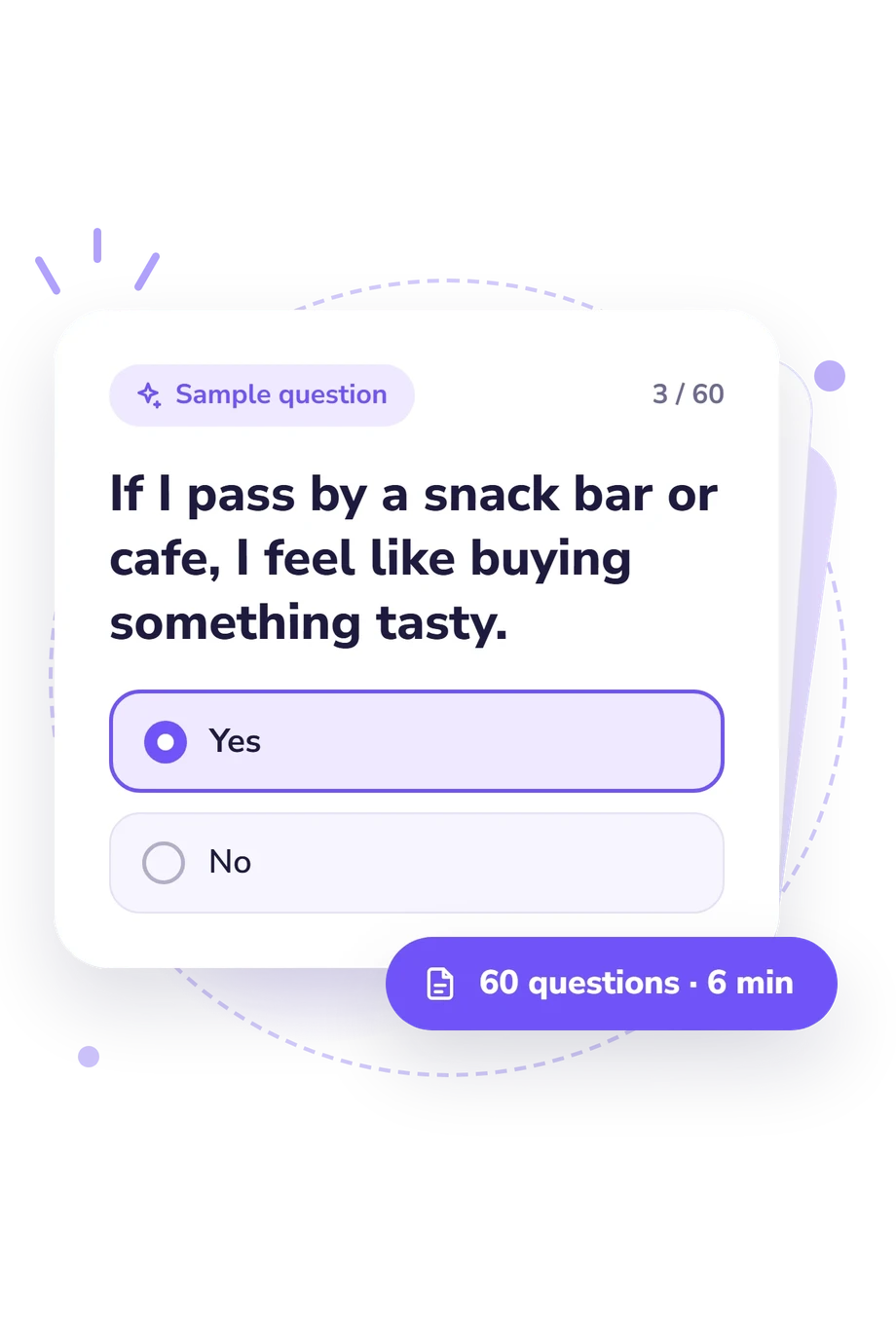
This self-report measure is used to characterize patterns of eating-related behavior and the situational or emotional factors that may influence food intake. The Eating Behavior Questionnaire (EEV) provides a brief screening of common behavioral tendencies relevant to clinical formulation and treatment planning.

Developed by Grunert, S., it consists of 30 items and typically takes about 6 minutes to complete. Item content addresses eating in response to external cues (e.g., sight or smell of food), eating in response to emotional states or stress, and deliberate dietary restraint.

Scores from the Eating Behavior Questionnaire (EEV) can support case conceptualization, guide clinical interviewing, and be used to monitor change over time when repeated alongside other assessment data. Interpretation should be integrated with clinical history, current symptoms, and relevant medical or nutritional information.

Author: Grunert, S.
Literature: Fairburn, C. G. Cognitive behavior therapy and eating disorders. Guilford Press. 2008.; Grunert, S. C. Ein Inventar zur Erhebung von Selbstaussagen zum Ernahrungsverhalten. Diagnostica. 1989.
Test Question Form
You Might Also Like
Dutch Eating Behavior Questionnaire (DEBQ)
This self-report measure assesses patterns of eating behavior relevant to c…
Start Test
Eating Disorder Examination Questionnaire – Short Form (EDE-QS)
When a brief self-report screen is needed to evaluate eating-related concer…
Start Test
Behavior Control Questionnaire
This measure assesses perceived self-regulation and behavioral management a…
Start Test
Popular tests
Narcissistic Personality Inventory (NPI)
This self-report measure is used to assess narcissism as a personality trai…
Start Test
Yale-Brown Obsessive Compulsive Scale (Y-BOCS)
This measure is used to rapidly quantify the current severity of obsessive…
Start Test
CRAFFT Screening Test (CRAFFT 2.1)
This brief screening measure is designed to identify potential alcohol and…
Start Test
Patient Health Questionnaire-9 (PHQ-9)
This measure is commonly used to quickly screen for the presence and severi…
Start Test
Maslach Burnout Inventory (MBI)
This self-report measure is used to assess occupational burnout symptoms in…
Start Test
Adolescent Anxiety Questionnaire
This measure is designed to support a brief appraisal of anxiety symptoms a…
Start Test
Emotional Creativity Inventory (ECI)
This self-report measure assesses individual differences in the originality…
Start Test
Horne–Ostberg Morningness–Eveningness Questionnaire (MEQ)
Circadian preferences influence typical patterns of alertness and sleep tim…
Start Test
Ambivalent Sexism Inventory (ASI)
This measure is designed to assess attitudes toward women, including both o…
Start Test
Internalized Misogyny Scale (IMS)
This measure is designed to assess internalized negative beliefs and stereo…
Start Test
Perceived Stress Scale (PSS-10)
This self-report measure assesses the degree to which individuals appraise…
Start Test
Impulsive Behavior Scale (SUPPS-P)
Impulsivity is a multidimensional construct that is often assessed with bri…
Start Test
Clinical Institute Withdrawal Assessment for Alcohol, Revised (CIWA-Ar)
This rating scale is used to rapidly assess the severity of alcohol withdra…
Start Test
Positive and Negative Affect Schedule (PANAS)
This measure provides a brief self-report assessment of current or typical…
Start Test
Light Triad Scale (LTS)
This self-report measure assesses prosocial personality tendencies and orie…
Start Test
Suicidal Ideation Scale
In clinical settings, the Suicidal Ideation Scale is used to structure an i…
Start Test
Body Dysmorphic Disorder Scale (BDD-D)
This brief self-report measure is designed to screen for and quantify distr…
Start Test
Beck Anxiety Inventory (BAI)
This measure is a brief self-report inventory used to screen for anxiety sy…
Start Test
Differential Test of Perfectionism
This instrument is used to screen for perfectionism-related attitudes and t…
Start Test
Locus of Control Scale
This measure assesses generalized expectancies regarding the degree to whic…
Start Test
New Apathy Scale
This brief self-report measure is used to screen for apathy-related symptom…
Start Test
Perth Alexithymia Questionnaire (PAQ)
This measure assesses individual differences in alexithymia, including diff…
Start Test
Social Intelligence Scale
This brief self-report measure is designed to support rapid screening of in…
Start Test
Fear Test
This measure is designed to evaluate individual differences in fear-related…
Start Test
Neuroticism Level Scale
The measure is intended for brief screening of an individual’s propensity t…
Start Test
Aggressiveness Indicators Screening Questionnaire
This screening tool is designed to quickly identify behavioral indicators a…
Start Test
Comments
Leave a Comment