
Brief Debt Behavior Questionnaire Test
How the Scales are Structured
Who Usually Takes This Test?
See How You Compare
Below is a preview of how scores are typically distributed across each scale.
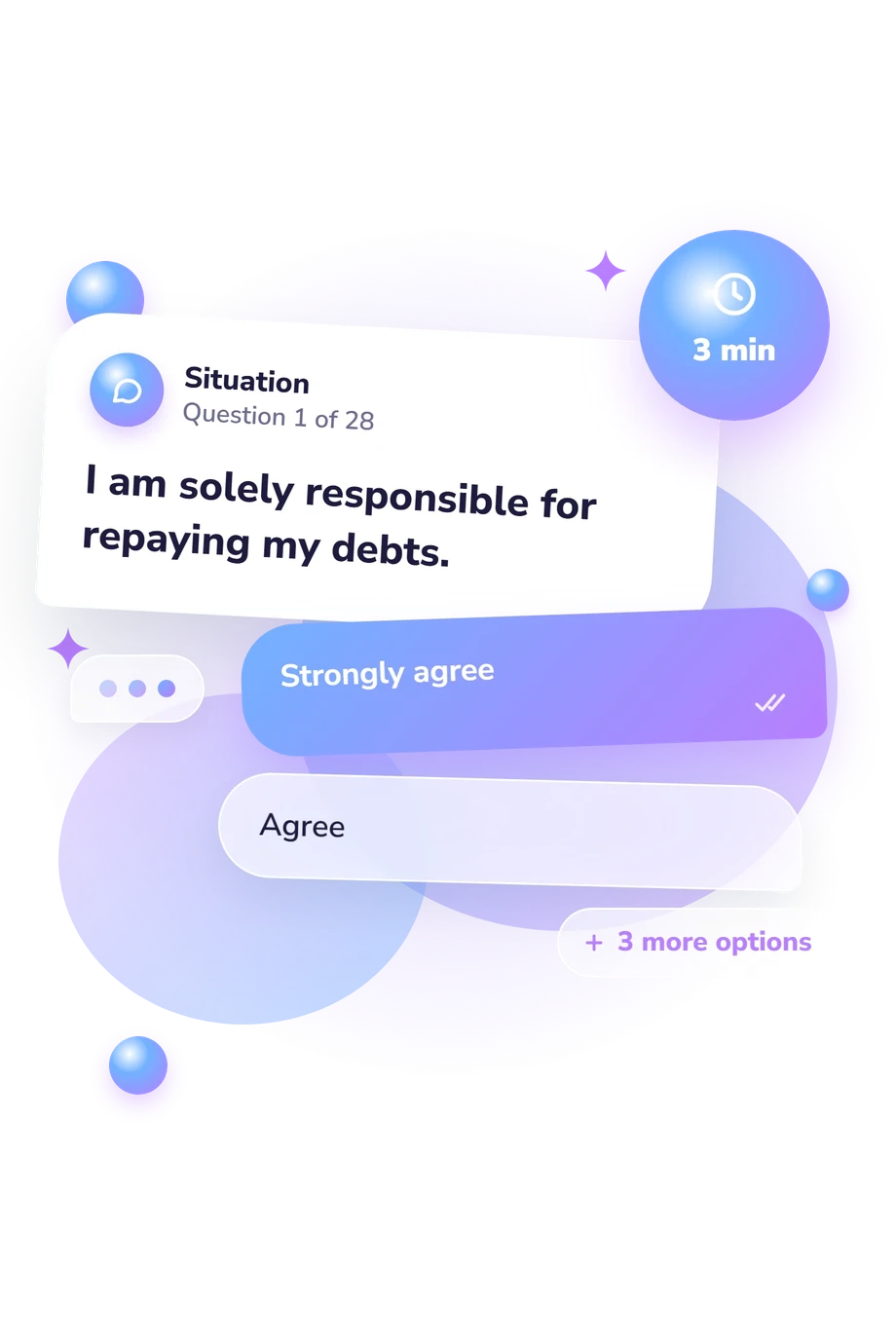
Example Questions From the Test
- Completely agree
- Agree
- Not sure
- Disagree
- Strongly disagree
- Completely agree
- Agree
- Not sure
- Disagree
- Completely disagree
- Strongly agree
- Agree
- Not sure
- Disagree
- Strongly disagree
Brief Debt Behavior Questionnaire Test - Description and methodology of the test
People who want to examine how they lend, borrow, or repay money can use the Brief Debt Behavior Questionnaire Test to consider everyday financial attitudes. This debt behavior questionnaire suits anyone reflecting on personal habits, social expectations, and decisions under uncertainty. The profile helps readers compare how social expectations, uncertainty, and repayment planning shape their money-related choices.
What This Assessment Measures
The questionnaire examines willingness to lend, willingness to borrow, and readiness to meet obligations promptly. Items address trust, social expectations, budgeting, loan comparison, total cost, and rapid repayment. Together, these themes capture social orientation, tolerance for financial uncertainty, and conscientiousness around obligations. This debt behavior assessment helps readers compare the three reported tendencies and identify money situations where their attitudes differ. The profile is read through three dimensions:
- Disapproval of Lending (4-20) measures willingness to lend money to others; Cautious lender (4-9), Selective lender (10-14), and Open-handed lender (15-20) are the displayed bands.
- Debt Avoidance (4-20) measures general willingness or unwillingness to borrow, including credit and informal loans; Debt-accepting (4-9), Balanced (10-14), and Debt-avoidant (15-20) are the displayed bands.
- Debt Rationality (6-30) measures readiness to act toward timely fulfillment of debt obligations; Lower rationality (6-14), Moderate rationality (15-22), and Higher rationality (23-30) are the displayed bands.
Methodology and Evidence Base
Responses use five ordered agreement choices, ranging from complete agreement to strong disagreement with an unsure or not-sure midpoint. Statements address responsibility, social norms, budgeting, loan comparison, and repayment. This is a self-report method: it records stated attitudes and intended actions, not verified transactions or financial records.
The online questionnaire is conceptually consistent with the Debt Behavior Express Questionnaire (Gagarina & Padun, 2021) but is a separate online measure; that source should not be treated as validation or scoring documentation for this version. Gagarina’s economic-psychological framework and 2021 generational study support viewing debt behavior as a combination of social orientation, uncertainty tolerance, and responsibility toward obligations.
Responses are combined into displayed scale scores and read through the result bands. The result screen provides scale ranges and bands, but does not specify how individual responses are weighted. Because this debt questionnaire relies on self-report, finances, social expectations, memory, and candor may shape results. Use the profile to examine budgeting, lending boundaries, borrowing choices, and repayment planning; it does not establish creditworthiness or a clinical condition.
- Gagarina, Maria, and Maria Padun. Debt Behavior Express Inventory: Development and Validation. Psychological Studies, vol. 14, no. 78, 2021, pp. 3-29. 10.54359/ps.v14i78.124
- Gagarina, Maria. Debt Mentality of Personality: An Economic-Psychological Study. Moscow: Institute of Psychology of the Russian Academy of Sciences, 2021, 275 pp. ISBN 978-5-9270-0430-0
- Gagarina, Maria. Debt Behavior of Different Generations Before and After the COVID-19 Pandemic. Izvestiya of Saratov University. Educational Acmeology. Developmental Psychology, vol. 10, no. 3 (39), 2021, pp. 240-251. 10.18500/2304-9790-2021-10-3-240-251
Updated: