
Type A Behavior Scale Test
How the Scales are Structured
Who Usually Takes This Test?
See How You Compare
Below is a preview of how scores are typically distributed across each scale.
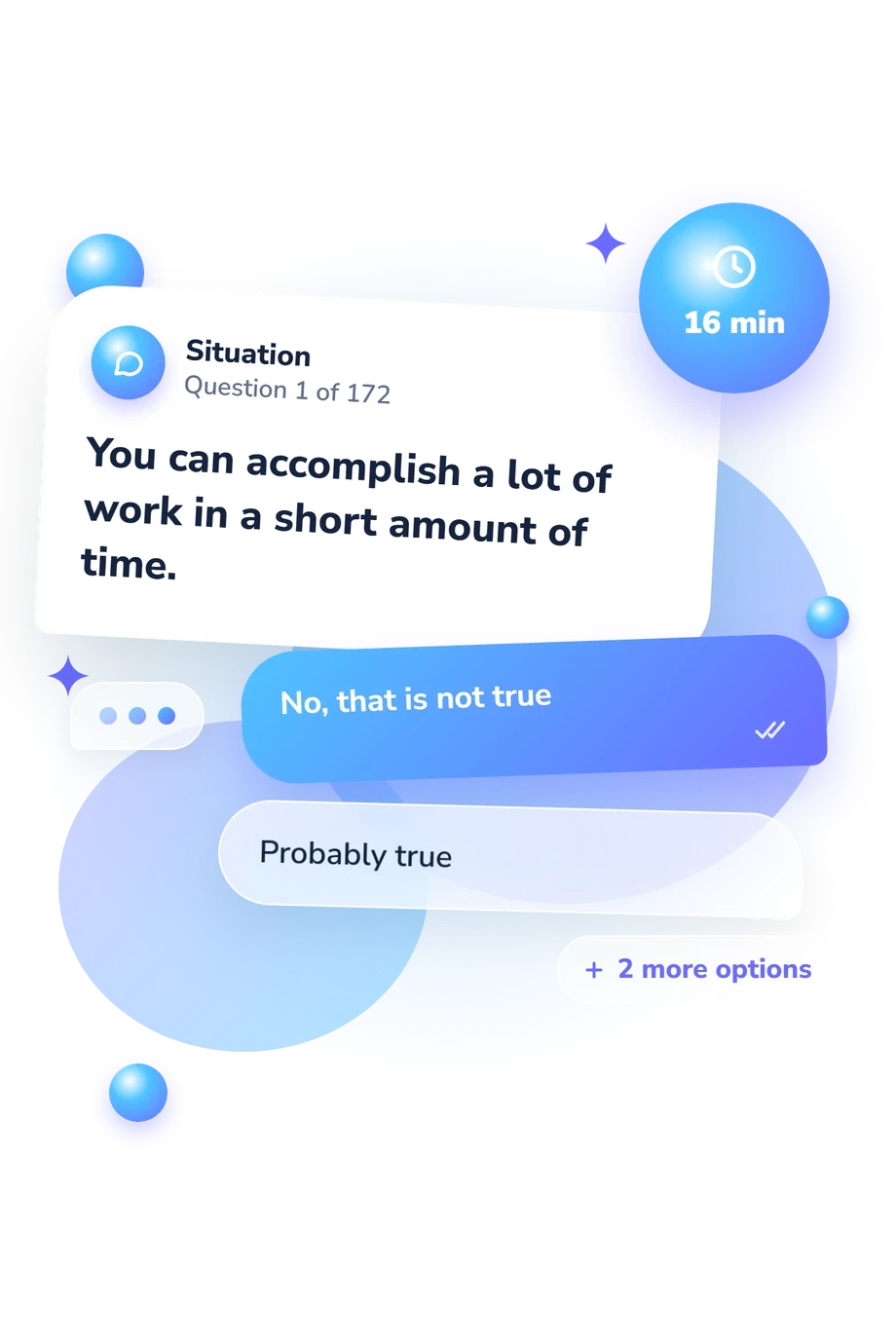
Example Questions From the Test
- No, that is not true
- Probably true
- True
- Completely true
- No, that is not true
- Probably true
- True
- Completely true
- No, that is not true
- Probably true
- True
- Completely true
Type A Behavior Scale Test - Description and methodology of the test
For readers who want a structured view of achievement, speed, emotional restraint, and interpersonal intensity, the Type A Behavior Scale Test offers a profile of behavioral tendencies. As a Type A behavior assessment, it connects work habits, competition, pressure, and reactions to delay without reducing personality to one fixed category. The result highlights patterns that may merit closer reflection in daily life.
What This Assessment Explores
Questions examine how a person approaches work, competition, control, emotion, activity, waiting, schedules, achievement, and conflict. They use familiar situations such as interruptions, leisure choices, rapid speech or eating, line-cutting, disagreement, responsibility, and keeping thoughts private. The result offers a Type A personality traits profile: separate dimensions show where intensity is concentrated and which tendencies accompany it.
This format suits people who want to compare their usual reactions across work and social settings. It describes behavioral tendencies rather than a fixed identity, so the overall pattern is most informative when read alongside component results and situations that feel typical. It can also support practical self-observation.
Methodology and Evidence Base
Four choices run from “No, that is not true” to “Completely true”; responses yield displayed totals and an overall pattern, with no stated item weights or conversion rules. The closest source is Type A Behavior Diagnostic Scale (Polozhentsev & Rudnev, 1990), conceptually consistent with, but not a direct adaptation of, the Jenkins Activity Survey and Friedman-Rosenman work. Norms are undocumented; stress and self-awareness affect self-report.
The displayed dimensions are:
- Work Involvement (14-56) and Competitiveness (6-24) show engagement and winning, respectively: Low 14-27/6-11; Moderate 28-56/12-24.
- Emotional Suppression (7-28) and Hostility (18-72) show restraint and irritability: Low restraint 7-13, Moderate restraint 14-20, High restraint 21-28; Low 18-35, Moderate/High 36-72.
- Behavioral Specificity (8-32) shows Type A organization: Low Type A specificity 8-15; High Type A specificity 16-32.
- Time Urgency (5-20) and Impatience (10-40) show rushing and waiting difficulty: Low time pressure 5-9, Moderate 10-14, High 15-20; Low impatience 10-19, High impatience 20-40.
- Vigor (4-16), Ambitiousness (14-56), and Behavior Pattern Type (86-250) show activity, achievement, and style: Lower energy 4-7, Moderate energy 8-8, Higher energy 9-16; Lower ambition 14-27, Moderate ambition 28-40, Higher ambition 41-56; Type B (calmer) 86-159, Type AB (mixed) 160-180, Type A (high intensity) 181-250.
- S. D. Polozhentsev and D. A. Rudnev. (1990). Behavioral Risk Factor for Ischemic Heart Disease (Type A). Leningrad: Nauka.
- C. D. Jenkins, S. J. Zyzanski, and R. H. Rosenman. (1979). Jenkins Activity Survey: JAS Manual, Form C. San Antonio, TX: Psychological Corporation.
- M. Friedman and R. H. Rosenman. (1959). Association of Specific Overt Behavior Pattern with Blood and Cardiovascular Findings; Blood Cholesterol Level, Blood Clotting Time, Incidence of Arcus Senilis, and Clinical Coronary Artery Disease. Journal of the American Medical Association, 169(12), 1286-1296. 10.1001/jama.1959.03000290012005
- S. Booth-Kewley and H. S. Friedman. (1987). Psychological Predictors of Heart Disease: A Quantitative Review. Psychological Bulletin, 101(3), 343-362. 10.1037/0033-2909.101.3.343
Updated: