
Type A Behavior Assessment for Schoolchildren Test
How the Scales are Structured
Who Usually Takes This Test?
See How You Compare
Below is a preview of how scores are typically distributed across each scale.
Example Questions From the Test
- "Business first, pleasure later."
- b) having fun, without worrying much about tomorrow;
- Somewhere in between.
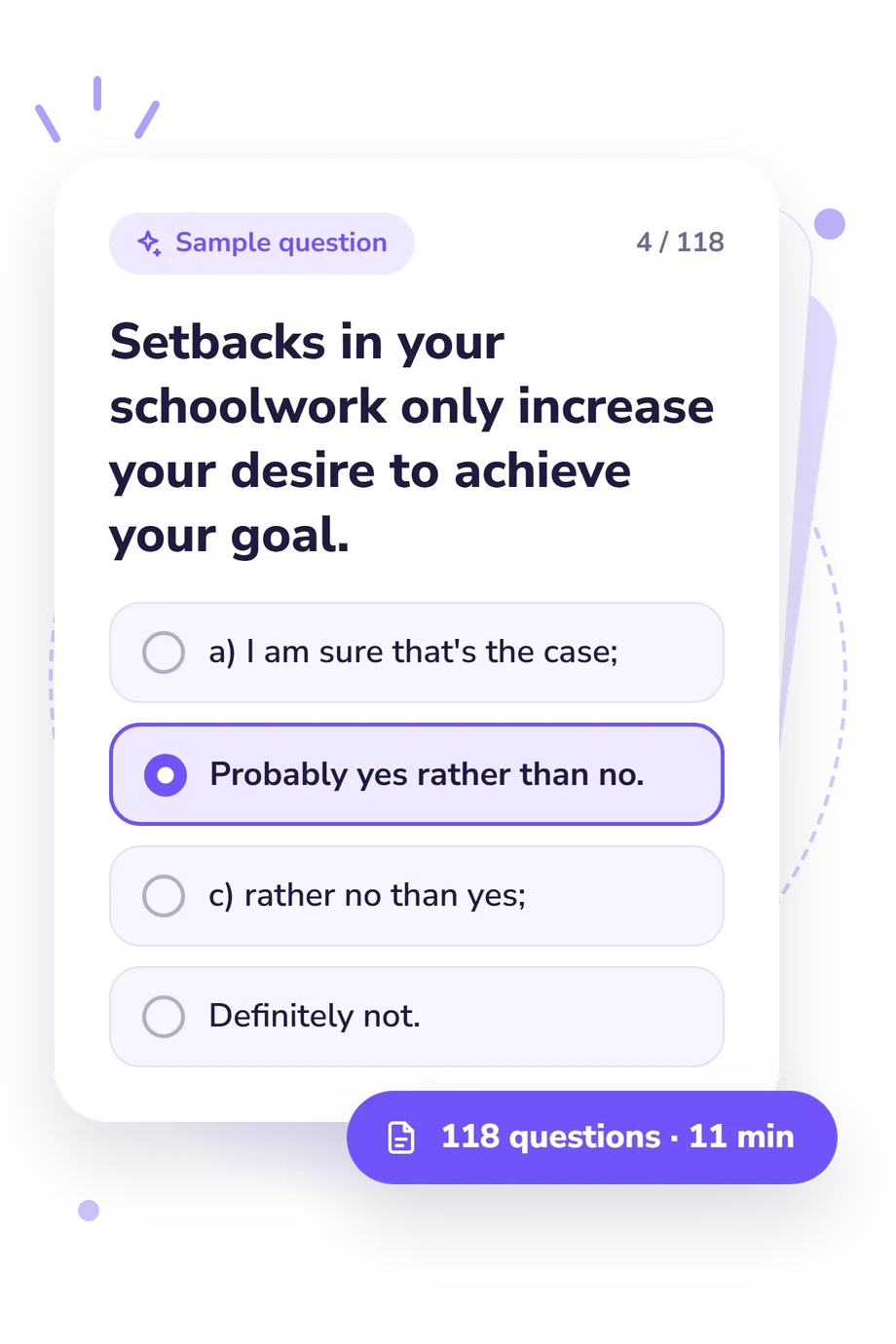
- a) I am sure that's the case;
- Probably yes rather than no.
- c) rather no than yes;
- Definitely not.
- a) I'm sure that's the case;
- Rather yes than no.
- c) more no than yes;
- Certainly not.
Type A Behavior Assessment for Schoolchildren Test - Description and methodology of the test
Schoolchildren who want to understand achievement pressure and pace of their behavior can use this questionnaire as a structured self-reflection tool. The Type A Behavior Assessment for Schoolchildren Test organizes everyday responses around competition, urgency, irritation, recognition, and control. As a Type A behavior test for schoolchildren, it offers a profile rather than a judgment about character.
What This Assessment Explores
The questionnaire looks at how achievement goals combine with pace, competition, irritation, recognition, and emotional control in school and daily situations. Items cover rushing, reactions to grades, impatience with slower people, difficult tasks, temper, rest, friendships, and winning or losing. Together, they indicate whether a driven style, a calmer style, or a mixed pattern is more prominent.
For many readers, this Type A behavior assessment is clearest when treated as a pattern, not a personality verdict. The displayed Behavior Type Scale ranges from 0-100 and uses three result bands:
- Type B (calmer), 0-59, reflects goal orientation with greater self-control and less aggressiveness.
- Mixed AB, 60-69, reflects features of both patterns with less pronounced expression.
- Type A (pronounced), 70-100, reflects stronger ambition, achievement striving, impatience, hostility, and recognition needs.
The band summarizes these responses, not the whole student.
Methodology and Scientific Basis
Responses combine yes/no choices with graded options such as definitely true, probably yes, probably no, and definitely not; some items use concrete alternatives, including arrival time. The response pattern is reported through the displayed bands. No per-item key or point allocation is specified, so the 0-100 range does not establish how individual answers become points.
The questionnaire is conceptually closest to the Matthews Youth Test for Health, which examined children’s competitiveness, impatience-anger, and aggression. The online questionnaire is conceptually consistent with that instrument, but it is not the published instrument or a claimed adaptation of it. Friedman and Rosenman’s research and explanatory work provide the Type A and Type B behavior framework.
That published work provides context for interpreting the themes, but it does not validate this online questionnaire’s scoring or bands. The result is best read as a behavioral tendency rather than a fixed label. Self-report answers can shift with honesty, self-awareness, mood, workload, and school context. No standardized norms or diagnostic cutoffs are stated, so use the bands for reflection alongside broader information about the student.
- Matthews, Karen A., and Julio Angulo. “Measurement of the Type A Behavior Pattern in Children: Assessment of Children’s Competitiveness, Impatience-Anger, and Aggression.” Child Development, vol. 51, no. 2, 1980, pp. 466-475. 10.1111/j.1467-8624.1980.tb02567.x
- Friedman, Meyer, and Ray H. Rosenman. “Association of Specific Overt Behavior Pattern with Blood and Cardiovascular Findings; Blood Cholesterol Level, Blood Clotting Time, Incidence of Arcus Senilis, and Clinical Coronary Artery Disease.” JAMA, vol. 169, no. 12, 1959, pp. 1286-1296. 10.1001/jama.1959.03000290012005
- Friedman, Meyer, and Ray H. Rosenman. Type A Behavior and Your Heart. New York: Alfred A. Knopf, 1974.
Updated: