
Perceptual Awareness Scale Test
How the Scales are Structured
Who Usually Takes This Test?
See How You Compare
Below is a preview of how scores are typically distributed across each scale.
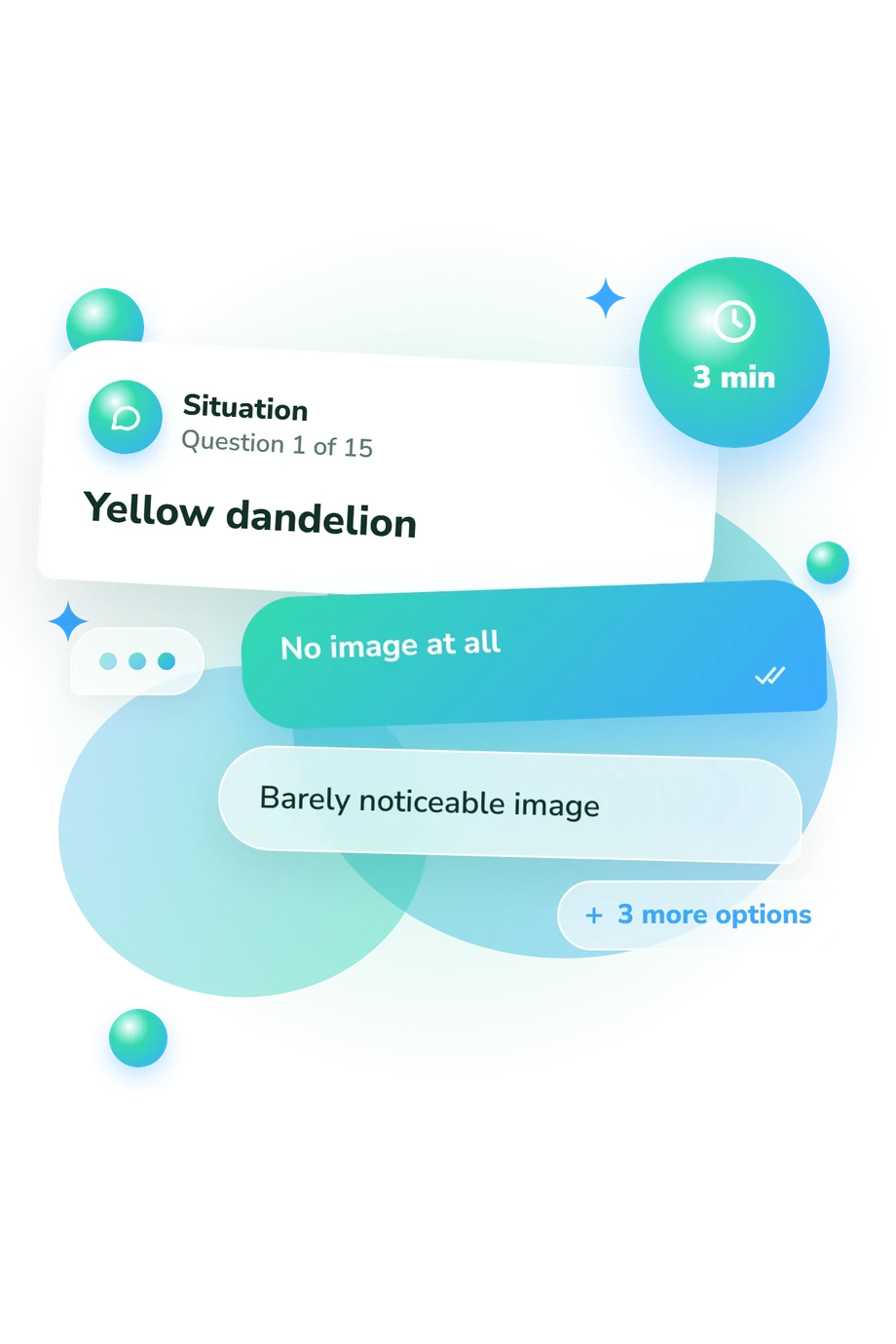
Example Questions From the Test
- No image at all
- Barely noticeable image
- More pronounced image
- Clearly defined image
- Extremely vivid image (as if real)
- No mental image
- Barely noticeable mental image
- More distinct mental image
- Clearly distinct mental image
- Very vivid mental image (lifelike image)
- No mental image
- Faint mental image
- Moderately clear mental image
- Clearly defined mental image
- Extremely vivid mental image (as if real)
Perceptual Awareness Scale Test - Description and methodology of the test
For readers curious about how sensory experience enters thought, the Perceptual Awareness Scale Test offers a structured look at sensory-perceptual awareness. It suits people exploring how sensory information may be weighted in everyday perception, thought, and memory, and whether their processing pattern feels more dependent on particular kinds of input. As a sensory perception assessment, it describes a profile rather than general ability.
What This Sensory Awareness Test Explores
Using mental imagery, this sensory imagery assessment samples sights, sounds, touches, smells, and tastes. It describes sensory-perceptual awareness and information processing across six scales:
- Olfactory (0-12) measures smell salience in perception; higher scores suggest a developed sense of smell: Low 0-4, Moderate 5-8, High 9-12.
- Sensory-Perceptual Awareness Level (0-60) measures overall sensory sensitivity: Low 0-20, Moderate 21-40, High 41-60.
- Gustatory (0-12) measures taste salience; higher scores suggest pronounced taste sensitivity: Low 0-5, Moderate 6-9, High 10-12.
- Tactile (0-12) measures bodily-sensation processing: Low tactile focus 0-5, Moderate tactile focus 6-9, High tactile focus 10-12.
- Auditory (0-12) measures verbal or sound perception and memory: Low 0-4, Moderate 5-8, High 9-12.
- Visual (0-12) measures reliance on visual imagery in thought and memory: Low visual orientation 0-5, Moderate visual orientation 6-9, High visual orientation 10-12.
Methodology and Scientific Basis
Each item offers a sensory experience with five ordered choices, from no mental image to a vivid or lifelike representation. Visual prompts use scenes; auditory prompts use birdsong and waves; tactile prompts involve contact; smell and taste prompts use familiar examples. There are no right answers: responses record subjective vividness.
The format creates a perceptual awareness questionnaire focused on sensory-perceptual awareness and modality-specific processing, with imagery serving as the response route. Its closest named source is Sheehan's shortened mental-imagery instrument (1967), derived from Betts's earlier work. Conceptually, this online questionnaire is consistent with Sheehan's shortened instrument, but it is not presented as an adaptation of that instrument. The Plymouth Sensory Imagery Questionnaire and Schifferstein's cross-modal research support treating vividness as a modality-specific experience.
Scores are reported by scale and level band; higher values indicate stronger self-reported sensory emphasis or imagery in each modality. Because displayed bands are descriptive and the weighting formula is unspecified, points per answer cannot be inferred from ranges; mood, attention, memory, familiarity, and self-awareness can affect responses, so read the result as a current snapshot rather than a fixed trait.
- Sheehan, Peter Winston. (1967). A shortened form of Betts' questionnaire upon mental imagery. Journal of Clinical Psychology, 23(3), 386-389. 10.1002/1097-4679%28196707%2923%3A3%3C386%3A%3AAID-JCLP2270230328%3E3.0.CO%3B2-S
- Betts, George Herbert. (1909). The distribution and functions of mental imagery. New York: Teachers College, Columbia University, Contributions to Education, No. 26.
- Andrade, Jackie, Jon May, Catherine Deeprose, Sarah-Jane Baugh, and Giorgio Ganis. (2014). Assessing vividness of mental imagery: The Plymouth Sensory Imagery Questionnaire. British Journal of Psychology, 105(4), 547-563. 10.1111/bjop.12050
- Schifferstein, H. N. J. (2009). Comparing mental imagery across the sensory modalities. Imagination, Cognition and Personality, 28(4), 371-388. 10.2190/IC.28.4.g
Updated: