
Social-Perceptual Attitude Assessment Test
How the Scales are Structured
Who Usually Takes This Test?
See How You Compare
Below is a preview of how scores are typically distributed across each scale.
Example Questions From the Test
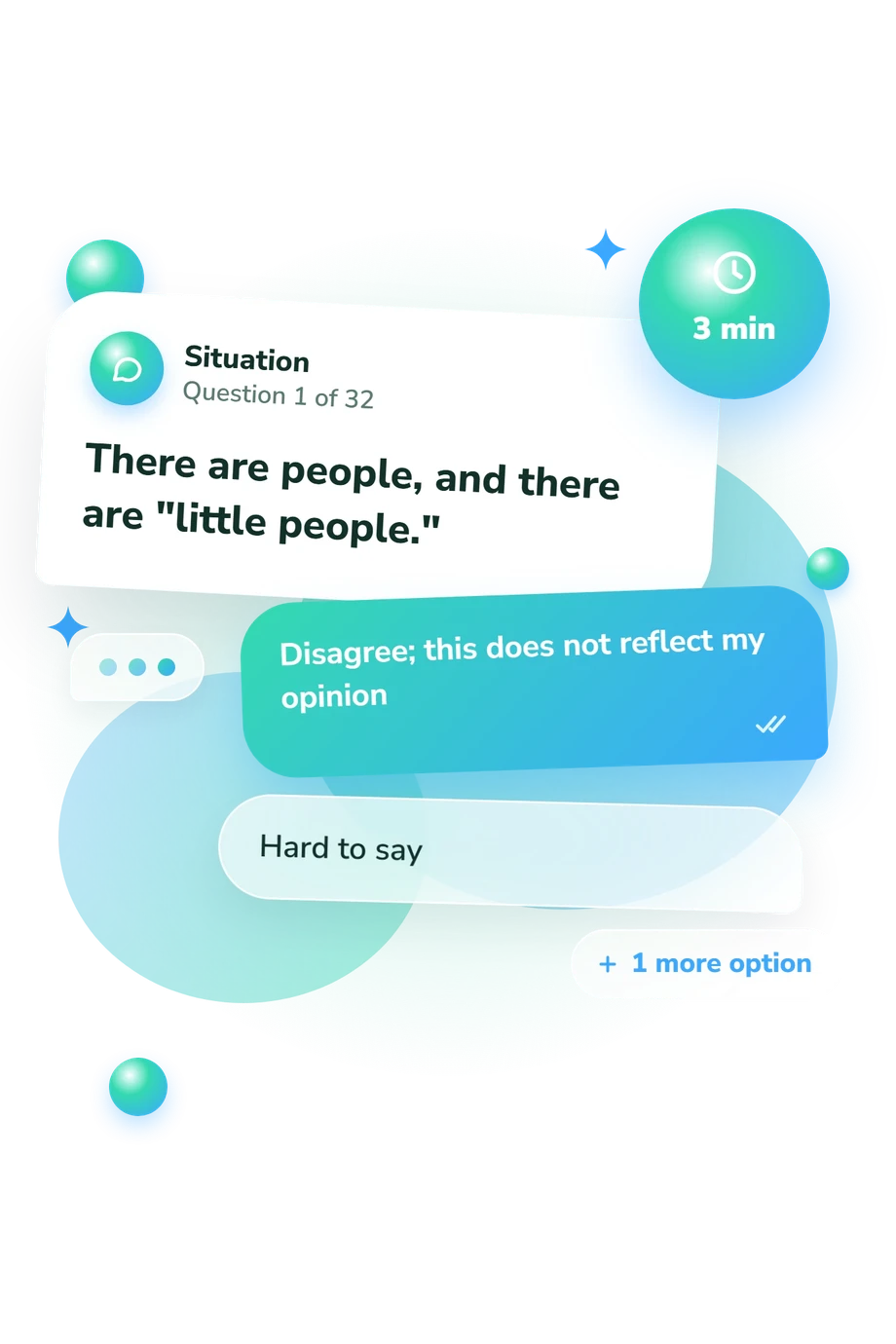
- Disagree; this does not reflect my opinion
- Hard to say
- Agree; this reflects my opinion
- Disagree; this does not reflect my opinion
- Hard to say
- Agree; this reflects my opinion
- Disagree; does not reflect my opinion
- Hard to say
- Agree; reflects my opinion
Social-Perceptual Attitude Assessment Test - Description and methodology of the test
People who want to examine how they interpret trust, kindness, closeness, and possible threat can use the Social-Perceptual Attitude Assessment Test for focused self-reflection. It is suited to readers interested in recurring interpersonal expectations rather than one isolated encounter. As a social perception test, it offers a concise indication of whether their outlook tends toward openness, cooperation, guardedness, or rejection.
What This Assessment Explores
The statements examine the lens through which a person interprets other people. The test is a social-perceptual attitude questionnaire contrasting benevolent and affiliative views with suspicion, criticism, pessimism, and expectations of harm. Other items address whether closeness strengthens happiness, whether caring creates vulnerability, and whether force or vigilance seems necessary in difficult relationships.
Because these themes concern broad judgments about human motives, the result describes a general interpersonal orientation rather than one isolated interaction. It can help a reader notice a tendency toward openness, cooperation, guardedness, or emotional rejection, while personal history and relationships may influence the answers.
The displayed result presents one overall dimension:
- The Overall Index (0-32) shows the direction of social-perceptual attitude: Low 0-10 indicates more suspicious, critical, or rejecting perceptions; Medium 11-21 indicates cooperation and understanding; High 22-32 indicates more positive, trusting, empathic, and supportive perceptions.
Methodology and Scientific Basis
Each item is a brief statement about people, trust, kindness, intimacy, criticism, or danger. The respondent selects disagreement, uncertainty, or agreement. This format captures an overall stance rather than a detailed account of one event, so the pattern across answers matters more than any single statement.
Responses in this interpersonal attitude assessment are combined into one displayed result. The questionnaire states the result bands but does not specify how individual responses are weighted or summed.
The closest published comparison is the Socio-Perceptual Attitude Inventory (Dubovitskaya et al., 2017), which provides the relevant construct and psychometric context. This online questionnaire is conceptually consistent with that instrument, but the inventory’s psychometric evidence belongs to that instrument and does not automatically establish this version as a validated adaptation. Allport’s theory of attitudes offers a broader framework for viewing social judgments as evaluative orientations shaped by experience.
Interpretation is descriptive; no normative standardization is stated for this online questionnaire, and mood, recent interactions, self-awareness, and socially desirable responding can shift one result.
- Dubovitskaya, Tatiana D., Galina F. Tulitbaeva, and Alexander V. Shashkov. “Inventory for Assessment of Socio-Perceptual Attitude: Psychometric Characteristics and Features of Use.” RUDN Journal of Psychology and Pedagogics, 14(2), 2017, 213-225. 10.22363/2313-1683-2017-14-2-213-225
- Allport, Gordon W. “Attitudes.” In Handbook of Social Psychology, edited by Carl Murchison, 798-844. Worcester, MA: Clark University Press, 1935.
Updated: