
Freudly+971 508685814hello@freudly.ai
Freudly
addiction

Gaming Addiction Assessment Test
Take the online Gaming Addiction Assessment Test - AI psychologist FreudlyYou can take Gaming Addiction Assessment Test here. Online version of a simple and accurate psychological test with interpretation.en
Understand whether gaming is a habit or an addiction in about 5 minutes. Get clear, fast insights into virtual attachment and actionable next steps for healthier balance.
Start Online Test
Questions: 245 minutes
08:30
October 2, 2025
October 2, 2025
Material has been updated
October 2, 2025
Material has been published
15,018 views
1,383 completions
1,114 likes
Verified by Daniel Hall
Psychologist with 25 years of experience
Share
Scale Explorer

How the Scales are Structured

example score
84/120
Gaming Addiction (GA)
Measures the overall severity of problematic involvement in online gaming and attachment to the virtual environment.
Low
Moderate
High
2455: Low | 5687: Moderate | 88120: High
A score of 84 falls in the Moderate range, suggesting noticeable signs of problematic gaming involvement that may be affecting daily life and relationships.
example score
19/30
Physical Symptoms (PS)
Assesses the intensity of physical signs associated with problematic gaming involvement, such as sleep disruption and fatigue.
Low
Moderate
High
613: Low | 1422: Moderate | 2330: High
A score of 19 falls in the Moderate range, suggesting noticeable but not extreme physical strain (e.g., sleep disturbance or fatigue) linked to gaming patterns.
example score
9/15
Behavioral (B)
Measures the degree of behavioral engagement in gaming and readiness to interact with the game world.
Low engagement
Moderate engagement
High engagement
36: Low engagement | 711: Moderate engagement | 1215: High engagement
A score of 9 indicates moderate behavioral engagement, suggesting regular involvement in gaming with a noticeable readiness to interact with the game world.
example score
6/15
Cognitive (C)
Assesses interest in gameplay and the tendency to seek out information about the game.
Low
Moderate
High
37: Low | 811: Moderate | 1215: High
A score of 6 falls in the Low range, suggesting relatively limited interest in gameplay and infrequent information-seeking about the game.
example score
13/15
Emotional (E)
Measures the emotional tone of gaming and the degree of pleasure derived from playing.
Low pleasure
Moderate pleasure
High pleasure
37: Low pleasure | 811: Moderate pleasure | 1215: High pleasure
A score of 13 indicates a predominantly positive emotional tone during gaming and strong enjoyment from playing.
example score
15/45
Attitudes Toward Gaming (ATG)
Assesses the emotional, cognitive, and behavioral importance of gaming in the respondent’s life.
Low importance
Moderate importance
High importance
920: Low importance | 2133: Moderate importance | 3445: High importance
A score of 15 falls in the Low importance range, suggesting gaming is generally not a central focus of the respondent’s emotions, thoughts, or daily behavior.
example score
10/15
Power (P)
Measures the tendency to seek dominance and control in interpersonal interactions, which in gaming can appear as striving for leadership and influence over others.
Low
Moderate
High
37: Low | 811: Moderate | 1215: High
A score of 10 falls in the Moderate range, suggesting a balanced but noticeable preference for taking charge or leading, including in online gaming contexts.
example score
13/15
Susceptibility to Others' Opinions (StOO)
Assesses how strongly the respondent’s behavior and self-evaluation depend on the opinions and expectations of other people or the gaming group.
Low referentiality
Moderate referentiality
High referentiality
37: Low referentiality | 811: Moderate referentiality | 1215: High referentiality
A score of 13 indicates high referentiality, suggesting that others’ opinions—potentially including the gaming community—may strongly influence the respondent’s gaming-related choices.
example score
7/15
Attraction (A)
Measures how attractive and personally significant other people are to the respondent, reflecting patterns of social connection relevant to gaming involvement.
Low
Moderate
High
37: Low | 811: Moderate | 1215: High
A score of 7 falls in the Low range, suggesting other people are perceived as less attractive or significant as social partners, which may be associated with weaker pull toward real-world connections in the gaming context.
example score
18/45
Interpersonal Relationships (IR)
Assesses how much a person’s significant interactions and emotional support shift from real-life relationships into the gaming environment.
Low shift to gaming
Moderate shift to gaming
High shift to gaming
921: Low shift to gaming | 2233: Moderate shift to gaming | 3445: High shift to gaming
A score of 18 falls in the Low shift to gaming range, suggesting relatively preserved real-life communication with limited reliance on gaming relationships for significant support.
Start Online Test
just completed the test
DATA-BASED USER COHORTS

Who Usually Takes This Test?

Concerned heavy gamers
41%OF USERS
People who spend many hours gaming and want a quick check on whether play is starting to replace real-life relationships and responsibilities.
Parents and partners
34%OF USERS
Family members or partners worried that a loved one is withdrawing into games and using virtual connections instead of real support.
Psychologists and counselors
25%OF USERS
Mental health professionals using a fast screening tool to understand gaming involvement and plan focused work on relationships and balance.
BASED ON AGGREGATED, ANONYMIZED DATA FROM TENS OF THOUSANDS OF FREUDLY USERS.
Benchmarking

See How You Compare

Once you complete the test, your results are compared with real-world data from people in your country.
Below is a preview of how scores are typically distributed across each scale.
Game Addiction (GA)
Game Addiction (GA)
Average
72.7
Normal range
56.688.8
min.
24
max.
120
This curve shows how scores are typically distributed.
Once you complete the test, your result will appear on the scale so you can see how you compare.
Physical Manifestations (PM)
Average
23
Normal range
18.527.5
min.
6
max.
30
This curve shows how scores are typically distributed.
Once you complete the test, your result will appear on the scale so you can see how you compare.
Behavioral (B)
Behavioral (B)
Average
9.7
Normal range
8.211.2
min.
3
max.
15
This curve shows how scores are typically distributed.
Once you complete the test, your result will appear on the scale so you can see how you compare.
Cognitive (C)
Cognitive (C)
Average
8.2
Normal range
6.410.1
min.
3
max.
15
This curve shows how scores are typically distributed.
Once you complete the test, your result will appear on the scale so you can see how you compare.
Emotional (E)
Emotional (E)
Average
8
Normal range
6.59.5
min.
3
max.
15
This curve shows how scores are typically distributed.
Once you complete the test, your result will appear on the scale so you can see how you compare.
Attitude toward the game (Attg)
Average
19.1
Normal range
13.224.9
min.
9
max.
45
This curve shows how scores are typically distributed.
Once you complete the test, your result will appear on the scale so you can see how you compare.
Power (P)
Power (P)
Average
7.9
Normal range
6.29.6
min.
3
max.
15
This curve shows how scores are typically distributed.
Once you complete the test, your result will appear on the scale so you can see how you compare.
Referentiality (R)
Referentiality (R)
Average
10.8
Normal range
8.812.8
min.
3
max.
15
This curve shows how scores are typically distributed.
Once you complete the test, your result will appear on the scale so you can see how you compare.
Attraction (A)
Attraction (A)
Average
7.9
Normal range
6.39.6
min.
3
max.
15
This curve shows how scores are typically distributed.
Once you complete the test, your result will appear on the scale so you can see how you compare.
Interpersonal Relationships (IR)
Average
29.5
Normal range
2534
min.
9
max.
45
This curve shows how scores are typically distributed.
Once you complete the test, your result will appear on the scale so you can see how you compare.
Featured On
SAMPLE QUESTIONS

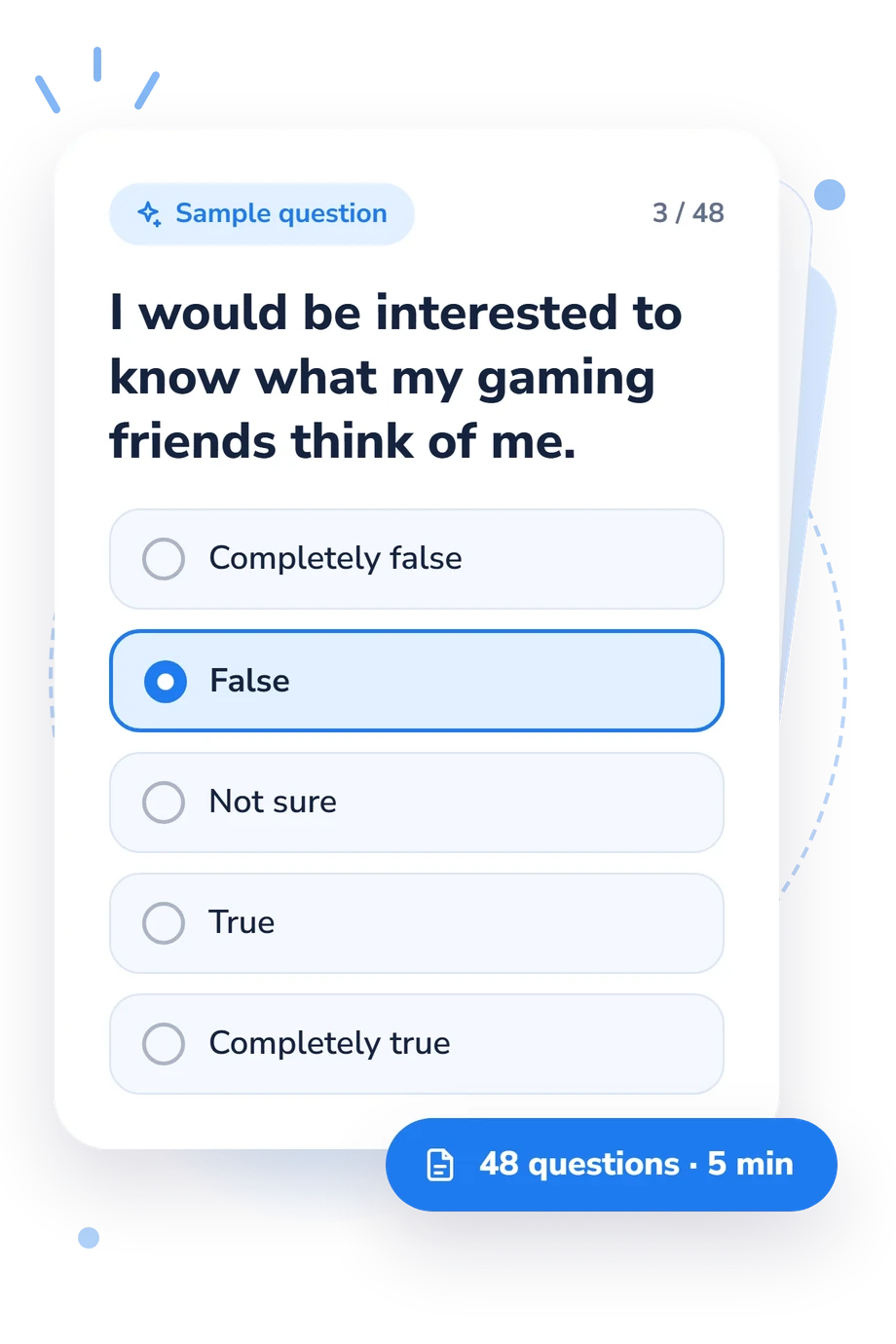
Example Questions From the Test

You will be presented with a series of statements. Please rate each statement using the response scale. Do not spend too much time considering your answers. Please note that there are no right or wrong answers on this questionnaire.
    • Completely false
    • False
    • Not sure
    • True
    • Completely true
    • Completely untrue
    • Not true
    • Not sure
    • True
    • Completely true
    • Completely untrue
    • Untrue
    • Not sure
    • True
    • Completely true
WHAT THE TEST MEASURES
About This Assessment
Method for Diagnosing Game Addiction, DGA Test

Gaming Addiction Assessment Test - Symptoms and Signs

addiction
cyberpsychology
computer addiction
computer games

This measure is designed to screen for problematic patterns of video game use and related impairment. The Gaming Addiction Assessment provides a brief self-report format to support clinical interviewing and case formulation.

The instrument includes 24 items and typically takes about 5 minutes to complete. It may be used with adolescents or adults in outpatient or community settings to quantify symptom severity and identify areas for follow-up.

Items ask respondents to rate behaviors and experiences commonly associated with excessive gaming (e.g., preoccupation, reduced control, and interference with daily functioning). The Gaming Addiction Assessment is attributed to Mark D. Griffiths and is intended to inform, not replace, comprehensive diagnostic evaluation.

Author: Mark D. Griffiths
Literature: King, D. L., Delfabbro, P. H., & Griffiths, M. D. The assessment of Internet gaming disorder: A systematic review. Clinical Psychology Review. 2013.
Popular tests
Comments
Leave a Comment