
Personality Maturity Assessment Test
How the Scales are Structured
Who Usually Takes This Test?
See How You Compare
Below is a preview of how scores are typically distributed across each scale.
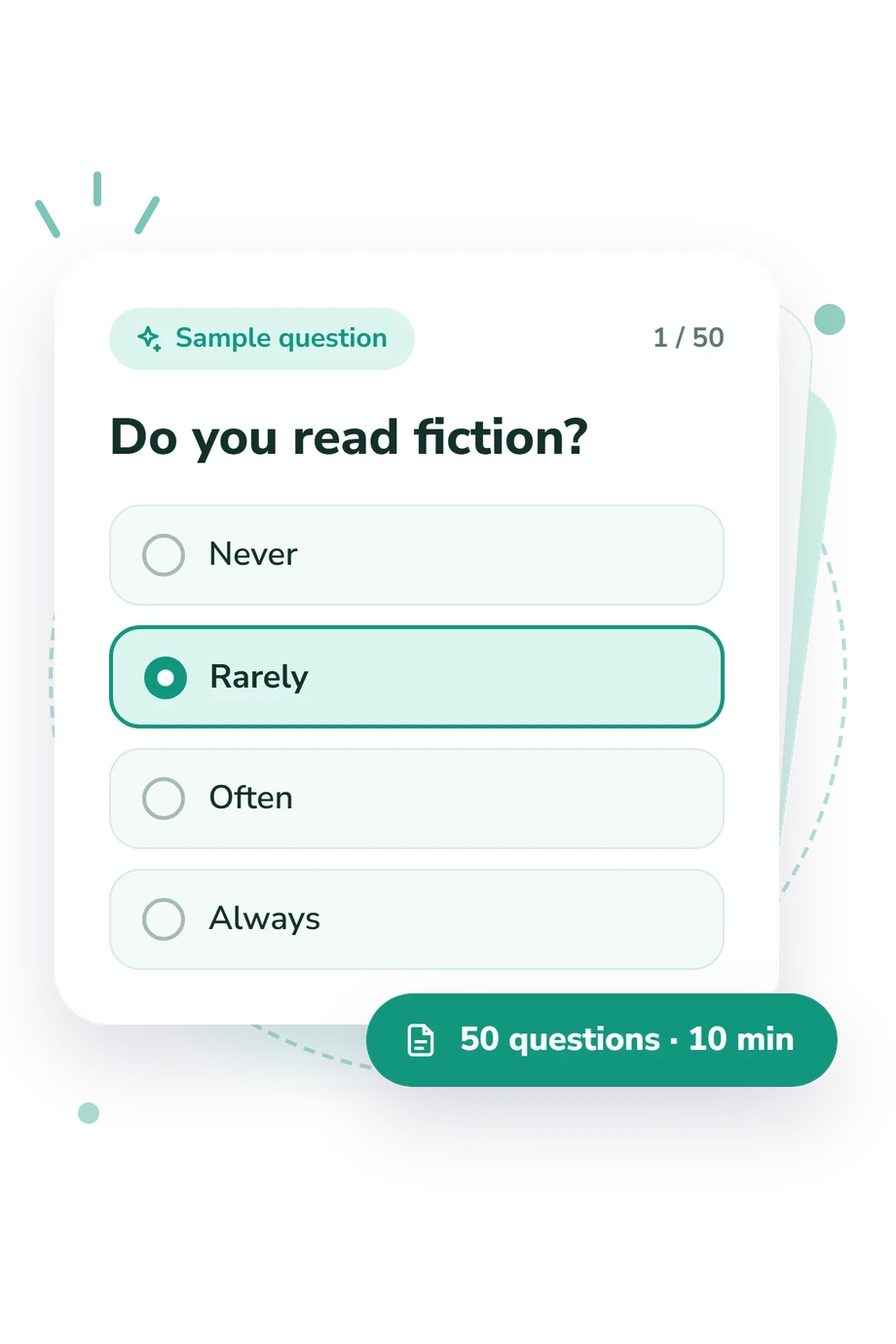
Example Questions From the Test
- Never
- Rarely
- Often
- Always
- Never
- Rarely
- Often
- Always
- Never
- Rarely
- Often
- Always
Personality Maturity Assessment Test - Description and methodology of the test
People seeking a structured way to reflect on independence, responsibility, relationships, and growth may find the Personality Maturity Assessment Test useful. This personality maturity test organizes everyday self-observations into a profile of patterns related to decision-making, obligations, adaptation, social understanding, and personal goals. It suits readers who want a focused framework for self-reflection about everyday functioning.
What This Assessment Explores
Five dimensions appear in daily habits and attitudes. Prompts cover initiative, criticism, listening, routine, and ownership; this personality maturity questionnaire turns them into patterns.
The profile includes:
- Autonomy (0-30) shows independent decisions: Low 0-10, Moderate 11-20, High 21-30.
- Positive Thinking (0-30) shows opportunities, strengths, and resources: Low 0-10, Moderate 11-20, High 21-30.
- Self-Development (0-30) shows improvement, potential, and growth: Low 0-10, Moderate 11-20, High 21-30.
- Tolerance (0-30) shows resilience and attitudes toward people and events: Low 0-10, Moderate 11-20, High 21-30.
- Responsibility (0-30) shows roles and obligations, distinguishing externalized and internalized responsibility: Externalized 0-10, Developing 11-20, Internalized 21-30.
- Personality Maturity (0-150) shows development; higher scores reflect maturity and adaptation: Low 0-50, Moderate 51-100, High 101-150.
Methodology and Scientific Basis
Representative items cover initiative, responsibility, outlook, social interaction, habits, emotional reactions, and follow-through. They use four ordered options-Never, Rarely, Often, or Always-to rate frequency or typicality; their wording includes both strengths and difficulties, so careful reading matters.
The Personal Maturity Diagnostic Method (Ruzhenkov et al., 2016) is the closest conceptual reference. This online questionnaire assesses personality maturity and is conceptually consistent with that method, not a direct adaptation, restandardization, or validation of it. Methodological recommendations by Ruzhenkov, Ruzhenkova, and Lukyantseva (2016) clarify the multidimensional framework; Lukyantseva, Ruzhenkov, and Ponomarenko (2018) add applied context, not evidence for this version.
Scoring combines responses into component results and an overall profile. The resulting personality maturity assessment is descriptive: displayed ranges are bands, and item weights, reverse-keying, and equal points per answer are not specified. For this version, no population norms, reliability data, or clinical cutoffs are provided. Current stress, self-perception, and response style may influence self-report, so read the pattern as a focused reflection aid rather than a diagnosis.
- Ruzhenkov, V.A., Ruzhenkova, V.V., and Lukyantseva, I.S. (2016). Methodology for Diagnosing Personal Maturity. Scientific Bulletin of Belgorod State University. Medicine. Pharmacy, 26(247), issue 36, 65-70.
- Ruzhenkov, V.A., Ruzhenkova, V.V., and Lukyantseva, I.S. (2016). Methodology for Diagnosing Personal Maturity: Methodological Recommendations. Belgorod: EHPICENTR.
- Lukyantseva, I.S., Ruzhenkov, V.A., and Ponomarenko, D.O. (2018). Addictive Behavior and Alcoholism in Medical Students of Senior Courses (Prevalence, Comorbidity and Treatment). I.P. Pavlov Russian Medical Biological Herald, 26(3), 380-387. 10.23888/PAVLOVJ2018263380-387
Updated: