
Urgent Addiction Assessment Test
How the Scales are Structured
Who Usually Takes This Test?
See How You Compare
Below is a preview of how scores are typically distributed across each scale.
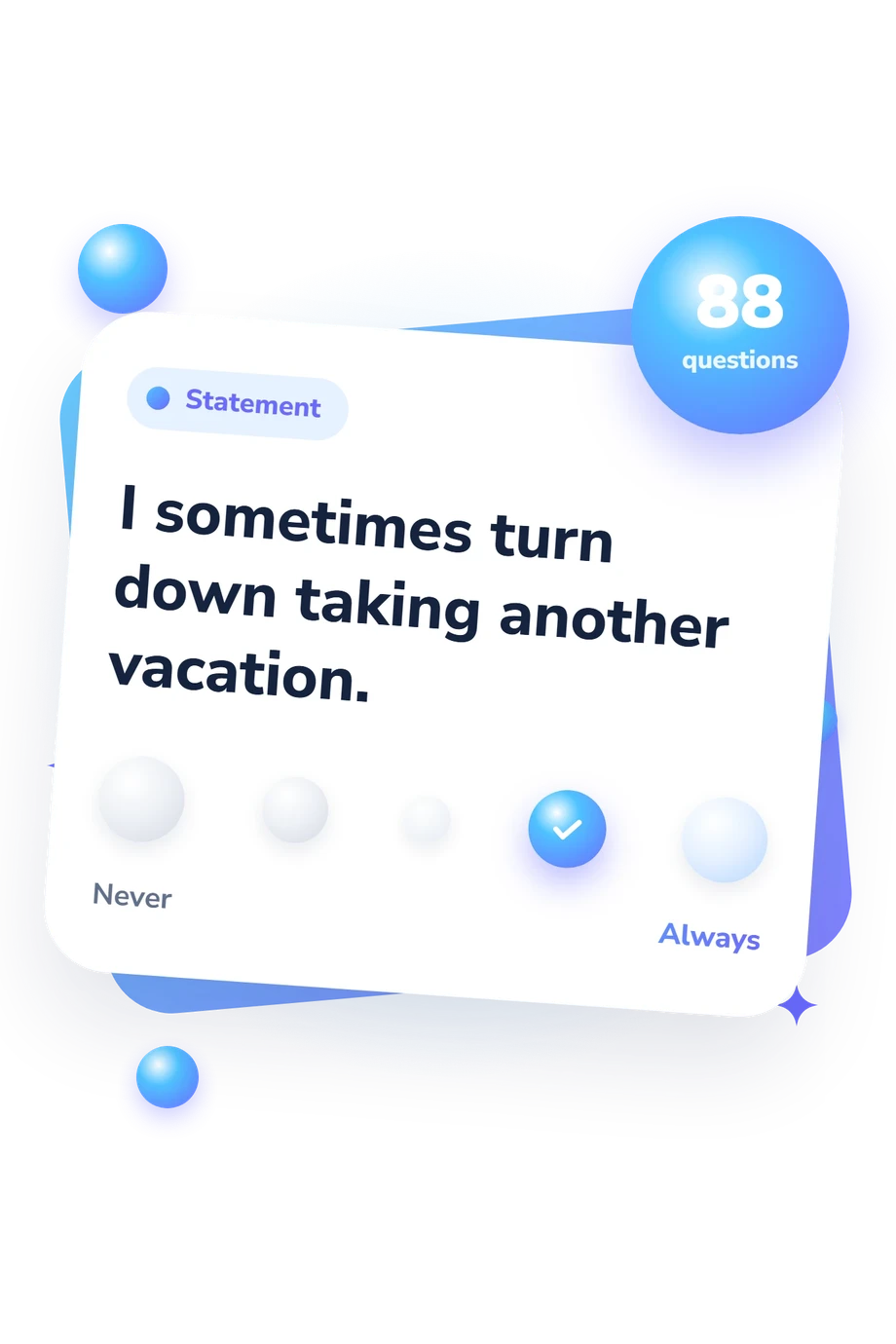
Example Questions From the Test
- Never
- Rarely
- Sometimes
- Often
- Always
- Never
- Rarely
- Sometimes
- Often
- Always
- Never
- Rarely
- Sometimes
- Often
- Always
Urgent Addiction Assessment Test - Description and methodology of the test
People who feel driven to hurry, remain mentally at work, or postpone rest may use the Urgent Addiction Assessment Test to examine how these patterns interact. This urgent addiction assessment is intended for people seeking a structured picture of work-centered pressure and its effects on everyday balance. The result can identify areas for reflection without reducing a complex lifestyle to a single label.
What This Assessment Explores
The questionnaire links urgency with work attachment, limited personal time, strained social connection, and reactions to delay. It suits people noticing chronic rushing, difficulty relaxing, or turning spare moments into tasks. Viewed as a workaholism questionnaire, it shows how these tendencies combine in daily life.
The result profile contains these dimensions:
- Pace of Life (12-60) measures rushing and time scarcity: Calm pace (12-27), Elevated pace (28-44), Urgent pace (45-60).
- Interpersonal Relationships (10-50) measures work's effect on close connections: Balanced connections (10-23), Some strain (24-36), Marked strain (37-50).
- Personal Time (10-50) measures the impact of insufficient free time: Low impact (10-23), Moderate impact (24-36), High impact (37-50).
- Workaholism (12-60) measures work's dominance and mental preoccupation: Balanced involvement (12-27), Elevated work focus (28-43), Work-centered pattern (44-60).
- Overall Urgent Addiction Index (44-220) summarizes urgency across domains: Low (44-102), Moderate (103-161), High (162-220).
Methodology and Evidence Base
Each statement asks the respondent to choose one frequency option-Never, Rarely, Sometimes, Often, or Always-so the profile reflects reported habits and reactions rather than measured performance. Items address work intruding on breaks and weekends, discomfort with free time, sleep and relaxation, family and friends, multitasking, impatience, speed, and achievement pressure. The scoring groups responses into the displayed domains and combines them in the overall index; no extra points rule should be inferred beyond the questionnaire's stated ranges.
The assessment is conceptually consistent with the Urgency Addiction Index (Shybko, 2008), while Tassi's account provides the psychological idea of urgency addiction as acceleration maintained in the pursuit of success. Later empirical work by Shcherbak and Usyk (2019) offers related discussion of the construct, but the online questionnaire is not presented as a standardized adaptation of their study. This work-life balance assessment is therefore best read as a structured profile of tendencies. Its result may vary with current workload, mood, recall, and willingness to answer candidly. The bands organize interpretation, but they are not clinical diagnoses or population norms.
- Shybko, O. L. (2008). Diagnosis of Urgent Addiction. Psychological Journal of Belarusian State University, no. 1, pp. 23-33.
- Tassi, Nina. (1993). Urgency Addiction: How to Slow Down Without Sacrificing Success. New York: Signet, Penguin Group (USA) Incorporated. ISBN 9780451175632.
- Shcherbak, T. I., & Usyk, D. B. (2019). Empirical Research of Urgency Addiction among Youth. Theoretical and Applied Problems of Psychology, no. 3 (50), vol. 3, pp. 324-337. 10.33216/2219-2654-2019-50-3-3-324-337
Updated: