
Comprehensive Coping Inventory (CCI-20) Test
How the Scales are Structured
Who Usually Takes This Test?
See How You Compare
Below is a preview of how scores are typically distributed across each scale.
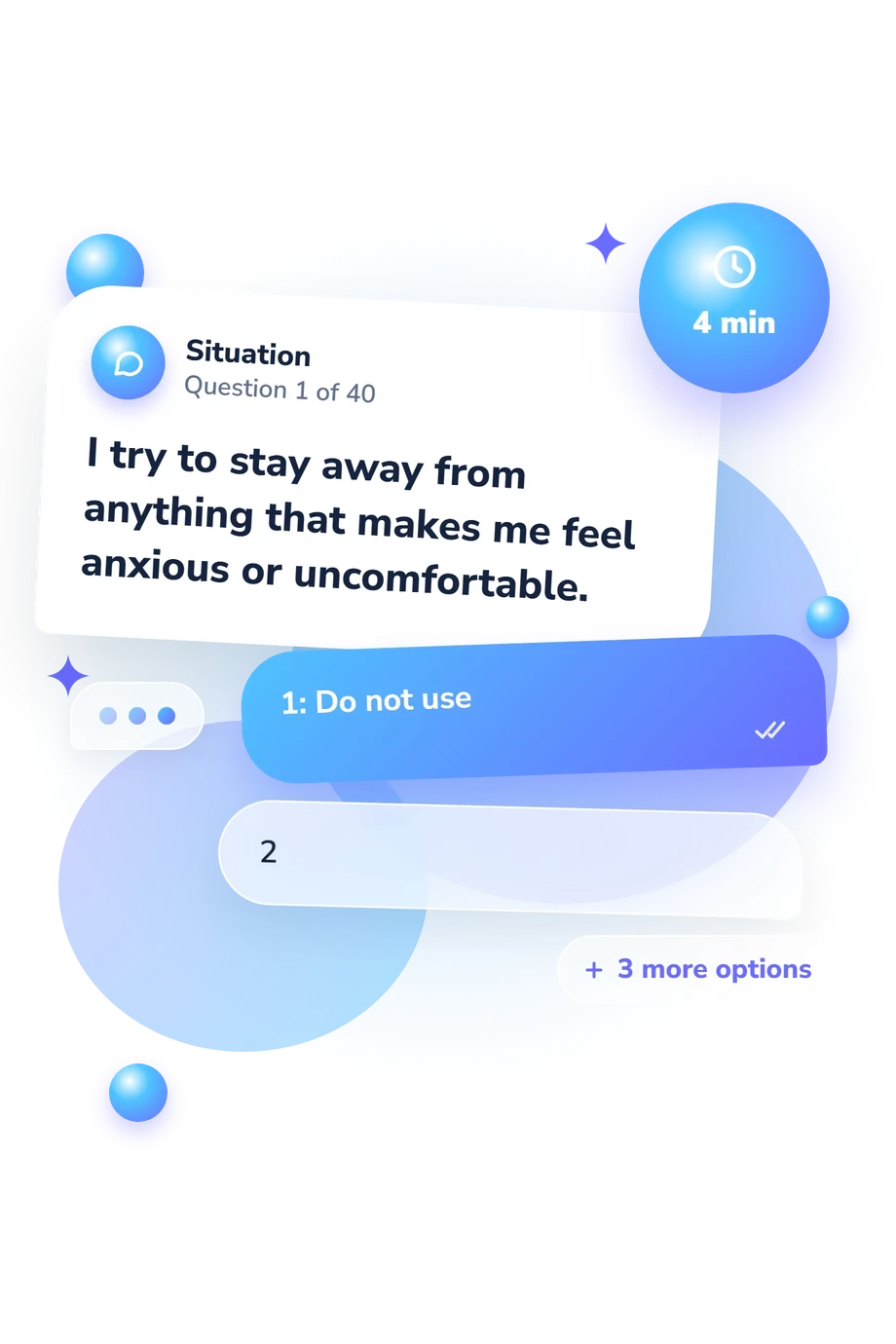
Example Questions From the Test
- 1: Do not use
- 2
- 3
- 4
- 5: Very often
- 1: Not at all
- 2
- 3
- 4
- 5: Very often
- 1: Never
- 2
- 3
- 4
- 5: Very often
Comprehensive Coping Inventory (CCI-20) Test - Description and methodology of the test
People examining recurring anxiety, threat-focused thinking, or avoidance may use a structured self-reflection tool to clarify their coping profile. The Comprehensive Coping Inventory (CCI-20) Test helps readers see how they appraise pressure, anticipate outcomes, and respond when discomfort rises. The result shows which of four measured tendencies are more prominent in the respondent’s profile.
What This Assessment Explores
Four related tendencies organize the result: difficulty handling distress, threat-biased interpretations, repetitive negative forecasting, and withdrawal from anxiety-provoking experiences. The profile is descriptive and shows how strongly each coping tendency is represented.
The displayed dimensions are:
- Stress Intolerance: 5-25 measures conviction that pressure and its emotions cannot be managed; Low 5-11, Moderate 12-18, High 19-25.
- Cognitive Reappraisal: 5-25 measures interpreting neutral or safe events as threatening; Low 5-11, Moderate 12-18, High 19-25.
- Worry: 5-25 measures persistent worry and negative expectations that may hinder problem-solving; Low 5-12, Moderate 13-19, High 20-25.
- Avoidance: 5-25 measures escaping people, places, situations, objects, or sensations that provoke distress; Low avoidance 5-11, Moderate avoidance 12-18, High avoidance 19-25.
Higher scores indicate stronger endorsement of the tendency measured by the relevant scale.
Methodology and Evidence Base
This coping questionnaire asks how often or how strongly each statement describes the respondent’s experience. The five response positions range from no endorsement or never at one end to very often at the other; some items label the low end as do not use. Responses are grouped by dimension, and four separate dimension scores are reported.
The related published Comprehensive Coping Inventory described in Zurita Ona’s 2007 dissertation provides a conceptual reference, and this questionnaire is conceptually consistent with it. Related CBT perspectives in McKay, Fanning, and Zurita Ona (2011) and McKay, Skeen, and Fanning (2017) help explain links among threat appraisal, worry, emotional distress, and avoidance. Folkman and Lazarus (1980) supply a broader framework for viewing coping as a response to demanding situations.
The dissertation’s evidence concerns its published instrument, whereas this online form presents the displayed low, moderate, and high bands as descriptive categories within each dimension. Current stress, self-awareness, and willingness to endorse uncomfortable reactions can shape self-report results, so use them to identify themes for reflection rather than as a standalone clinical conclusion.
- Zurita Ona, Patricia E. (2007). Development and Validation of a Comprehensive Coping Inventory. PhD dissertation, The Wright Institute, Berkeley, CA. ProQuest Dissertations and Theses.
- McKay, Matthew, Patrick Fanning, and Patricia E. Zurita Ona. (2011). Mind and Emotions: A Universal Treatment for Emotional Disorders. Oakland, CA: New Harbinger Publications.
- McKay, Matthew, Michelle Skeen, and Patrick Fanning. (2017). The CBT Anxiety Solution Workbook: A Breakthrough Treatment for Overcoming Fear, Worry, and Panic. Oakland, CA: New Harbinger Publications.
- Folkman, Susan, and Richard S. Lazarus. (1980). An Analysis of Coping in a Middle-Aged Community Sample. Journal of Health and Social Behavior, 21(3), 219-239. 10.2307/2136617
Updated: