
Freudly+971 508685814hello@freudly.ai
Freudly
cbt

Comprehensive Coping Inventory (CCI-55) Test
Take the online Comprehensive Coping Inventory (CCI-55) Test - AI psychologist FreudlyYou can take Comprehensive Coping Inventory (CCI-55) Testhere. Online version of a simple and accurate psychological test with interpretation.en
Understand how clients cope with stress and where coping breaks down in about 11 minutes. Get clear targets for treatment by pinpointing maladaptive patterns across a wide range of coping styles.
Start Online Test
Questions: 5511 minutes
08:30
October 2, 2025
October 2, 2025
Material has been updated
October 2, 2025
Material has been published
26,968 views
2,036 completions
1,645 likes
Verified by Daniel Hall
Psychologist with 25 years of experience
Share
Scale Explorer

How the Scales are Structured

example score
2/15
Rumination (R)
Measures the tendency toward repetitive, negative thinking about past events that can prolong distress.
Low
Elevated
-110: Low | 115: Elevated
A score of 2 falls in the Elevated range, suggesting some tendency to get stuck in repetitive negative thoughts about the past when stressed.
example score
6/15
Worry (W)
Measures the tendency toward recurring negative future-focused thoughts that can increase distress and hinder emotional recovery.
Low
Elevated
-110: Low | 115: Elevated
A score of 6 falls in the Elevated range, suggesting more frequent or intense anxious, future-oriented worrying as a coping pattern.
example score
4/15
Blaming Others (BO)
Measures the tendency to attribute personal difficulties primarily to other people’s actions or mistakes rather than one’s own role or situational factors.
Low externalization
Elevated externalization
-110: Low externalization | 115: Elevated externalization
A score of 4 falls in the Elevated externalization range, suggesting a noticeable tendency to shift responsibility for difficulties onto others, which may temporarily ease self-blame but can be linked with frustration or helplessness.
example score
6/15
Self-Blame (SB)
Measures the tendency to attribute negative events to one’s own fault, which can undermine self-esteem and self-forgiveness.
Low
Moderate
High
-11-1: Low | 07: Moderate | 815: High
A score of 6 falls in the Moderate range, suggesting a noticeable but not extreme tendency toward self-blame when unpleasant events occur.
example score
0/15
Cognitive Distortions (CD)
Measures the tendency to interpret situations through inaccurate or negatively skewed thinking patterns that can intensify emotional distress.
Low distortions
Typical range
Elevated distortions
-11-1: Low distortions | 0: Typical range | 115: Elevated distortions
A score of 0 falls in the typical range, suggesting cognitive distortions are not especially prominent in the person’s reported coping pattern.
example score
3/15
Cognitive Avoidance (CA)
Measures the tendency to suppress or mentally shift away from unpleasant thoughts to reduce discomfort.
Low
Moderate
High
-11-1: Low | 07: Moderate | 815: High
A score of 3 falls in the Moderate range, suggesting a noticeable but not dominant habit of mentally avoiding unpleasant thoughts.
example score
1/15
Emotional Avoidance (EA)
Measures the tendency to suppress, deny, or avoid experiencing intense emotions when under stress.
Low
Elevated
-110: Low | 115: Elevated
A score of 1 falls in the Elevated range, suggesting a noticeable tendency to avoid or suppress emotions rather than engage with them directly.
example score
7/15
Stress Intolerance (SI)
Measures how strongly a person tends to react emotionally and physically to stress and how difficult it is for them to regain control during unpleasant events.
Low
Elevated
-110: Low | 115: Elevated
A score of 7 falls in the Elevated range, suggesting stronger-than-usual stress reactivity that may make it harder to stay balanced and work through difficulties in the moment.
example score
-2/15
Emotional Behavior (EB)
Measures the tendency toward intense, automatically triggered emotional reactions to stress, especially frequent negative emotional expression that can prolong distress.
Low
Moderate
High
-11-1: Low | 07: Moderate | 815: High
A score of -2 falls in the Low range, suggesting relatively infrequent intense negative emotional reactions when under stress.
example score
1/15
Safety Behaviors (SB)
Assesses how often a person uses anxiety-reducing protective strategies such as avoidance, checking, or reassurance seeking when under stress.
Low use
Elevated use
-110: Low use | 115: Elevated use
A score of 1 falls in the Elevated use range, suggesting protective behaviors are used somewhat more than minimal levels and may modestly contribute to discomfort with uncertainty.
example score
-4/15
Behavioral Avoidance (BA)
Measures the tendency to avoid situations or actions that might trigger unpleasant emotions such as fear, shame, or guilt.
Low avoidance
High avoidance
-110: Low avoidance | 115: High avoidance
A score of -4 falls in the Low avoidance range, suggesting relatively infrequent reliance on avoiding stress-triggering situations or actions.
Start Online Test
just completed the test
DATA-BASED USER COHORTS

Who Usually Takes This Test?

Therapy Clients in Distress
41%OF USERS
People in psychotherapy who feel overwhelmed by stress, anxiety, or low mood take it to pinpoint which coping patterns are keeping them stuck.
Clinician Intake Assessments
34%OF USERS
Psychologists, psychotherapists, and counselors use it with new or ongoing clients to quickly map maladaptive coping strategies and guide treatment focus.
Progress Monitoring in Therapy
25%OF USERS
Clients and clinicians repeat it during treatment to track changes in avoidance, worry, and other coping responses over time.
BASED ON AGGREGATED, ANONYMIZED DATA FROM TENS OF THOUSANDS OF FREUDLY USERS.
Benchmarking

See How You Compare

Once you complete the test, your results are compared with real-world data from people in your country.
Below is a preview of how scores are typically distributed across each scale.
Rumination (R)
Rumination (R)
Average
4.3
Normal range
17.5
min.
-11
max.
15
This curve shows how scores are typically distributed.
Once you complete the test, your result will appear on the scale so you can see how you compare.
Anxiety (A)
Anxiety (A)
Average
2.5
Normal range
-1.86.8
min.
-11
max.
15
This curve shows how scores are typically distributed.
Once you complete the test, your result will appear on the scale so you can see how you compare.
Shifting the blame onto others (Stboo)
Average
6.5
Normal range
3.29.8
min.
-11
max.
15
This curve shows how scores are typically distributed.
Once you complete the test, your result will appear on the scale so you can see how you compare.
Self-Blame (S)
Self-Blame (S)
Average
7.6
Normal range
3.511.8
min.
-11
max.
15
This curve shows how scores are typically distributed.
Once you complete the test, your result will appear on the scale so you can see how you compare.
Cognitive Biases (CB)
Average
1.8
Normal range
-2.56.2
min.
-11
max.
15
This curve shows how scores are typically distributed.
Once you complete the test, your result will appear on the scale so you can see how you compare.
Cognitive Avoidance (CA)
Average
8
Normal range
3.912.1
min.
-11
max.
15
This curve shows how scores are typically distributed.
Once you complete the test, your result will appear on the scale so you can see how you compare.
Emotional Avoidance (EA)
Average
4.4
Normal range
-0.39.2
min.
-11
max.
15
This curve shows how scores are typically distributed.
Once you complete the test, your result will appear on the scale so you can see how you compare.
Inability to Handle Stress (ItHS)
Average
2.8
Normal range
-1.47.1
min.
-11
max.
15
This curve shows how scores are typically distributed.
Once you complete the test, your result will appear on the scale so you can see how you compare.
Emotional Behavior (EB)
Average
-3.4
Normal range
-7.40.5
min.
-11
max.
15
This curve shows how scores are typically distributed.
Once you complete the test, your result will appear on the scale so you can see how you compare.
Protective Behavior (PB)
Average
7.6
Normal range
3.711.6
min.
-11
max.
15
This curve shows how scores are typically distributed.
Once you complete the test, your result will appear on the scale so you can see how you compare.
Behavioral avoidance (Ba)
Average
6.2
Normal range
2.410.1
min.
-11
max.
15
This curve shows how scores are typically distributed.
Once you complete the test, your result will appear on the scale so you can see how you compare.
Featured On
SAMPLE QUESTIONS

Example Questions From the Test

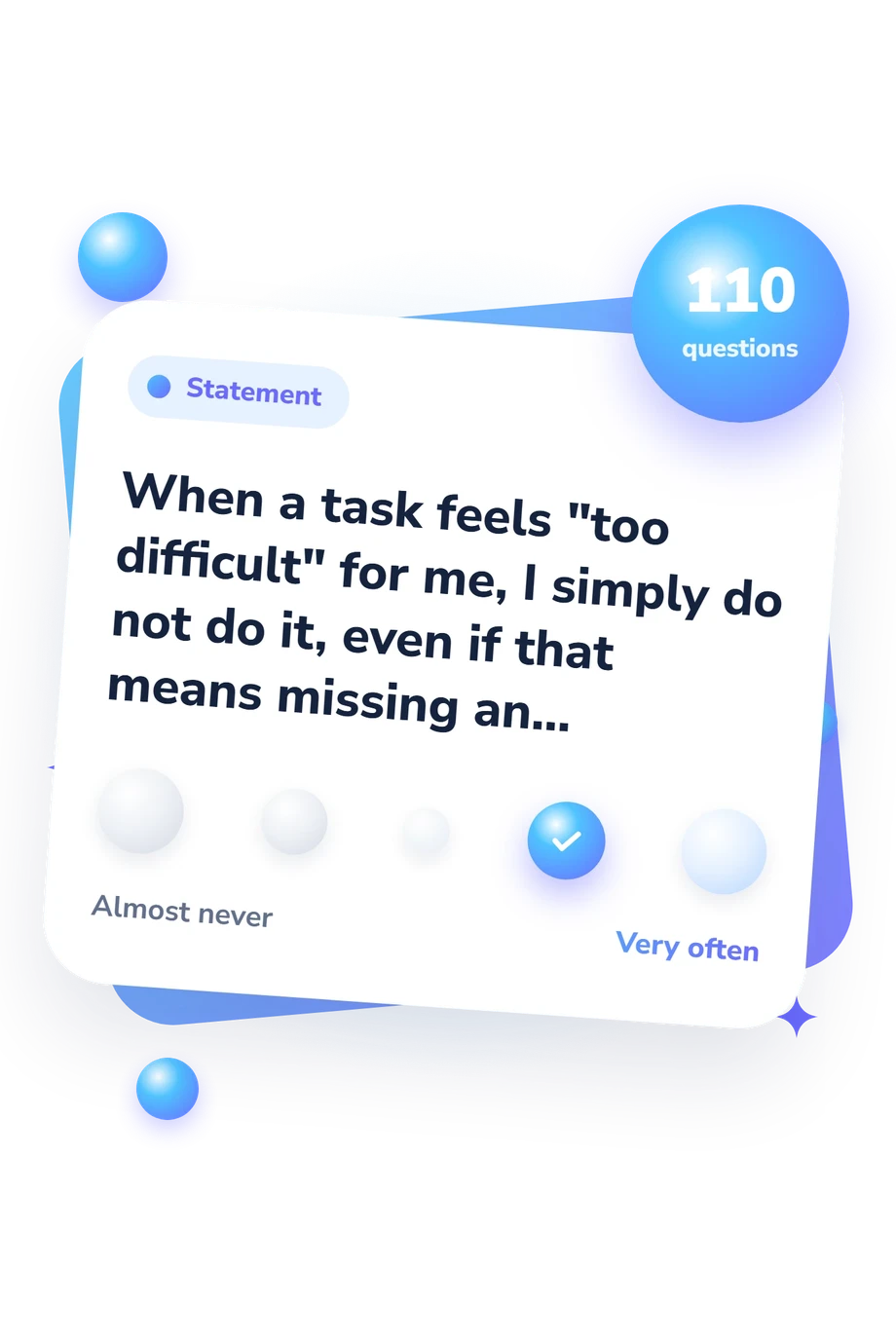
Think about any difficult, unpleasant, or stressful events you have experienced during the past three months. Below are the most common stressful situations and the strategies people use to cope with difficulties and manage stress. Indicate how often you experience particular feelings and emotions, or how often you use a particular strategy. Select the response options that best fit your situation. Do not try to guess which answer is the most “correct” or how most people would respond. There are no “bad” or “good” answers—these are simply different ways people cope with difficulties. When answering the questions, be as honest as possible. Only you will see your test results, and it is important to understand which specific mechanisms may be interfering with your daily functioning. Therefore, there is no need to feel ashamed or embarrassed if you recognize yourself in certain patterns of behavior.
    • Almost never
    • Rarely
    • Sometimes
    • Often
    • Very often
    • Almost never
    • Rarely
    • Sometimes
    • Often
    • Very often
    • Almost never
    • Rarely
    • Sometimes
    • Often
    • Very often
WHAT THE TEST MEASURES
About This Assessment
Comprehensive Coping Inventory, CCI-55 Test

Comprehensive Coping Inventory (CCI-55) Test - Symptoms and Signs

cbt
defense mechanisms

This self-report measure is intended to characterize how an individual typically responds to stress and emotional distress. The Comprehensive Coping Inventory (CCI-55) can help identify coping patterns that may be adaptive versus those that may be associated with difficulties in adjustment.

It includes 55 items and typically takes about 11 minutes to complete. Item content samples a range of coping mechanisms (e.g., avoidance, worry, and cognitive/perceptual distortions) that may be relevant across multiple clinical presentations. Results are commonly used to support case formulation, guide treatment planning, and monitor change over time when interpreted in clinical context; the Comprehensive Coping Inventory (CCI-55) is not a standalone diagnostic instrument.

Author: Richard S. Lazarus, Susan Folkman
Literature: Folkman, S., & Lazarus, R. S. An analysis of coping in a middle-aged community sample. Journal of Health and Social Behavior. 1980.; Barlow, D. H. Anxiety and its disorders: The nature and treatment of anxiety and panic. Guilford Press. 2002.
Popular tests
Comments
Leave a Comment