
Freudly+971 508685814hello@freudly.ai
Freudly
family

Rewards and Punishments Test
Take the online Rewards and Punishments Test - AI psychologist FreudlyYou can take Rewards and Punishments Testhere. Online version of a simple and accurate psychological test with interpretation.en
Understand how childhood rewards and punishments shaped you in just 10 minutes. Get clear scores that pinpoint parenting patterns and guide the next steps in therapy or self-work.
Start Online Test
Questions: 5410 minutes
08:30
October 2, 2025
October 2, 2025
Material has been updated
October 2, 2025
Material has been published
19,535 views
2,413 completions
2,111 likes
Verified by Daniel Hall
Psychologist with 25 years of experience
Share
Scale Explorer

How the Scales are Structured

example score
3/12
Serious Misconduct (SM)
This scale measures how often serious childhood offenses or significant misbehavior were present in the participant's experience.
Low
Moderate
High
03: Low | 47: Moderate | 812: High
A score of 3 falls in the Low range, suggesting few indications of serious offenses in the described childhood behavior history.
example score
7/12
Moderate Misconduct (MM)
Assesses how often moderate childhood offenses or rule violations were present and drew parental attention.
Low
Moderate
High
03: Low | 48: Moderate | 912: High
A score of 7 falls in the Moderate range, suggesting a noticeable but not extreme frequency of moderate offenses in childhood that likely required periodic parental response.
example score
8/12
Minor Misconduct (MM)
Measures how often the child engaged in minor misdeeds or small rule/norm violations in childhood recollections.
Low
Moderate
High
03: Low | 48: Moderate | 912: High
A score of 8 falls in the Moderate range, suggesting occasional to fairly frequent minor rule or norm violations in childhood experience.
example score
8/12
Psychological Pressure (PP)
Measures how often a parent used psychological pressure (e.g., emotional manipulation) as a form of punishment during childhood.
Low
Moderate
High
04: Low | 58: Moderate | 912: High
A score of 8 falls in the Moderate range, suggesting psychological pressure was used fairly often but not at the highest level.
example score
10/12
Physical Punishment and Coercion (PPaC)
Assesses how often physical force and coercion were used as punishment in childhood parenting experiences.
Low
Moderate
High
03: Low | 48: Moderate | 912: High
A score of 10 falls in the High range, suggesting physical punishments and coercive discipline were reported as relatively frequent in childhood.
example score
9/12
Deprivation of Material Goods (DoMG)
Measures how often punishment in childhood involved restricting or withholding material goods.
Low
Moderate
High
04: Low | 58: Moderate | 912: High
A score of 9 falls in the High range, suggesting material restriction was a relatively frequent form of punishment in your childhood experience.
example score
10/12
Praise and Support (PaS)
Measures how often a parent used praise and emotional support to encourage the child during childhood.
Low
Moderate
High
04: Low | 58: Moderate | 912: High
A score of 10 falls in the High range, suggesting frequent experiences of parental praise and emotional support as a form of positive reinforcement.
example score
7/12
Granting Greater Autonomy (GGA)
Measures how often a parent encouraged the child by granting greater freedom and autonomy.
Low freedom-granting
Moderate freedom-granting
High freedom-granting
04: Low freedom-granting | 58: Moderate freedom-granting | 912: High freedom-granting
A score of 7 falls in the Moderate freedom-granting range, suggesting freedom was used as encouragement with some regularity but not as a dominant pattern.
example score
8/12
Pleasures and Material Rewards (PaMR)
This scale measures how often material rewards and pleasurable incentives were used in childhood as a way to motivate behavior.
Low
Moderate
High
04: Low | 58: Moderate | 912: High
A score of 8 falls in the Moderate range, suggesting material rewards and pleasures were used fairly often but were not the dominant motivational approach.
Start Online Test
just completed the test
DATA-BASED USER COHORTS

Who Usually Takes This Test?

Therapy and coaching clients
41%OF USERS
People in personal work who want to connect current habits, self-esteem, or relationship patterns to how they were rewarded or punished growing up.
Self-reflection seekers
34%OF USERS
Adults curious about their upbringing who want a quick, structured way to recall and quantify childhood responses from caregivers.
Psychology students and practitioners
25%OF USERS
Learners and professionals who use brief assessments to map parenting dynamics and guide further discussion or intervention.
BASED ON AGGREGATED, ANONYMIZED DATA FROM TENS OF THOUSANDS OF FREUDLY USERS.
Benchmarking

See How You Compare

Once you complete the test, your results are compared with real-world data from people in your country.
Below is a preview of how scores are typically distributed across each scale.
Serious offenses (So)
Average
3.1
Normal range
0.95.3
min.
0
max.
12
This curve shows how scores are typically distributed.
Once you complete the test, your result will appear on the scale so you can see how you compare.
Moderate Offenses (MO)
Average
5.3
Normal range
3.86.9
min.
0
max.
12
This curve shows how scores are typically distributed.
Once you complete the test, your result will appear on the scale so you can see how you compare.
Minor Offenses (MO)
Minor Offenses (MO)
Average
7
Normal range
59
min.
0
max.
12
This curve shows how scores are typically distributed.
Once you complete the test, your result will appear on the scale so you can see how you compare.
Psychological Pressure (PP)
Average
5.5
Normal range
3.97.2
min.
0
max.
12
This curve shows how scores are typically distributed.
Once you complete the test, your result will appear on the scale so you can see how you compare.
Physical Punishments and Coercion (PPaC)
Average
6.7
Normal range
4.88.6
min.
0
max.
12
This curve shows how scores are typically distributed.
Once you complete the test, your result will appear on the scale so you can see how you compare.
Deprivation of material goods (Domg)
Average
8.9
Normal range
7.210.7
min.
0
max.
12
This curve shows how scores are typically distributed.
Once you complete the test, your result will appear on the scale so you can see how you compare.
Praise and Support (PaS)
Average
7.9
Normal range
6.29.6
min.
0
max.
12
This curve shows how scores are typically distributed.
Once you complete the test, your result will appear on the scale so you can see how you compare.
Granting Greater Freedom (GGF)
Average
7.3
Normal range
5.78.8
min.
0
max.
12
This curve shows how scores are typically distributed.
Once you complete the test, your result will appear on the scale so you can see how you compare.
Pleasures, material reward (Pmr)
Average
6.8
Normal range
5.38.3
min.
0
max.
12
This curve shows how scores are typically distributed.
Once you complete the test, your result will appear on the scale so you can see how you compare.
Featured On
SAMPLE QUESTIONS

Example Questions From the Test

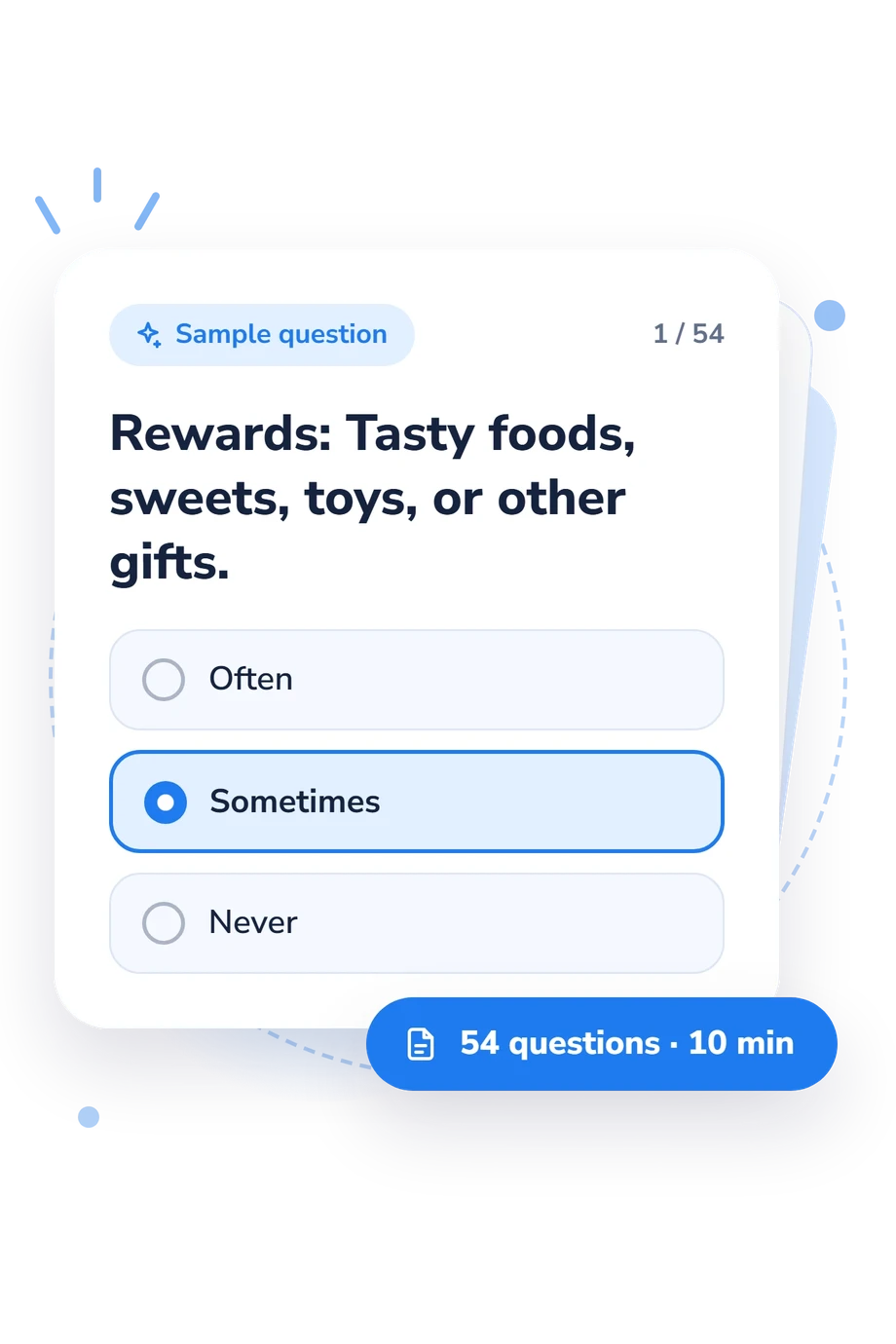
    • Often
    • Sometimes
    • Never
    • Often
    • Sometimes
    • Never
    • Often
    • Sometimes
    • Never
WHAT THE TEST MEASURES
About This Assessment
Rewards and Punishments, R&P Test

Rewards and Punishments Test - Symptoms and Signs

family
upbringing

This measure is designed to examine recalled childhood experiences of caregiver responses to behavior, with an emphasis on reinforcement and disciplinary practices. Rewards and Punishments presents a series of situational statements for respondents to rate how often specific parental reactions occurred in their upbringing.

The instrument contains 54 items and typically requires about 10 minutes to complete. Items sample a range of reinforcement and punishment scenarios to support a quantitative summary of perceived frequency and relative prominence of these experiences.

In clinical or research contexts, Rewards and Punishments may be used to inform case formulation by characterizing early learning contingencies and their potential associations with current behavior patterns and beliefs. It is attributed to B. F. Skinner and is generally interpreted alongside other clinical data rather than as a standalone diagnostic tool.

Author: B. F. Skinner
Literature: Skinner, B. F. Science and human behavior. Macmillan. 1953.
Popular tests
Comments
Leave a Comment