
Psychological Readiness to Provide Assistance Scale Test
How the Scales are Structured
Who Usually Takes This Test?
See How You Compare
Below is a preview of how scores are typically distributed across each scale.
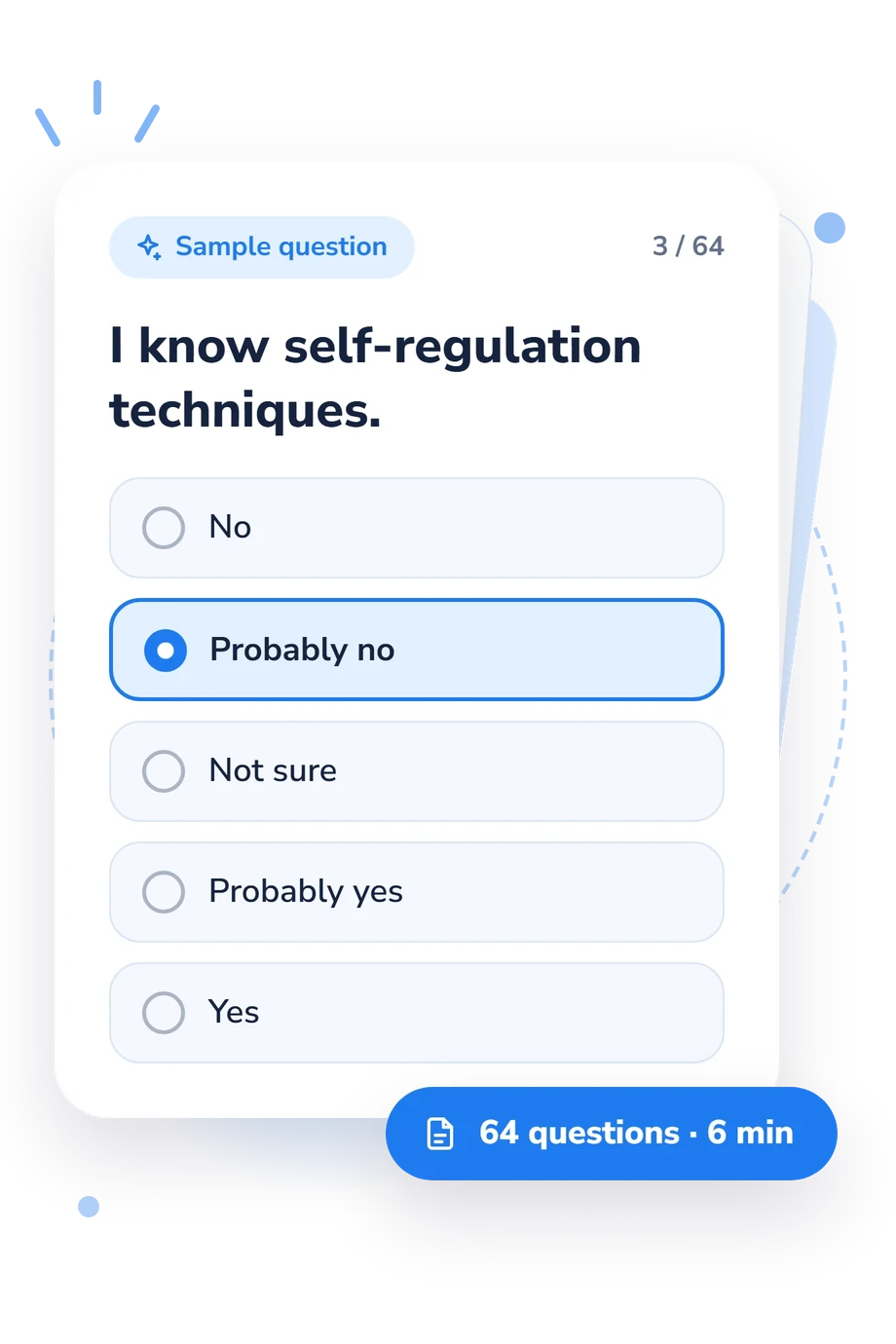
Example Questions From the Test
- No
- Probably not
- Not sure
- Probably yes
- Yes
- No
- Probably not
- Not sure
- Probably yes
- Yes
- No
- Probably no
- Not sure
- Probably yes
- Yes
Psychological Readiness to Provide Assistance Scale Test - Description and methodology of the test
People who may support others during emergencies can use the Psychological Readiness to Provide Assistance Scale Test to examine whether their attitudes, knowledge, self-regulation, and action habits fit demanding helping situations. For anyone considering volunteer, response, care, or community-support roles, readiness to help in emergencies is worth examining before taking responsibility. The single readiness score can guide reflection on skills to strengthen and preparation for helping roles.
What This Assessment Explores
Responses focus on resources that may support effective assistance under pressure. They suit people considering helping roles, emergency work, volunteering, or examining how they may react when another person needs support. This questionnaire assesses readiness to provide emergency assistance and highlights preparation needs.
Items address these themes:
- Planning and self-regulation show how you organize action, manage pressure, and mobilize resources.
- Empathic communication reflects patient listening, understanding distress, and easing tension.
- Knowledge and judgment indicate familiarity with acute stress, emergency interaction, and mental-state assessment.
- Responsibility and teamwork capture willingness to help, follow standards, stay focused, and coordinate.
The result is reported as Psychological Readiness to Provide Assistance on a 0-100 scale. Results indicate low, moderate, or high readiness: Low readiness (0-33), Moderate readiness (34-66), or High readiness (67-100); the themes above describe item content rather than separate scores.
Methodology and Scientific Basis
Each statement uses a five-choice response format running from No to Yes, with intermediate options such as Probably not, Not sure, and Probably yes. The items ask about planning, self-regulation, empathy, knowledge, attention, endurance, communication, rule-following, teamwork, and emergency action. Because this questionnaire is a self-report readiness test, its score reflects how the respondent sees their usual capacities and intentions; honest answers matter because the result depends on those judgments.
The displayed score summarizes the pattern of answers, but the questionnaire does not state how many points each response contributes. The relevant instrument is PGOPP-1 (Kharitonova & Stavskaya, 2019), with related discussion in their 2017 study. The online questionnaire is conceptually consistent with PGOPP-1 and is not an adaptation of that instrument. This online version has no separate standardization or validation.
Interpret the result as a prompt for reflection, training, and suitable helping roles. Its precision is limited by self-report bias, current stress, confidence, and experience; a score cannot establish competence in a real emergency or replace broader preparation and assessment.
- Kharitonova, Tamara G., and Kristina S. Stavskaya. “Methodological Aspects of the Development and Use of the Questionnaire ‘Psychological Readiness to Provide Assistance to Victims in an Extreme Situation.’” Koncept: Scientific and Methodological Electronic Journal, no. 8, 2019, pp. 93-103. 10.24411/2304-120X-2019-12034.
- Kharitonova, Tamara G., and Kristina S. Stavskaya. “On the Problem of the Population’s Psychological Readiness to Provide Assistance to Victims in an Extreme Situation.” Problems of Modern Pedagogical Education. Series: Pedagogy and Psychology, vol. 54, no. 4, 2017, pp. 220-233.
Updated: