
Freudly+971 508685814hello@freudly.ai
Freudly
cognitive functions

Dyscalculia Test for Adults: Numbers, Reading and Spelling
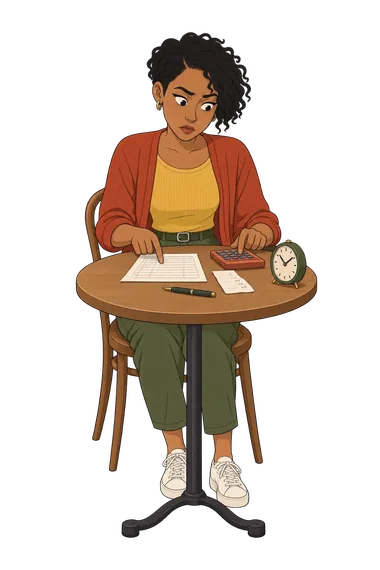
Dyscalculia Test for Adults, with Dyslexia Traits - FreudlyFree dyscalculia test for adults: 25 everyday statements show how much effort numbers and words cost you, with separate dyscalculia and dyslexia scores.en
Do sums vanish from your head while letters swap places on the page? This dyscalculia test for adults turns 25 everyday statements into one score from 0 to 100 and shows where the effort goes: mental arithmetic, time and directions, reading or spelling. It takes about 5 minutes.
Questions: 255 minutes
Dyscalculia Test for Adults: splitting the bill
October 28, 2026October 28, 2026Material has been updatedOctober 28, 2026Material has been published
7,758 views
692 completions
595 likes
Daniel HallPsychologist · Test reviewer
595 likes
Scale Explorer

How the Scales are Structured

Learning difficulty traitsLdt
How much extra effort numbers and words cost you, from 0 to 100.
example score68/100
68/100Pronounced traitsexample score
0 – 40Few traits
41 – 65Some traits
66 – 100Pronounced traits
Your learning difficulty traits score is 68 out of 100: Pronounced traits.
Mental arithmeticMa
Sums in your head, tips, change and swapped digits.
example score18/28
18/28Moderateexample score
0 – 11Low
12 – 18Moderate
19 – 28High
You scored 18 out of 28: Moderate.
Clocks, schedules and directionsCsad
Clocks, dates, left and right, order and rough totals.
example score15/24
15/24Moderateexample score
0 – 10Low
11 – 16Moderate
17 – 24High
You scored 15 out of 24: Moderate.
ReadingR
Re-reading, losing the line and reading aloud.
example score15/24
15/24Moderateexample score
0 – 10Low
11 – 16Moderate
17 – 24High
You scored 15 out of 24: Moderate.
Spelling and writingSaw
Spelling, swapped letters and forms.
example score15/24
15/24Moderateexample score
0 – 10Low
11 – 16Moderate
17 – 24High
You scored 15 out of 24: Moderate.
Numbers (dyscalculia traits)Nt
How much effort numbers, time and money take.
example score33/52
33/52Moderateexample score
0 – 21Low
22 – 34Moderate
35 – 52High
You scored 33 out of 52: Moderate.
Reading and writing (dyslexia traits)Rawt
How much effort reading and spelling take.
example score31/48
31/48Moderateexample score
0 – 19Low
20 – 31Moderate
32 – 48High
You scored 31 out of 48: Moderate.
just completed the test
DATA-BASED USER COHORTS

Who Usually Takes This Test?

Always bad at maths
38%OF USERS
Numbers slipped away at school and still do at the till, and you want to know why.
Readers who work twice as hard
35%OF USERS
You re-read emails, dread reading aloud and lean on spellcheck, and wonder if it has a name.
Parents who saw it in their child
27%OF USERS
Your child's school flagged something, and you recognised your own school years in it.
BASED ON AGGREGATED, ANONYMIZED DATA FROM TENS OF THOUSANDS OF FREUDLY USERS.
Benchmarking

See How You Compare

Once you complete the test, your results are compared with real-world data from people in your country.
Below is a preview of how scores are typically distributed across each scale.
Shaded area — where most people score
Dot — the average
You — your score lands on each curve after the test— your score, after the test
Learning difficulty traitsLdt
You?
Average38
Typical rangeTypical27.2 – 48.8
Possible0 – 100
Mental arithmeticMa
You?
Average11
Typical rangeTypical8 – 14
Possible0 – 28
Clocks, schedules and directionsCsad
You?
Average9
Typical rangeTypical6.3 – 11.7
Possible0 – 24
ReadingR
You?
Average9
Typical rangeTypical6.3 – 11.7
Possible0 – 24
Spelling and writingSaw
You?
Average9
Typical rangeTypical6.3 – 11.7
Possible0 – 24
Numbers (dyscalculia traits)Nt
You?
Average20
Typical rangeTypical14.6 – 25.4
Possible0 – 52
Reading and writing (dyslexia traits)Rawt
You?
Average18
Typical rangeTypical12.6 – 23.4
Possible0 – 48
Featured On
SAMPLE QUESTIONS

Example Questions From the Test

Think about an ordinary week, not one tired evening or one good day. Each statement describes a moment you may know: a tip at a café, a clock on the wall, a form, a page of text. Choose how often it happens to you, from Never to Very often; your first reaction is usually the most accurate. Four statements describe the easy opposite and are scored in reverse, so read each one to the end. There are 25 statements, and the whole test takes about 5 minutes.
    • Never
    • Rarely
    • Sometimes
    • Often
    • Very often
    • Never
    • Rarely
    • Sometimes
    • Often
    • Very often
    • Never
    • Rarely
    • Sometimes
    • Often
    • Very often
WHAT THE TEST MEASURES

Dyscalculia Test for Adults: Numbers, Reading and Spelling - Description and methodology of the test

cognitive functions

Some adults have spent years quietly working around numbers and words: the calculator for every tip, the email read three times before sending. This dyscalculia test for adults looks at those everyday workarounds and the patterns behind them. Many people only start to suspect learning difficulties long after school, once work, bills and forms pile up, and a clear picture of where the effort goes is the first useful step.

What the test measures

The questionnaire covers four areas of everyday life. Mental arithmetic asks about sums in your head, tips, change and digits that swap places. Clocks, schedules and directions covers reading the time, mixing up left and right, keeping steps in order and estimating what you will pay. Persistent trouble with numbers in situations like these is what Brian Butterworth and other researchers call developmental dyscalculia. Reading looks at re-reading, losing the line and reading aloud, while spelling looks at swapped letters, uncertain words and long forms. Adult reading difficulties of this kind are the everyday signs Michael Vinegrad gathered in his checklist of how dyslexia shows up after school. The four areas add up to one overall score and also form two summaries: numbers, linked to dyscalculia, and reading and writing, linked to dyslexia.

How the test works and how to read the result

You rate 25 short statements about real moments, such as splitting a bill or filling in a form, from “Never” to “Very often”. It takes about 5 minutes. Number and word statements are mixed, and four of them describe the easy opposite, like spotting wrong change at a glance, so they are scored in reverse. Answer for an ordinary week, not for one tired evening. The result shows:

  • your overall score from 0 to 100 with a plain label: few, some or pronounced traits;
  • separate scores for mental arithmetic, time and directions, reading, and spelling;
  • your numbers score and your reading and writing score side by side;
  • how your answers compare with other people who took the same test.

People who come looking for a dyslexia test for adults are often surprised to find that numbers cost them more effort than words, or the other way round. That split matters, because the workarounds that help on each side are different. Seeing which side is heavier tells you where a small change will save you the most time.

Literature:
  • Vinegrad, M. (1994). A revised adult dyslexia checklist. Educare, 48, 21-23.
  • Butterworth, B. (1999). The Mathematical Brain. London: Macmillan.
  • Butterworth, B. (2005). The development of arithmetical abilities. Journal of Child Psychology and Psychiatry, 46(1), 3-18.
  • Butterworth, B., Varma, S., & Laurillard, D. (2011). Dyscalculia: From brain to education. Science, 332(6033), 1049-1053.
  • Snowling, M. J. (2000). Dyslexia (2nd ed.). Oxford: Blackwell.

Updated:

Popular tests
Comments
Leave a Comment