
Dispositional Tolerance Test
How the Scales are Structured
Who Usually Takes This Test?
See How You Compare
Below is a preview of how scores are typically distributed across each scale.
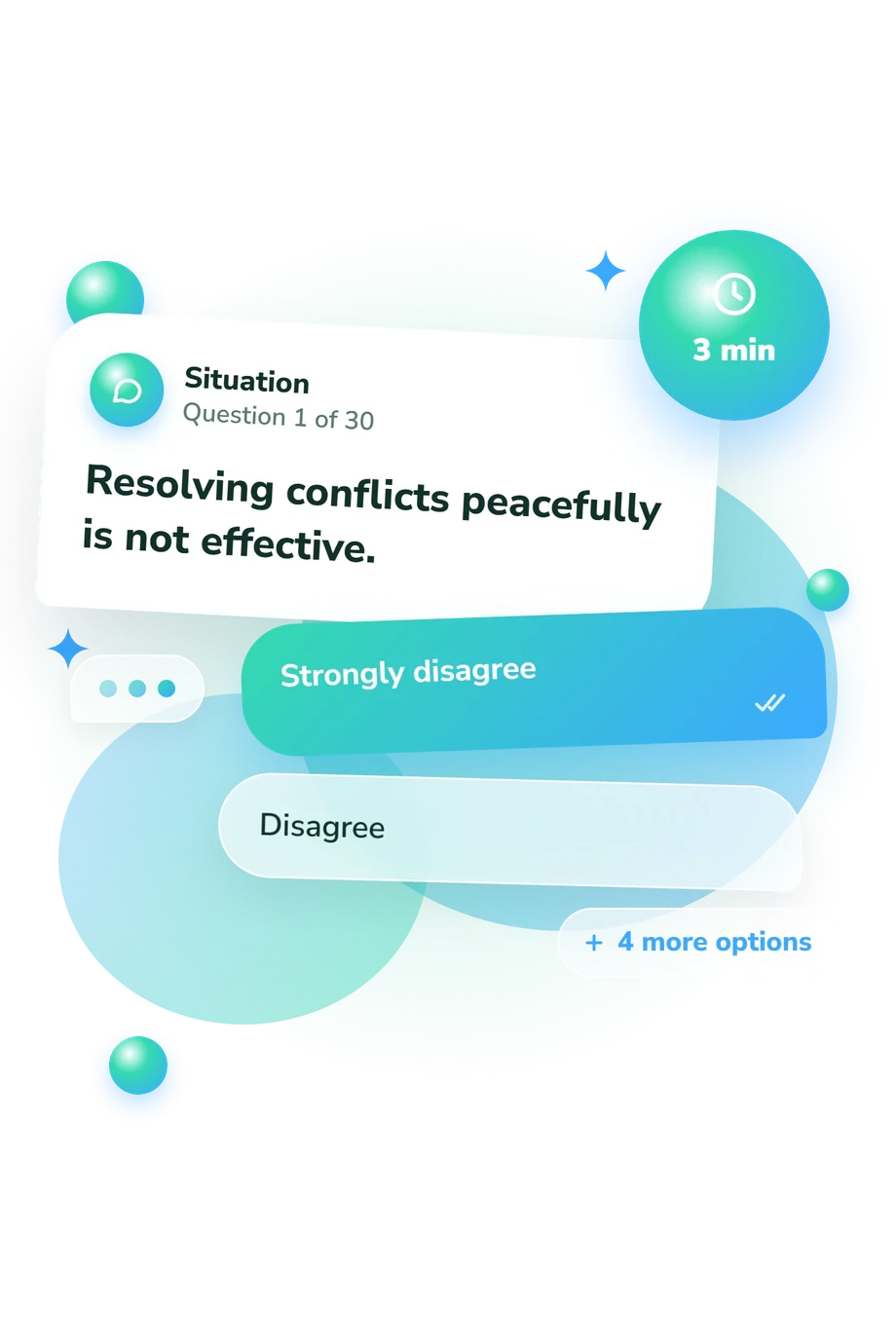
Example Questions From the Test
- Strongly disagree
- Disagree
- Somewhat disagree
- Somewhat agree
- Agree
- Strongly agree
- Strongly disagree
- Disagree
- Somewhat disagree
- Somewhat agree
- Agree
- Strongly agree
- Strongly disagree
- Disagree
- Somewhat disagree
- Somewhat agree
- Agree
- Strongly agree
Dispositional Tolerance Test - Description and methodology of the test
For readers examining how they meet disagreement, difference, and everyday friction, the Dispositional Tolerance Test offers a focused self-report result. This social tolerance test connects broad attitudes with concrete reactions, including how someone handles another person’s customs, mistakes, pace, opinions, and boundaries. Together, these reactions show how a general attitude may appear in everyday interactions.
What This Assessment Explores
Tolerance describes a social disposition: how someone views people, their behavior, oneself, and life generally. It concerns accepting differing viewpoints, understanding mistakes, and responding without retaliation. The construct is attitudinal, not physiological, and may coexist with sensitivity.
The statements touch four themes:
- Respect for difference reflects comfort with other customs, appearances, and expressive behavior.
- Conflict regulation covers peaceful resolution, forgiveness, second chances, and reactions to rudeness.
- Boundary awareness shows whether limits can be protected without violating others’ boundaries.
- Anger, impatience, resentment, and vindictiveness appear in situations interpreted through the overall tolerance tendency.
One displayed scale is Dispositional Tolerance (15-90): Lower tolerance (15-39), Moderate tolerance (40-64), and Higher tolerance (65-90). A higher result on this tolerance assessment suggests openness and understanding across these situations, while a lower result suggests more difficulty. The score describes a tendency, not a fixed identity.
Methodology and Scientific Basis
Each statement uses a six-point agreement continuum, moving from disagreement to agreement; some choices use ‘strongly’ and others ‘completely,’ but the response task remains the same. The themes include customs, forgiveness, boundaries, reciprocal behavior, impatience, anger, and reactions to humiliation or ridicule.
In its online form, the dispositional tolerance questionnaire condenses those responses into one overall result. The questionnaire does not state item weights, reverse-keyed items, or the point contribution of each option, so those details should not be inferred. Its displayed bands function as result categories rather than population norms.
Conceptually, it aligns with the Dispositional Forbearance Scale reported by Rean and colleagues, the closest subject-specific evidence for the construct, but it is not presented as a direct adaptation of that published scale. Allport’s account of prejudice supplies a broader theoretical context, while Soldatova et al. describe personality tolerance within a Russian psychodiagnostic tradition.
Because responses are self-reported, results can shift with current mood, recent conflict, social desirability, and self-awareness. The bands are useful for structured reflection, but they do not establish a diagnosis or show how the respondent compares with a representative population.
- Rean, A. A., Shevchenko, A. O., & Stavtsev, A. A. (2024). Development and Approbation of the Dispositional Forbearance Scale. Experimental Psychology (Russia), 17(2), 217-228. 10.17759/exppsy.2024170213
- Soldatova, G. U., Shaigerova, L. A., Prokofieva, T. Yu., & Kravtsova, O. A. (2008). Psychodiagnostics of Personality Tolerance. Moscow: Smysl. 172 pp.
- Allport, G. W. (1954). The Nature of Prejudice. Reading, MA: Addison-Wesley.
Updated: