
Dispositional Egoism Scale Test
How the Scales are Structured
Who Usually Takes This Test?
See How You Compare
Below is a preview of how scores are typically distributed across each scale.
Example Questions From the Test
- 1: strongly disagree
- 2
- 3
- 4: neither agree nor disagree
- 5
- 6
- 7: strongly agree
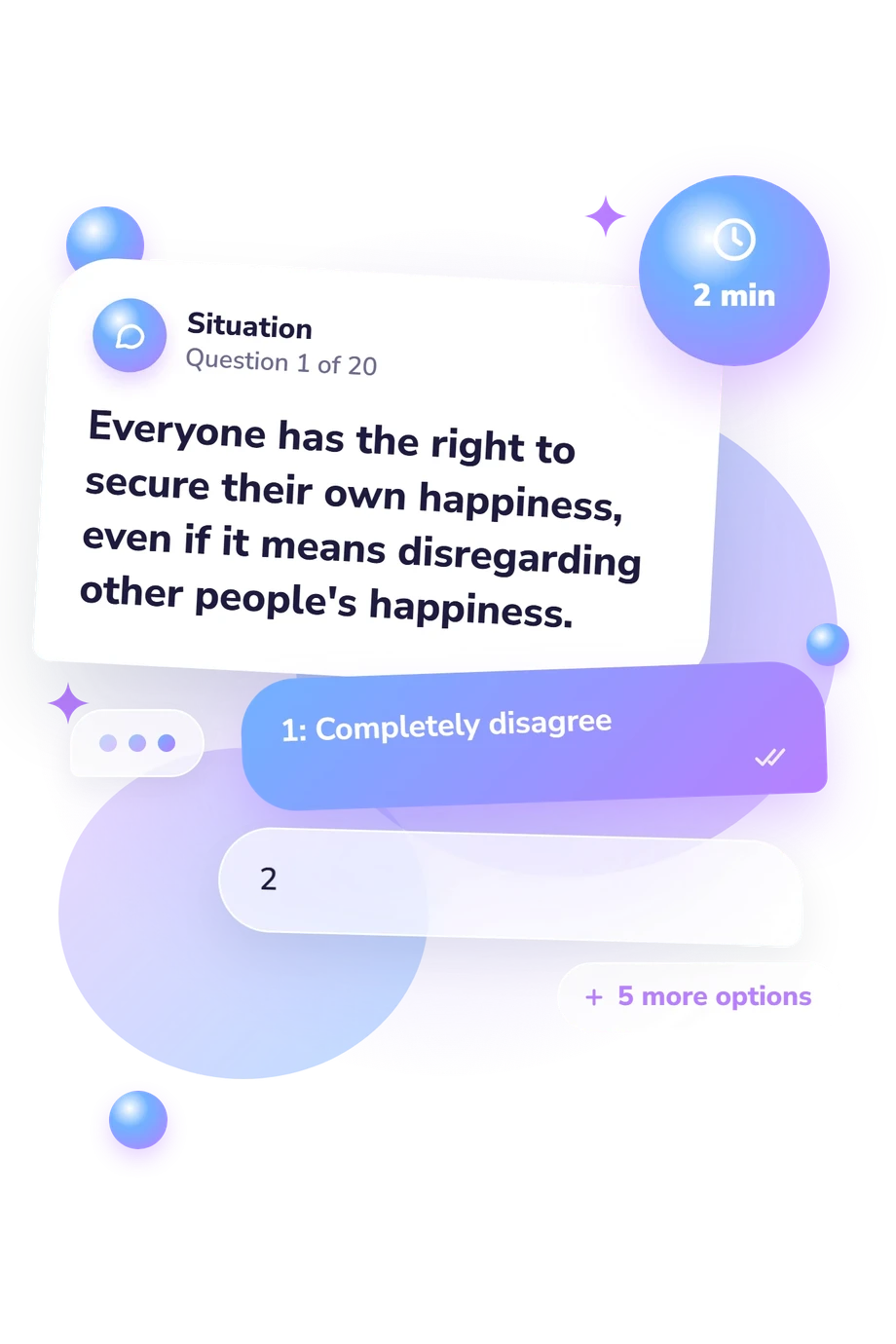
- 1: Completely disagree
- 2
- 3
- 4: Neither agree nor disagree
- 5
- 6
- 7: Completely agree
- 1: Completely disagree
- 2
- 3
- 4: Neither agree nor disagree
- 5
- 6
- 7: Completely agree
Dispositional Egoism Scale Test - Description and methodology of the test
People who want to examine how strongly self-interest shapes their moral and everyday judgments may find the Dispositional Egoism Scale Test a focused starting point. It is intended for readers reflecting on how they weigh personal happiness, other people’s welfare, and competitive advantage. An egoism assessment result offers a compact indication of the tendency represented by these choices, not a permanent description of character.
What This Assessment Explores
The questionnaire examines dispositional tendencies rather than one isolated decision. It asks whether personal happiness should take priority when it conflicts with another person’s well-being, whether goals should be moderated by concern for others, and whether gaining an advantage is acceptable in competition. The items form a dispositional egoism questionnaire capturing these judgments in everyday social situations.
The statements cluster around three practical themes:
- Personal happiness and well-being are treated as priorities that may be pursued even when they conflict with other people’s interests.
- Regard for others shows whether feelings, welfare, and possible harm are given weight alongside personal goals.
- Competitive advantage reflects how acceptable respondents find taking opportunities that improve their position.
Results are reported as Dispositional Egoism on a 10-70 scale: Low egoism 10-29, Moderate egoism 30-49, and High egoism 50-70. Higher scores indicate stronger prioritization of personal interests; lower scores indicate more consideration of others’ needs.
Methodology and Scientific Basis
Seven-position response scales structure the questionnaire. Across its ten statements, the endpoints express disagreement and agreement around a neutral midpoint, while the neutral wording varies between items. The questionnaire presents one composite result without stating how individual responses are weighted beyond the displayed scale and its result bands; it therefore summarizes an overall tendency rather than providing separate item scores.
The construct is conceptually consistent with Muzdybaev's 2000 Dispositional Egoism Scale, while this online form has no stated standardization procedure or published norms. Batson's 1994 work and Batson and Shaw's 1991 work provide a complementary framework for distinguishing self-interested choices from altruistic or prosocial motives. Their work clarifies why regard for others matters here without making this questionnaire a measure of every prosocial motive.
As an egoism personality assessment, the questionnaire yields a descriptive snapshot of self-reported attitudes. Social desirability, current mood, recent interpersonal experiences, and limited self-awareness can shape answers. The displayed bands support self-reflection, but understanding behavior across settings requires broader evidence than this brief questionnaire alone.
- Muzdybaev, K. (2000). Egoism of personality. Psychological Journal, 21(2), 27-39.
- Batson, C. D. (1994). Why act for the public good? Four answers. Personality and Social Psychology Bulletin, 20(5), 603-610. DOI 10.1177/0146167294205016
- Batson, C. D., & Shaw, L. L. (1991). Evidence for altruism: Toward a pluralism of prosocial motives. Psychological Inquiry, 2(2), 107-122. DOI 10.1207/s15327965pli0202_1
Updated: