
Basic Needs Satisfaction at Work Scale Test
How the Scales are Structured
Who Usually Takes This Test?
See How You Compare
Below is a preview of how scores are typically distributed across each scale.
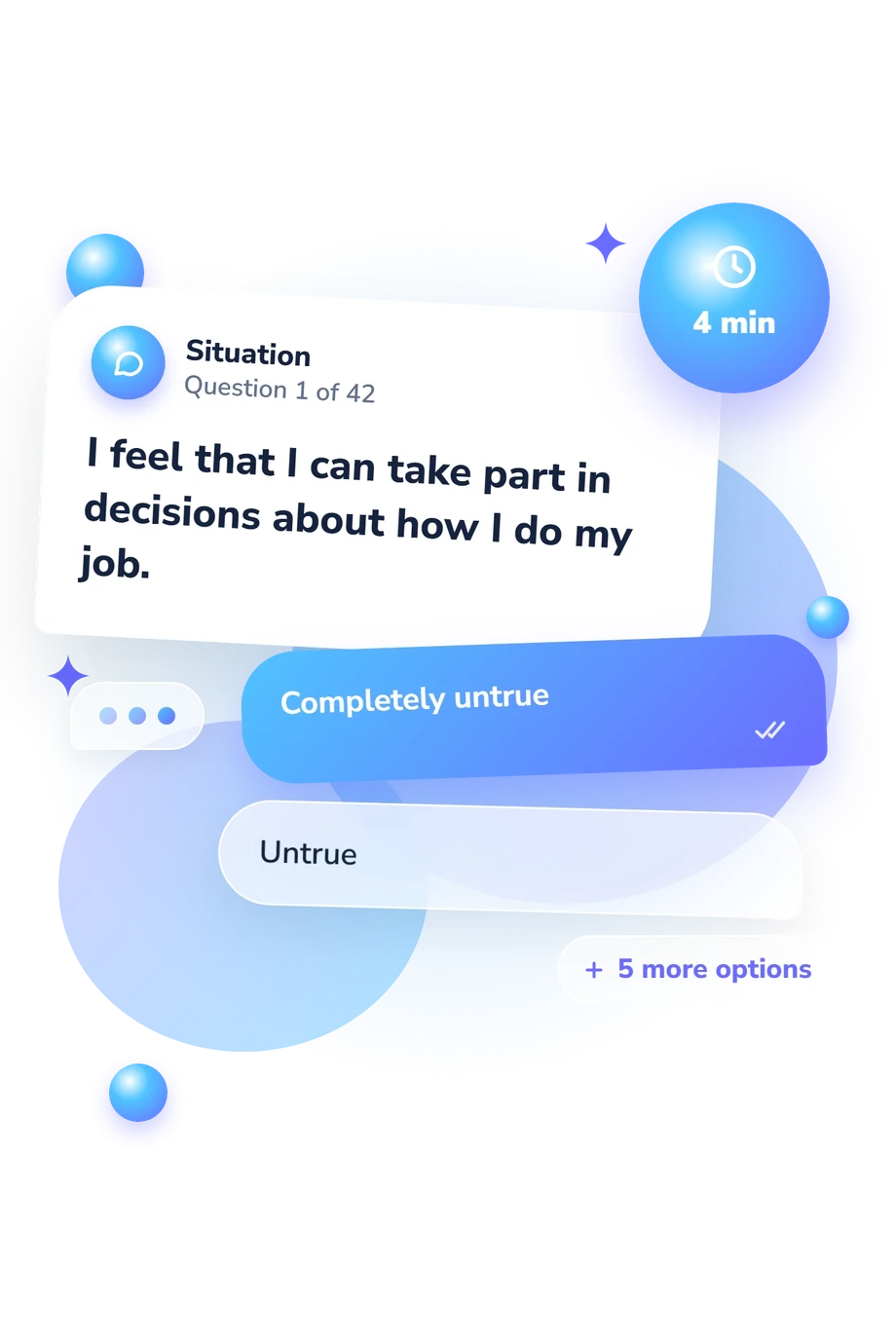
Example Questions From the Test
- Completely untrue
- Untrue
- Mostly untrue
- Somewhat true
- Mostly true
- True
- Completely true
- Completely untrue
- Untrue
- Mostly untrue
- Somewhat true
- Mostly true
- True
- Completely true
- Completely untrue
- Untrue
- Mostly untrue
- Partly true
- Mostly true
- True
- Completely true
Basic Needs Satisfaction at Work Scale Test - Description and methodology of the test
For employees examining how their working environment is experienced, the Basic Needs Satisfaction at Work Scale Test provides a three-need workplace profile rather than a job-performance rating. The assessment uses a basic needs satisfaction at work measure to organize perceptions of the job and prompt reflection on experiences associated with motivation and well-being. The profile can support personal reflection across many kinds of work.
What This Assessment Explores
The questionnaire examines whether work allows meaningful choice, supports a sense of capability, and provides acceptance and support from colleagues. It focuses on the employee’s lived experience rather than job title or formal performance. This basic needs at work scale is relevant to people reflecting on motivation, relationships, and growth. The three result dimensions are:
- Relatedness Need Satisfaction (1-7) shows how much belonging, acceptance, care, and support the respondent experiences at work; bands are Low connectedness (1-4.2), Moderate connectedness (4.3-6), and High connectedness (6.1-7).
- Competence Need (1-7) reflects perceived effectiveness, capability, and skill growth; bands are Low competence satisfaction (1-4.2), Moderate competence satisfaction (4.3-5.9), and High competence satisfaction (6-7).
- Autonomy Need (1-7) reflects choice, self-direction, and value alignment; bands are Low autonomy (1-3.9), Moderate autonomy (4-5.6), and High autonomy (5.7-7).
Methodology and Scientific Basis
Each statement asks how true a workplace experience is on a seven-point continuum from untrue to true, with minor wording variations across items. The items address choice, pressure, capability, skill development, collegial warmth, inclusion, and opportunities to express ideas. The three dimensions are reported separately, and the online presentation does not document how responses are combined or whether negatively worded items are reverse-scored.
The online questionnaire presents an adaptation of the Basic Need Satisfaction at Work Scale associated with Deci et al. (2001), linking these needs with motivation and well-being in organizations. Related research by Ilardi and colleagues (1993) and Kasser and colleagues (1992) examines need satisfaction alongside motivation, adjustment, and workplace relationships. This employee needs satisfaction questionnaire therefore has a theory-linked interpretation, while its online wording and administration remain distinct.
Results summarize the questionnaire’s three displayed scale scores; the online version does not establish population norms, reliability estimates, or clinical cutoffs. Workload, leadership, team climate, self-awareness, and response style can influence answers, so the profile is best used as a current snapshot for focused reflection.
- Deci, E. L., Ryan, R. M., Gagné, M., Leone, D. R., Usunov, J., & Kornazheva, B. P. (2001). Need Satisfaction, Motivation, and Well-Being in the Work Organizations of a Former Eastern Bloc Country: A Cross-Cultural Study of Self-Determination. Personality and Social Psychology Bulletin, 27(8), 930-942. 10.1177/0146167201278002
- Ilardi, B. C., Leone, D., Kasser, T., & Ryan, R. M. (1993). Employee and Supervisor Ratings of Motivation: Main Effects and Discrepancies Associated with Job Satisfaction and Adjustment in a Factory Setting. Journal of Applied Social Psychology, 23(21), 1789-1805. 10.1111/j.1559-1816.1993.tb01066.x
- Kasser, T., Davey, J., & Ryan, R. M. (1992). Motivation and Employee-Supervisor Discrepancies in a Psychiatric Vocational Rehabilitation Setting. Rehabilitation Psychology, 37(3), 175-188. 10.1037/h0079104
Updated: