
Workplace Culture Quiz
How the Scales are Structured
Who Usually Takes This Test?
See How You Compare
Below is a preview of how scores are typically distributed across each scale.
Example Questions From the Test
- Customers will interpret shorter calls as more caring in every situation.
- The operating norm may prioritize speed over the stated service value.
- Employees will ignore the reward because the written value is clearer.
- The organization has a weak culture simply because it uses performance measures.
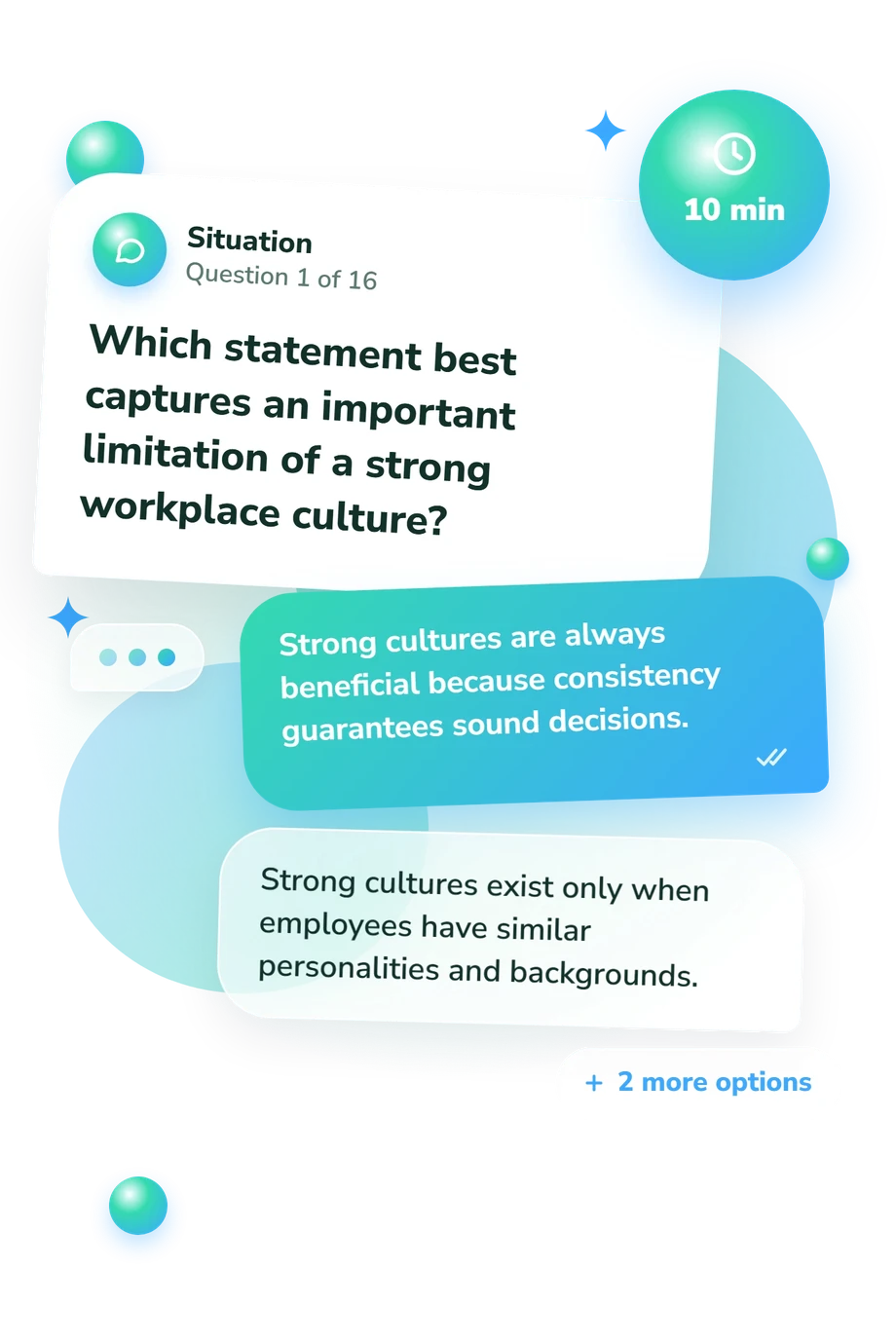
- Strong cultures are always beneficial because consistency guarantees sound decisions.
- Strong cultures exist only when employees have similar personalities and backgrounds.
- Shared norms can aid coordination but become a liability when they discourage dissent or no longer fit the environment.
- Strong cultures prevent subcultures from developing in specialized teams.
- Accept the survey as definitive because numerical evidence is inherently more reliable.
- Treat each source as partial evidence and investigate why the findings differ.
- Discard the survey because interviews always reveal the true culture.
- Average the different findings into one number without examining context.
Workplace Culture Quiz - Description and methodology of the test
People who want to examine how work gets done beneath official value statements can use this workplace culture quiz as a focused knowledge check. It is suited to learners, managers, team members, and anyone taking this organizational culture quiz to examine incentives, leadership, norms, inclusion, and decision-making. The result shows how well the respondent recognizes core concepts and applies them to realistic workplace situations.
What the Test Measures
At the center is the ability to distinguish what an organization says from what its systems and routines reward. The items examine how incentives, leadership responses, decision practices, onboarding, accountability, psychological safety, inclusion, and rituals shape expectations. They also address subcultures, workplace climate, and the tension between consistency and dissent.
This workplace culture assessment is intended for readers seeking a clearer map of organizational life, not a rating of their employer. Workplace Culture Knowledge (0-16) summarizes how well the respondent connects behavior, incentives, leadership, and shared assumptions. The result is shown in three bands:
- Foundations to build (0-6) indicates that some culture signals are recognized, although stated intentions and operating norms may still be confused.
- Developing understanding (7-12) shows that many common patterns can be interpreted, while systems and context need further attention.
- Strong understanding (13-16) indicates consistent connections among behavior, incentives, leadership, and shared assumptions.
Methodology and Evidence Base
Each item presents four alternatives and asks for the best interpretation of a workplace situation. The scenarios test whether respondents connect practices with incentives, power, assumptions, and consequences rather than repeat stated values. The displayed total is mapped to the three bands above; the range does not establish a per-answer weighting rule.
Conceptually, the questionnaire is consistent with Schein's organizational culture framework, distinguishing visible artifacts, stated values, and deeper assumptions. It is not presented as an adaptation of that work. The questionnaire's themes are conceptually consistent with Martin and Siehl's work on countercultures, Schneider, Ehrhart, and Macey's distinction between climate and culture, and Edmondson's study of psychological safety and learning.
As a workplace culture test, it supports learning and structured self-reflection, but the result reflects selected concepts rather than direct observation of an organization. The questionnaire has no stated standardization, reliability estimate, or population norms. Responses may vary with familiarity with management language, scenario interpretation, and current workplace experience, so the score indicates conceptual understanding rather than a complete culture assessment.
- Schein, Edgar H., and Peter A. Schein. Organizational Culture and Leadership. 5th ed., Jossey-Bass, 2017.
- Martin, Joanne, and Caren Siehl. "Organizational Culture and Counterculture: An Uneasy Symbiosis." Organizational Dynamics, vol. 12, no. 2, 1983, pp. 52-64. 10.1016/0090-2616(83)90033-5
- Schneider, Benjamin, Mark G. Ehrhart, and William H. Macey. "Organizational Climate and Culture." Annual Review of Psychology, vol. 64, 2013, pp. 361-388. 10.1146/annurev-psych-113011-143809
- Edmondson, Amy C. "Psychological Safety and Learning Behavior in Work Teams." Administrative Science Quarterly, vol. 44, no. 2, 1999, pp. 350-383. 10.2307/2666999
Updated: