
What Should I Blog About Quiz
How the Scales are Structured
Who Usually Takes This Test?
See How You Compare
Below is a preview of how scores are typically distributed across each scale.
Example Questions From the Test
- It consistently introduces useful things to try
- It makes complicated debates easier to think through
- It offers a distinctive take on familiar subjects
- It raises interesting questions, even when posts stay concise
- How the experience connects with something happening in my life
- The details that distinguish it from similar choices
- A few standout features I might mention in a roundup
- Whether I can turn what I learn into a practical lesson
- A monthly comparison or themed collection of discoveries
- A weekly reflection on a personal moment
- A recurring “three things worth checking out” post
- A series that teaches one core skill from beginning to end
What Should I Blog About Quiz - Description and methodology of the test
For anyone choosing a direction for a new or changing blog, the What Should I Blog About Quiz turns a vague ambition into a profile of preferred content work. It suits aspiring writers weighing personal openness, teaching, analysis, or curation rather than seeking one fashionable niche. As a what to blog about quiz, it connects your interests with formats you could realistically sustain.
What This Assessment Explores
Questions distinguish four content directions: ideas, experience, teaching, and discovery. A blog niche quiz can clarify the role you want to play, not just the topics that interest you. Your highest score is strongest; scores within one point suggest a blend.
These dimensions describe each result:
- Ideas and Commentary Blogger (0-12) measures analysis, assumptions, arguments, and connections: Occasional Commentator (0-4), Developing Perspective (5-8), or Strong Ideas Affinity (9-12).
- Personal Story Blogger (0-12) measures experience-led writing about life, growth, identity, and meaningful moments: Selective Storyteller (0-4), Emerging Personal Voice (5-8), or Strong Story Affinity (9-12).
- Practical Guide Blogger (0-12) measures tutorials, explainers, and problem-solving: Supporting Style (0-4), Useful Potential (5-8), or Strong Guide Affinity (9-12).
- Review and Discovery Blogger (0-12) measures comparisons, curation, and recommendations: Occasional Curator (0-4), Active Explorer (5-8), or Strong Review Affinity (9-12).
Methodology and Scientific Basis
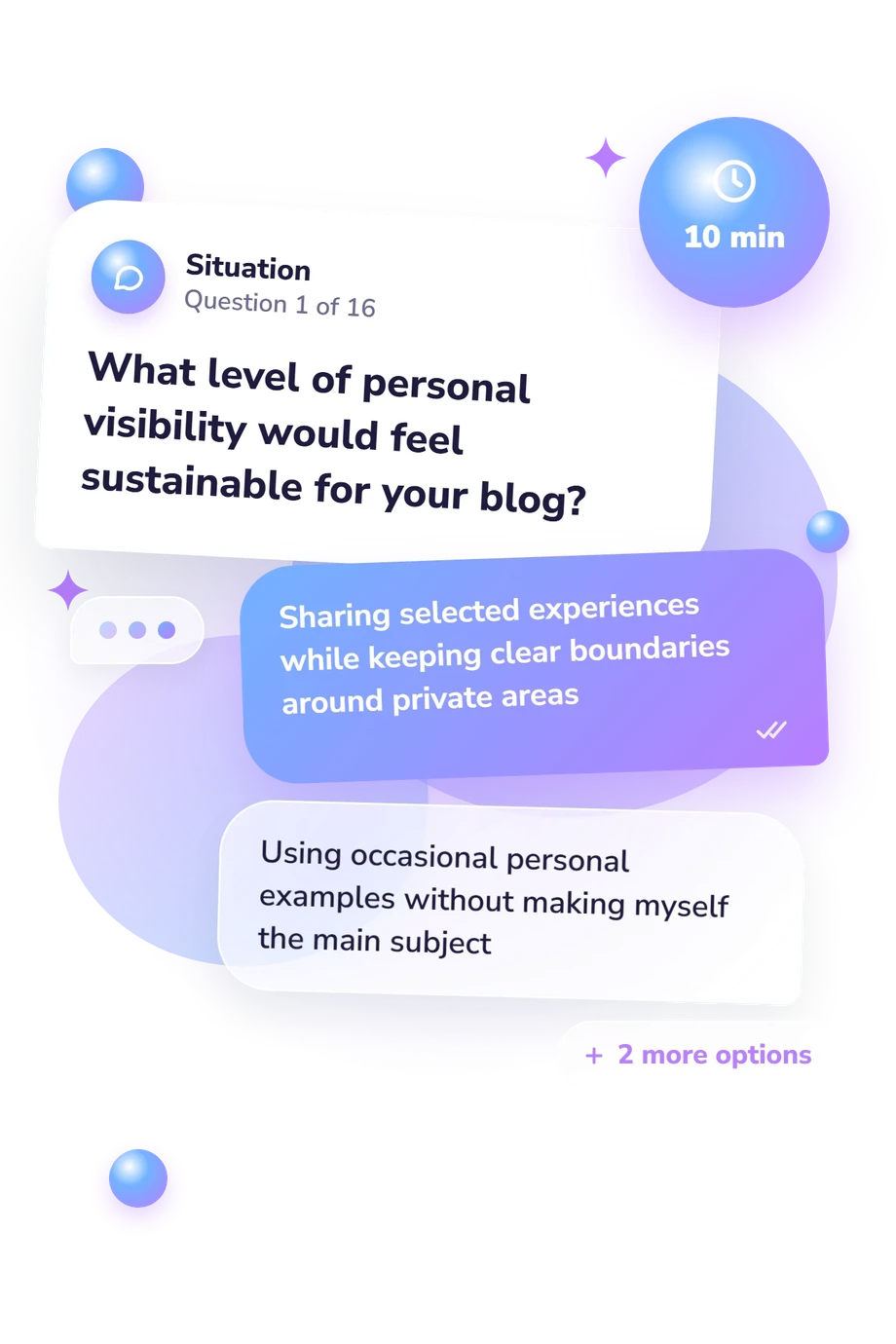
Each item presents a blogging situation with four response options. The scenarios cover visibility, disagreement, process structure, discovery, recommendations, and valued reader responses. This blog content ideas quiz profiles preferred work rather than generating random topics.
Four separate scores are produced, not one total. Answers are grouped by content direction, and the highest score identifies the strongest affinity. Near ties indicate a blended profile. The displayed bands organize tendencies for reflection, not population-based cutoffs or evidence of writing ability.
Its conceptual fit can be traced to blogging research. Gill et al. (2009) examined links among personality, blog topics, and motivations. Fullwood, Nicholls, and Makichi (2015) connected individual differences with blogging motivations, while Mewburn and Thomson (2013) discussed audiences, purposes, and challenges. This questionnaire is conceptually consistent with those findings, not an adaptation of their instruments.
Self-reported answers may shift with current interests, confidence, and the public identity a writer hopes to develop. Use the profile to test formats in practice, rather than treating it as a permanent label.
- Gill, Alastair, Scott Nowson, and Jon Oberlander. “What Are They Blogging About? Personality, Topic and Motivation in Blogs.” Proceedings of the International AAAI Conference on Web and Social Media, 3(1), 2009, 18-25. DOI 10.1609/icwsm.v3i1.13949
- Fullwood, Chris, Wendy Nicholls, and Rumbidzai Makichi. “We've got something for everyone: How individual differences predict different blogging motivations.” New Media & Society, 17(9), 2015, 1583-1600. DOI 10.1177/1461444814530248
- Mewburn, Inger, and Pat Thomson. “Why do academics blog? An analysis of audiences, purposes and challenges.” Studies in Higher Education, 38(8), 2013, 1105-1119. DOI 10.1080/03075079.2013.835624
Updated: