
Universal Perceived Locus of Causality Scale (UPLOC) Test
How the Scales are Structured
Who Usually Takes This Test?
See How You Compare
Below is a preview of how scores are typically distributed across each scale.
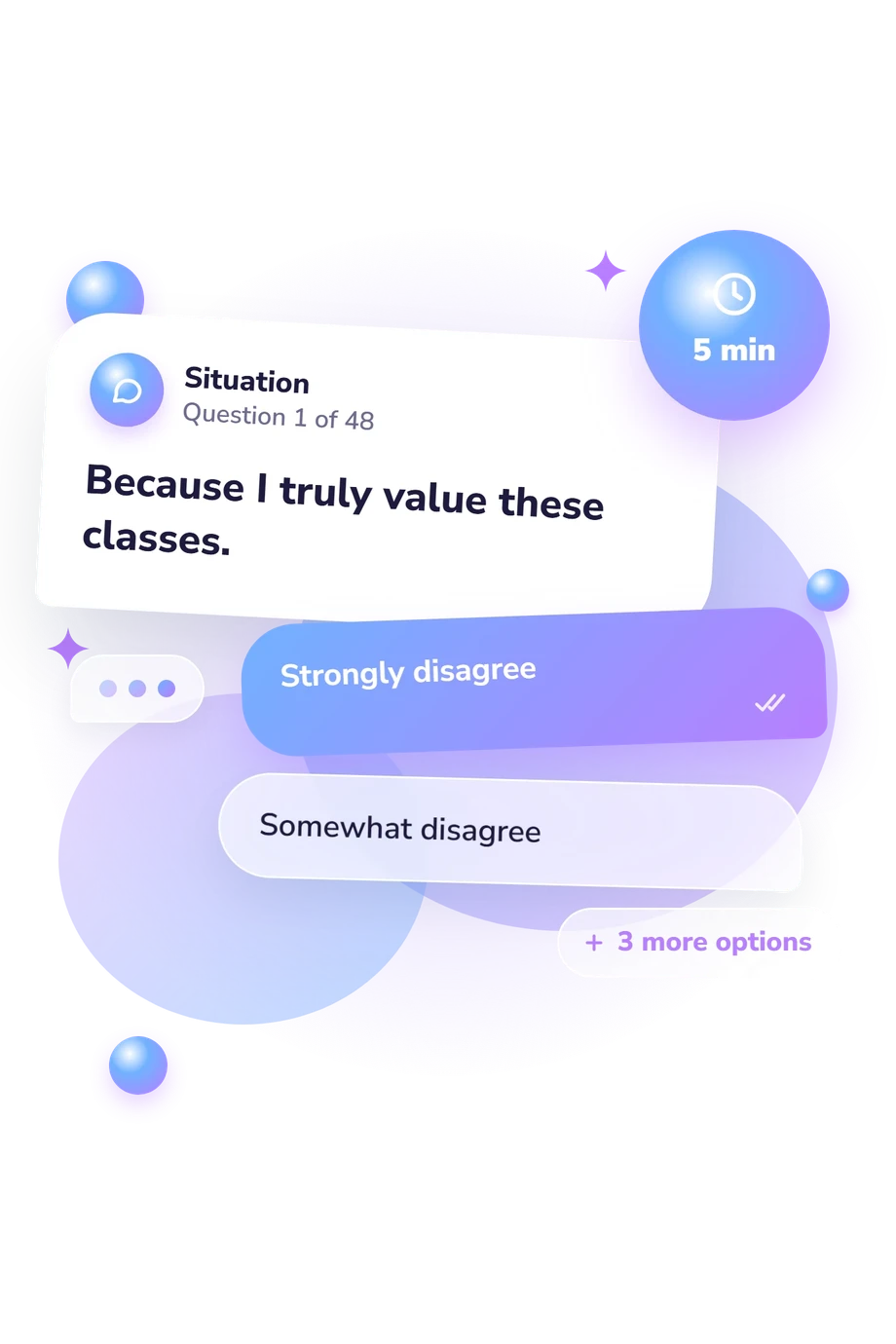
Example Questions From the Test
- Strongly disagree
- Disagree
- Neither agree nor disagree
- Agree
- Strongly agree
- Strongly disagree
- Disagree
- Neither agree nor disagree
- Agree
- Strongly agree
- Strongly disagree
- Disagree
- Neither agree nor disagree
- Agree
- Strongly agree
Universal Perceived Locus of Causality Scale (UPLOC) Test - Description and methodology of the test
People who want to understand why they keep studying, attending classes, or pursuing another demanding activity can use the Universal Perceived Locus of Causality Scale (UPLOC) Test to examine the motives they recognize in themselves. It suits self-reflection about current behavior, showing whether action feels chosen, personally meaningful, enjoyable, externally controlled, guilt-driven, or difficult to explain. This motivational regulation questionnaire presents a profile rather than a verdict.
What This Assessment Explores
Study and goal-directed activity is assessed through perceived locus of causality: pressure, value, enjoyment, and amotivation.
Six scales show:
- Amotivation (4-20) indicates low intrinsic and extrinsic motivation plus unclear goals: Low 4-9; Moderate 10-15; High 16-20.
- External Regulation (4-20) shows reward or punishment: Low external control 4-9; Moderate external control 10-14; High external control 15-20.
- Negative Introjected Regulation (4-20) shows guilt or shame: Low guilt-driven pressure 4-9; Moderate guilt-driven pressure 10-14; High guilt-driven pressure 15-20.
- Positive Introjected Regulation (4-20) shows self-esteem or approval: Low 4-9; Moderate 10-15; High 16-20.
- Identified Regulation (4-20) shows personal value: Low 4-9; Moderate 10-15; High 16-20.
- Intrinsic (4-20) shows interest or enjoyment: Low intrinsic 4-9; Moderate intrinsic 10-15; High intrinsic 16-20.
Methodology and Evidence Base
Items ask respondents to indicate how much they agree or disagree with each motivational statement, using five ordered response choices ranging from disagreement to agreement. Separate dimensions produce a profile of coexisting motives rather than one overall position.
Published UPLOC work organizes regulation by how self-endorsed a motive is and describes a six-subscale structure with a relative autonomy continuum. The online questionnaire is conceptually consistent with that work, rather than being identical to the published research version. Within the theory of self-determination, autonomy concerns endorsement, not merely whether behavior is externally visible.
Displayed bands are questionnaire-specific descriptive categories indicating strength within this set of items, not universal rankings. They help show whether motives for a particular activity lean toward pressure, internal value, enjoyment, or loss of motive, so interpretation should stay tied to that activity and current context. Self-report is also shaped by honesty, workload, expectations, and self-awareness; use the profile as structured reflection rather than a stand-alone account of motivation.
- Sheldon, K. M., Suchkov, D. D., Osin, E. N., Gordeeva, T. O., Rasskazova, E. I., & Bobrov, V. V. (2015). Development of the Universal Scale of Types of Motivational Regulation (UPLOC). In N. A. Baturin (Ed.), Modern Psychodiagnostics of Russia: Overcoming the Crisis: Proceedings of the III All-Russian Conference on Psychological Diagnostics (Vol. 1, pp. 336-343). Chelyabinsk: South Ural State University Publishing Center. In Russian.
- Sheldon, K. M., Osin, E. N., Gordeeva, T. O., Suchkov, D. D., & Sychev, O. A. (2017). Evaluating the Dimensionality of Self-Determination Theory’s Relative Autonomy Continuum. Personality and Social Psychology Bulletin, 43(9), 1215-1238. 10.1177/0146167217711915
- Ryan, R. M., & Connell, J. P. (1989). Perceived Locus of Causality and Internalization: Examining Reasons for Acting in Two Domains. Journal of Personality and Social Psychology, 57(5), 749-761. 10.1037/0022-3514.57.5.749
Updated: