
Questions for the Player’s Family and Friends Test
How the Scales are Structured
Who Usually Takes This Test?
See How You Compare
Below is a preview of how scores are typically distributed across each scale.
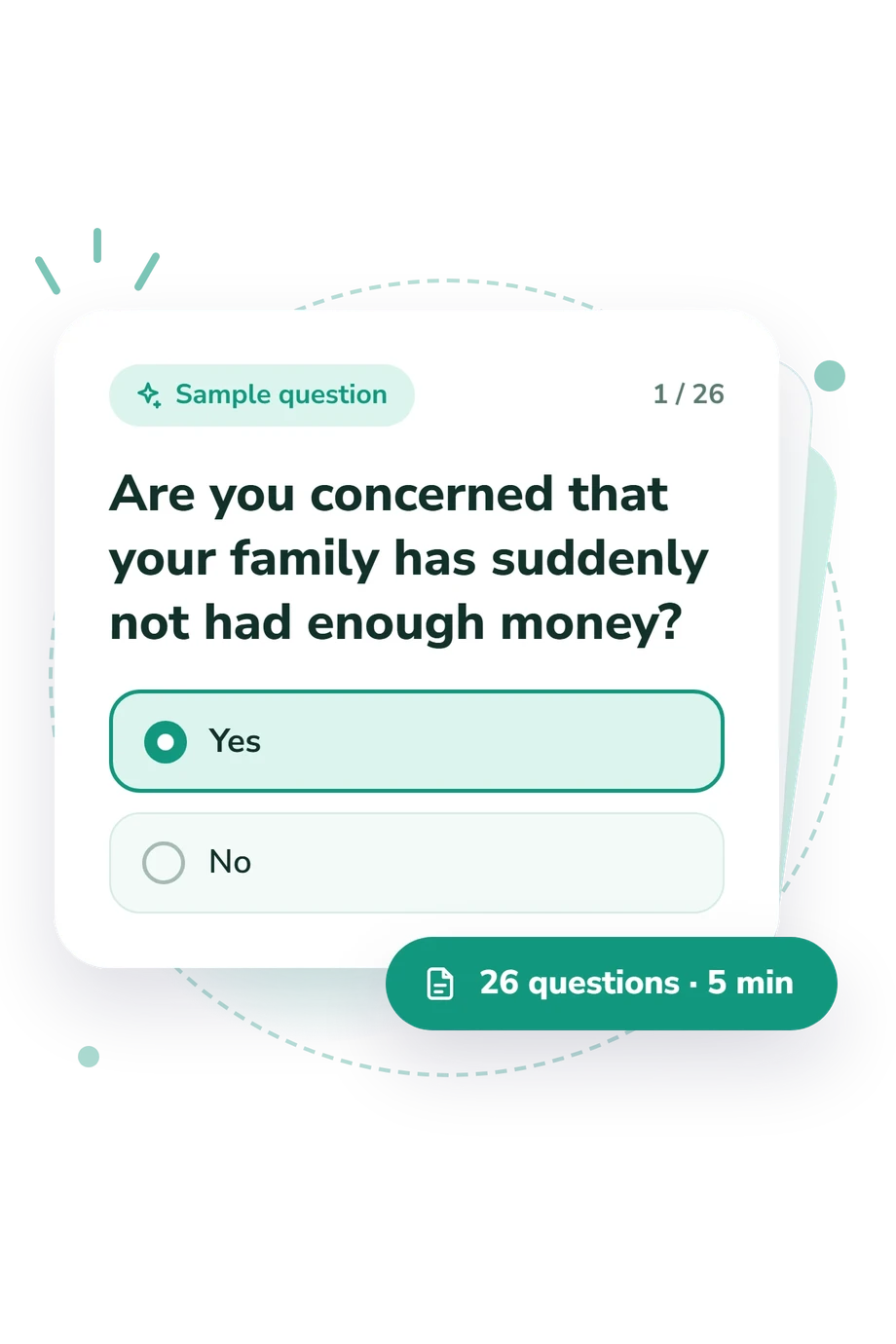
Example Questions From the Test
- Yes
- No
- Yes
- No
- Yes
- No
Questions for the Player’s Family and Friends Test - Description and methodology of the test
Relatives, partners, and close friends worried about another person’s gambling can use this questionnaire to organise observations about money, secrecy, borrowing, and changes in family life. The Questions for the Player’s Family and Friends Test turns those observations into a profile, helping a respondent distinguish gambling involvement from family impact. Organising those observations through a questionnaire for family members about gambling supports clearer conversations about next steps.
What This Test Measures
The questions focus on observable consequences involving the player. They cover money shortages, borrowing, hidden loans, altered spending, missing valuables, co-signing pressure, legal trouble, evasive conversations, gambling frequency, large stakes, concealed bets, and gambling-related gifts.
The financial, social, and relational situations are item themes rather than a separate warning score. The two results distinguish gambling involvement from its effects on family relationships and climate. The items report signs of problem gambling in someone close rather than establish a disorder.
The two result scales are:
- Scale 1 (0-20) measures how gambling affects family relationships and household climate; bands are Low impact 0-6, Moderate impact 7-13, and High impact 14-20.
- Scale 2 (0-6) measures indicators of problematic gambling involvement in a close person; bands are Low indicators 0-2, Moderate indicators 3-3, and High indicators 4-6.
Methodology and Evidence Base
Each item uses a yes-or-no response and asks about an observed event or pattern involving the person of concern and the household. The item groups move from household finances and money management to secrecy, social withdrawal, and gambling behavior. This informant report depends on what the respondent has noticed, remembered, and feels able to disclose. Because the questionnaire does not state the point value for each response, totals should be read through the displayed bands rather than an inferred scoring formula.
The closest published comparison is the 2016 study by Dowling et al., which examines effects of problem gambling on family functioning. This questionnaire is conceptually consistent with that work, not an adaptation of it. Orford et al. (2005) supply a related family-member perspective on stress, coping, and strain, while Hodgins et al. (2007) provide context on support for concerned significant others. As a questionnaire measuring the family impact of problem gambling, this online version has no stated norms or standardization. Current context, memory, self-awareness, and reluctance to disclose can shape results; interpret them alongside wider circumstances.
- Dowling, N. A., Suomi, A., Jackson, A. C., & Lavis, T. (2016). Problem Gambling Family Impacts: Development of the Problem Gambling Family Impact Scale. Journal of Gambling Studies, 32(3), 935-955. 10.1007/s10899-015-9582-6
- Hodgins, D. C., Toneatto, T., Makarchuk, K., Skinner, W. J., & Vincent, S. (2007). Minimal Treatment Approaches for Concerned Significant Others of Problem Gamblers: A Randomized Controlled Trial. Journal of Gambling Studies, 23(2), 215-230. 10.1007/s10899-006-9052-2
- Orford, J., Templeton, L., Velleman, R., & Copello, A. (2005). Family members of relatives with alcohol, drug and gambling problems: A set of standardized questionnaires for assessing stress, coping and strain. Addiction, 100(11), 1611-1624. 10.1111/j.1360-0443.2005.01178.x
Updated: