
Organizational Culture Type Assessment Questionnaire Test
How the Scales are Structured
Who Usually Takes This Test?
See How You Compare
Below is a preview of how scores are typically distributed across each scale.
Example Questions From the Test
- Strong, decisive, and firm, but fair; protects loyal subordinates; generous and forgiving toward them.
- Objective and precise; avoids using authority for personal gain; expects from subordinates only what is required by their job duties.
- Avoids conflict; is easily influenced on task-related matters; uses authority to obtain the resources needed to complete the work.
- Attends to others’ personal needs; uses their position to provide opportunities that motivate subordinates’ work.
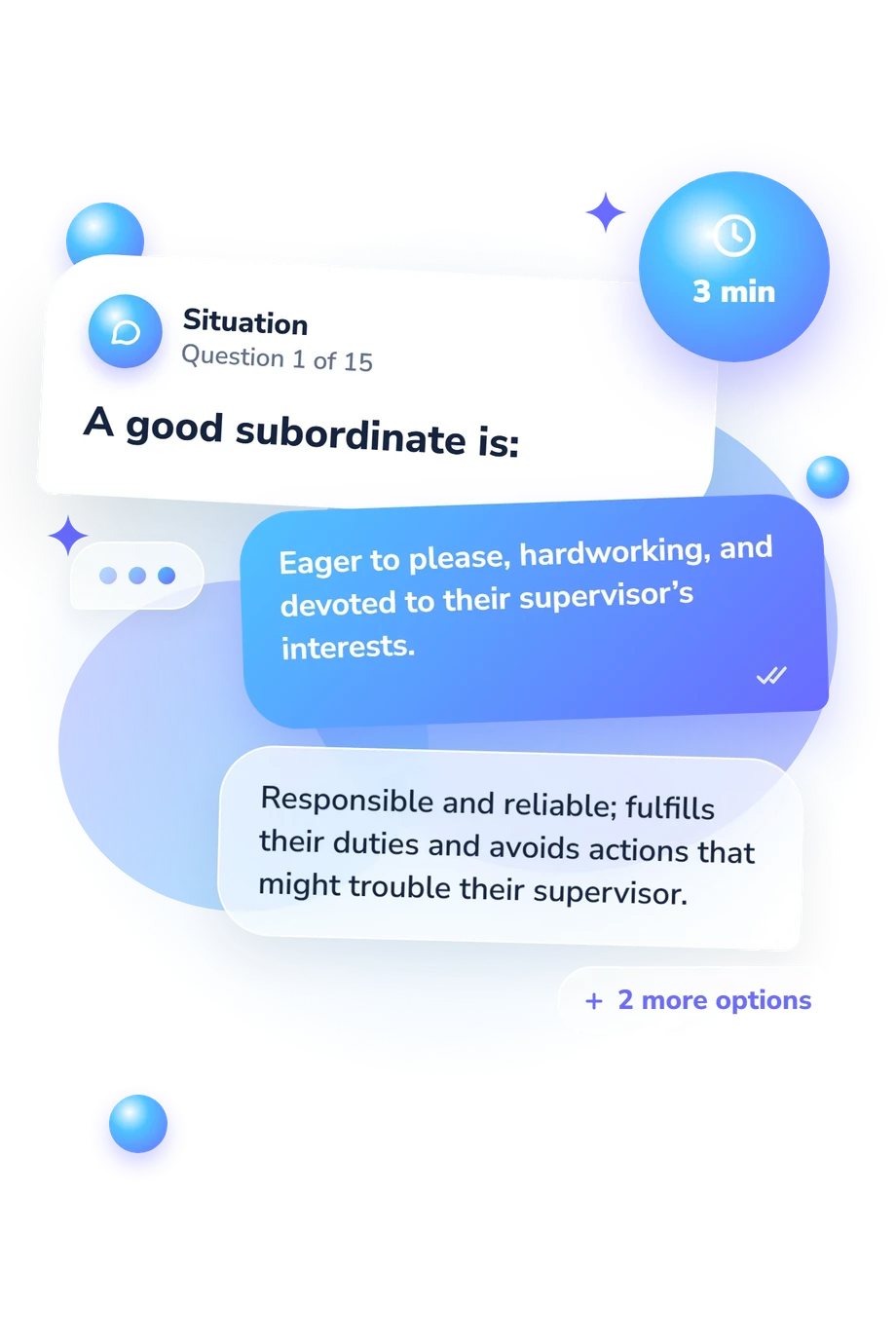
- Eager to please, hardworking, and devoted to their supervisor’s interests.
- Responsible and reliable; fulfills their duties and avoids actions that might trouble their supervisor.
- Wants to contribute to solving the task and puts forward ideas and suggestions, yet readily yields leadership to others who are more competent and capable.
- Highly interested in developing their own potential; has no bias against seeking help or training; is respectful of others’ needs and values; and readily helps others.
- Personal power and gain
- A high-status position in the formal system
- Maximum contribution to accomplishing tasks
- Attention to someone’s personal needs
Organizational Culture Type Assessment Questionnaire Test - Description and methodology of the test
Managers, team members, and organizational observers can use the Organizational Culture Type Assessment Questionnaire Test to examine how authority, responsibility, cooperation, and work priorities appear in a workplace. An organizational culture assessment can clarify the patterns shaping decisions, relationships, and responses to change. It is intended for reflective use when interpreting a profile of organizational tendencies.
What This Assessment Measures
Questions address authority, roles, decisions, conflict, cooperation, motivation, information flow, and reactions to the environment. The profile from this organizational culture questionnaire shows which tendencies are most pronounced:
- Person Culture: 0–15 — measures individual goals, professional cooperation, resource access, and coordinating leadership; Low personal culture (0–5), Moderate personal culture (6–10), High personal culture (11–15).
- Task Culture: 0–15 — measures expertise, project completion, cooperation, flexibility, and rapid response; Low task focus (0–5), Moderate task focus (6–10), High task focus (11–15).
- Role Culture: 0–15 — measures defined duties, hierarchy, rules, predictability, and order; Low role orientation (0–5), Moderate role orientation (6–10), High role orientation (11–15).
- Power Culture: 0–15 — measures dominant leadership, loyalty, hierarchy, resource control, and swift decisions; Low power culture (0–5), Moderate power culture (6–10), High power culture (11–15).
Methodology and Evidence Base
Each item presents four descriptions of organizational behavior, and the respondent chooses the option that best fits the situation. Answers are combined into four scale scores; the questionnaire does not state how many points each response contributes, so the profile should be interpreted as displayed rather than reverse-engineered.
The online questionnaire is conceptually consistent with the Harrison–Handy framework but is not an adaptation of the published questionnaire. Harrison and Stokes’ Diagnosing Organizational Culture describes the framework, while Wudarzewski’s validation study concerns the published Harrison and Handy questionnaire and does not validate or establish norms for this online version.
Interpretation is strongest when answers refer to a defined organization and readers consider differences between departments or leadership levels.
Because this is self-report, scores may shift with perspective, current events, and knowledge of informal practices. The profile is therefore a structured reflection on organizational dynamics rather than a diagnosis; interviews, observation, and broader organizational evidence can add context, while an organizational culture types framework can help organize that reflection.
- Harrison, Roger, and Herb Stokes. Diagnosing Organizational Culture: Instrument and Trainer's Package. San Diego, CA: Pfeiffer & Co., 1992. ISBN 0-88390-326-1.
- Harrison, Roger. Understanding Your Organization's Character. Harvard Business Review, 50(3), 119–128, 1972.
- Wudarzewski, Grzegorz. Validation of Harrison and Handy Organizational Culture Questionnaire in Polish Conditions. Annales Universitatis Mariae Curie-Sklodowska, Sectio H – Oeconomia, 52(1), 211–223, 2018. 10.17951/h.2018.52.1.211
Updated: